








Fastest Path for Developers: AI Engineer Roadmap for 2026
Key Highlights
Here are the key takeaways from our AI engineer roadmap:
Developers can transition into an artificial intelligence career in just 6–12 months.
The fastest path involves leveraging existing developer skills in programming and systems.
This guide provides a step-by-step roadmap to master machine learning and essential AI concepts.
Focusing on practical projects is crucial for building a strong portfolio.
The AI job market is booming, with high demand for skilled professionals.
Our 2026 outlook highlights the rise of generative AI roles.
Introduction
Are you a developer who wants to move into the world of artificial intelligence? The field of ai is growing fast. There is now a high demand for people with the right skills. This guide gives you a simple roadmap to help you go from being a developer to becoming an ai engineer. You will see what essential skills you need, get a clear step-by-step plan to learn, and find out the best career paths to follow. Get ready to use machine learning and artificial intelligence to change your career.
How Long Does It Take to Become an AI Engineer in India?
 If you are a developer, becoming an AI engineer may take less time than you think. Your coding skills give you a head start. Most developers can get ready for an ai job market in about six to twelve months. This time helps you build a strong foundation in machine learning, deep learning, and other key AI topics. You do not need to start over from the beginning.
Right now, there is high demand for ai engineers in India. It is a good moment if you want to switch your job and start a successful career as an ai engineer. How fast you reach your goal will depend on where you begin and how much effort you put in. How much time you can study and work on hands-on projects will shape your learning path. With a plan that works well, you will be able to move through this change quicker and make your way into this field.
Typical Timeline for Developers: 6–12 Months
A developer who works hard can be ready for an AI engineer job in about six to twelve months. This faster way to get there is possible because you have many important technical skills already. You will spend the first few months working to learn the main ideas of AI and build a new skill set.
In this time, you will study the basics of machine learning, learn the first steps in deep learning, and see how AI models work. The goal is to fill in the space between what you know now and what you need for an AI developer job.
The last half of your work should be all about using this stuff in real life. Make real projects and get hands-on time with machine learning, deep learning, and ai models. Doing this will help you stand out to employers who want someone with real-world skills. If you keep at it and have a good plan, you can meet your goal in time and be set for a good job.
Factors Influencing Your Learning Speed
Many things can change how fast you get into an AI engineering job. The most important thing is what you know before. If you have a good base in Python and data structures, things will go a lot easier for you.
How much time you spend each day or week matters, too. If you study often, you will build new technical skills and understand new ideas better. Start with the core skills, like Python for AI, machine learning basics, and data preprocessing. These will help you move faster.
A few other important things are:
Your learning resources: Good, structured courses, like those from SocialPrachar, give you a simple and clear path.
Practical application: When you build more projects, you learn faster.
Networking: Talking with others in the AI community gives you help and can lead to job opportunities.
In the end, getting a professional certificate shows you have learned new skills. But what will really help you get ahead is being able to use those skills well. If you focus on the right areas, you will reach your goal of becoming an AI engineer sooner.
Role of Prior Coding Experience in Accelerating the Journey
Your background in software engineering is a big help. If you know programming languages like Python, you do not need to start with the basics. Instead, you can move right into working with ai-specific libraries and frameworks. You already get ideas like data structures, algorithms, and system design. These are used a lot when you build and use ai models.
This early start lets you pay more attention to the parts of ai that are new, such as data preprocessing, model training, and evaluation. Since you already feel good about writing code, understanding how machine learning works is a lot quicker.
In India, becoming an ai engineer is a great move for people with a background in software development. The tech industry is strong, and there is a high demand for people who can bring software engineering and ai together. Continuous learning will always be needed, but knowing software engineering makes it easier to move into this line of work than if you were new to it.
Why Developers Can Transition Faster into AI Engineering
 As a software engineer, you can move into ai engineering fast. You already have the technical skills that help you on this path. It is easy for you to start because your skill set is a good base for new ai work.
Your skill set includes programming, system design, and problem-solving. These give you and all software engineers a big step forward. You don’t have to start from zero. It is better to focus on learning the tools and ideas used in ai engineering. This makes the way to ai the fastest for you. Let’s talk about how your technical skills help you get there quicker.
Leveraging Existing Programming Knowledge
If you know programming languages, you already have a strong edge. Python is used a lot in AI, so if you can use it, you are ahead of many people. If you work with Java or C++, that is also good, because the main ideas in programming are much the same in all these languages. You will be able to learn Python's way of writing code, and use its many AI tools without too much trouble.
With your current skills, you do not have to go through the basic lessons that new people in programming face. You can start using machine learning libraries like NumPy, Pandas, and Scikit-learn from day one. These tools help you work with data and build AI projects. Your software engineering experience also lets you write code that is neat and steady, and your code will be able to handle different jobs.
Being able to use new tools and learn new things fast puts you in a good spot. You get more options for career paths in AI. If you build on your base of programming skills, you can move into these high-demand jobs quickly.
Familiarity with APIs, Systems, and Integrations
If you are a developer, you know how useful it is to work with application programming interfaces (APIs) and connect different systems. This skill is very important in AI engineering. AI models are not often used alone. They have to be added to apps and everyday jobs for people to get real use from them. When you know how to build or use APIs, you make it easier to add AI services to products people use.
You might need to set up a machine learning model as a REST API or connect apps to outside AI platforms. The hands-on experience you have in software development makes this possible. Many data scientists do not learn this, so you stand out when you look for a job.
Having a background in data engineering and system design also helps a lot. It pushes you to see the full AI process—from bringing in data to setting up the model and watching it run. This big-picture way of thinking is key for building strong and lasting AI solutions.
Applying Problem-Solving Skills to AI Challenges
Problem-solving is key in both software development and ai engineering. When you work as a developer, you learn how to split complex problems into small pieces that are easier to handle. This skill is very useful in machine learning projects, too. In ai engineering, you spend a lot of time testing models, making them faster, and coming up with ways to fix data problems.
With your good mindset, you look at ai issues in a careful way. You know how to find the main problem, try new ways, and check your answers. This is one of the core skills that makes an ai developer stand out. To get better, build projects that let you work with these skills. For best results, pick projects where you can:
Define a clear problem statement.
Gather and preprocess data.
Experiment with different algorithms.
Evaluate and interpret model performance.
By doing this kind of work, you will quickly get better at ai engineering and be ready for the real world.
Core Developer AI Skills Needed for a Fast Transition
To move into AI fast, you have to focus on some key AI skills. If you have a developer background, that's a good base. But you must know the basics of machine learning. It's important to stick to the core skills that give you the most value and do it in the shortest time.
This part tells you about the main technical skills you should learn. You need to start with Python programming, then learn about deep learning and deep learning models. These skills are the base for your work in AI engineering. If you start here, you can get into the AI field quickly and in a good way.
Python Programming Essentials for AI
Python is the main choice when it comes to programming languages for data science and AI models. The way it is set up is easy to learn, and the large number of libraries help you get started with AI work. There is strong help from the people who use Python, which makes it good for anyone who is working to build AI models. If you want to be an AI developer, learning how to use Python’s main data tools is something you should do first.
NumPy and Pandas make it easy to do number work and handle data. With Matplotlib and Seaborn, you can make charts that help you see what your data tells you. This visual part helps you know what is in your data before you move forward to build any models. Try to get good at using these tools to clean your data, change it, and look at different sets of data fast.
Many people talk about other languages like R or Java, and they each have their use. But Python is the one that is used by most and is very versatile. For any AI developer, taking the time to get good at Python and its group of tools is the first thing you need to do if you want to move ahead quickly in the field of data science and AI models.
Machine Learning Fundamentals Every Developer Should Know
To become an AI engineer, you need to know the main ideas of machine learning. You do not have to be an expert in statistics, but it is important to understand basic ideas. One important thing is knowing what makes supervised, unsupervised, and reinforcement learning different from each other.
You should spend time learning about common ML algorithms, like linear regression, logistic regression, decision trees, and support vector machines. These are simple models that help you understand bigger and more complex models in machine learning. When you know how these work, what they are good at, and what they are not good at, you can pick the right one for your job.
It also helps to know how to tell if a model is good or bad. Some ways you do this are by looking at accuracy, precision, recall, and the F1-score. A strong foundation in data analysis and knowing these basic ideas will help you build good machine learning systems.
Deep Learning Basics and LLMs Overview
Deep learning is a big part of what makes today’s AI so exciting. It helps with things like image recognition and understanding what people write or say. If you want to become a developer in this field, you should first learn the basics of neural networks. You need to know what neural networks are, how backpropagation helps them learn, and what different layers and activation functions do.
After you get the basics down, move on to more advanced ai models. Convolutional Neural Networks (CNNs) are used in computer vision to help machines see and understand images. Recurrent Neural Networks (RNNs) are great when you have to deal with data that comes in a sequence, like words in a sentence. These deep learning models help you solve problems that regular machine learning can’t.
Now, there are even bigger changes in machine learning with generative ai and Large Language Models (LLMs) like GPT. You should have a basic idea of how these huge models are trained. Knowing how to use them with APIs will be an important skill for you in the next few years.
Data Preprocessing and Model Deployment Skills
Data from the real world can be messy. Data preprocessing is an important step. This is when you clean, change, and get the data ready for building models. If you are an AI engineer, you will spend a lot of your time here. In this step, you handle missing values. You also turn text labels into numbers. Often, you scale number features too.
When you finish building a model, you need to make it work in real life. Model deployment is how you place your model in a live system. This is so it can make real predictions for people. Your software engineering background will help you a lot in this stage. The main skills you need for deployment are:
Wrapping your model in an API, like with Flask or FastAPI.
Using Docker to put your app in a container so it is easy to move and can grow as needed.
By picking up these practical skills, you become more than someone who just knows theory. When you work on end-to-end projects that use both data preprocessing and model deployment, you really boost your skills and stand out as an AI engineer.
Beginner’s Guide: What You Need to Get Started as an AI Engineer
 If you want to start out in ai engineering, you need more than just essential skills. You have to get the right tools and find the best resources. These are important things that will help you learn well. Think of this part as your to-do list before you step into new technologies.
You should know what kind of computer you need, and find the best online courses too. We will talk about each step to make sure your learning journey is smooth. Boot camps and online courses, like the ones at SocialPrachar, can give you strong, structured training. These programs will also help you get job opportunities as you move forward in this field.
Must-Have Equipment and Software Setup
Having the right equipment and software can help you learn AI more smoothly. You do not need a very powerful computer, but a good laptop or desktop is helpful, especially when you want to train models. Try to get a machine with a multi-core processor and at least 16GB of RAM. This is a good place to start.
For software, make sure you have the right tools for your work and practice. Python is the most used programming language in AI, so you should have that ready. You also need a program where you can write your code, such as VS Code or PyCharm. People often use the Anaconda distribution because it brings many helpful tools at once. You should get the right tools, which includes:
Python 3.x
Anaconda or Miniconda
Jupyter Notebook or JupyterLab
A code editor like VS Code
If you need more power for big tasks, you can use a cloud platform, like Google Colab. This gives you free use of GPUs, so you can train your models much faster.
Recommended Online Resources and Courses for Indian Developers
For developers in India, the internet has many places where you can learn about AI. There are plenty of courses and resources online to help you switch into AI engineering. You get to learn at your own pace, which is good if you are working. Big platforms like Coursera, Udemy, and edX have a lot of courses that come from top schools and big companies.
If you want a faster and more organized way, boot camps and professional certificate programs might help you more. In Hyderabad, you can join an AI engineering course at a well-known place like SocialPrachar. Here, you get hands-on training and have someone guide you while you learn. These programs are made to get you ready for work in a short time. Here are some top resources:
SocialPrachar's AI Engineering Course: This is a full program for developers in India.
Coursera: They offer specializations such as the Deep Learning Specialization from deeplearning.ai.
Kaggle: You can get practical experience on this platform by joining competitions.
fast.ai: They give free courses that focus on hands-on deep learning.
Picking the right AI training institute in Hyderabad can help you stand out in the job market there.
Step-by-Step AI Learning Guide for Developers (2026 Fast Track)
Are you ready to begin your AI learning journey? This simple guide is here to help you go from a developer to an AI developer in less than a year. We break down the path into key steps that are easy to follow. This way, you can keep your drive up and not lose motivation. It puts a focus on practical skills, so you will be job-ready by 2026.
Just follow these stages to get a strong foundation and move on to more advanced things step by step. Keep in mind, continuous learning is important in AI. But this clear path will help you start off right and build a successful career as an AI developer.
Step 1: Master Python for AI (2–3 Weeks)
The first thing you need to do in your AI journey is to get good at Python for the ai field. If you already know Python well, you should spend this time learning the main libraries used in data science and machine learning. But if you have learned other programming languages before, now is when you get used to how Python looks and works.
You should focus on some key libraries. NumPy helps with numbers. Pandas is good for working with data. For charts and graphs, use Matplotlib and Seaborn. These are tools that people in this area use every day. Try tutorials and do a few small projects so you can get real hands-on time with them.
Once you finish this step, you will have what you need to work with data and make models. Knowing Python well opens up a lot of career paths. It is also the most needed language if you really want to do well in machine learning or data science.
Step 2: Understand Machine Learning Fundamentals (3–4 Weeks)
Now that you know Python well, it is a good time to start learning the main ideas in machine learning. This next part will help you build a strong base in both the theory and real work of how ml algorithms work. Begin by learning what supervised and unsupervised learning are.
You should also try to learn about the most used ml algorithms. These include linear regression, logistic regression, decision trees, and clustering algorithms like K-Means. You do not have to be great at math, but it will help if you know the basics of linear algebra and a bit of statistics. What matters most is that you understand how these algorithms think.
Work with the Scikit-learn library to try out these models on real data. This hands-on practice will help you get better at data analysis and learn how to build models. Both are core skills you need if you want to be an ai engineer.
Step 3: Learn Deep Learning and LLMs (3–4 Weeks)
Now you are set to get into the basics of deep learning and neural networks. This is the point where AI becomes really strong. Start by learning about the structure of a simple neural network. Look at layers, neurons, and activation functions. Tools like TensorFlow or PyTorch will be your main tools for this.
Next, you can try out deep learning models like Convolutional Neural Networks (CNNs) for pictures and Recurrent Neural Networks (RNNs) for looking at text. You can make small projects such as building an image sorter or a model that checks if words show good or bad feelings. This will help you use all that you have picked up.
At last, get to know the most recent changes in the field of generative AI and Large Language Models, also called LLMs. See how you can use APIs from tools like OpenAI's GPT to make your own apps. Knowing this will help you stay at the top in the AI field.
Step 4: Build Real-World AI Projects (4–6 Weeks)
Knowing theory is good, but practical skills are what help you get a job. In this step, you need to build a set of real-world machine learning projects. Here, you can use everything you have learned and show what you can do to people who might want to hire you. Pick projects that you like and those that fix a real problem.
Work on projects that go from start to finish. Handle the whole process, like gathering and cleaning data, building your model, and putting it to use. This shows you are able to do more than just build a project—you can make sure it's useful too. Here are some machine learning project ideas you can try:
An AI chatbot using LLM APIs.
An image classifier that tells what objects are in a photo.
A movie or product recommendation system.
A tool that looks for feeling in social media posts.
Trying out these AI projects will help your resume get noticed in the ai job market. They also help you feel sure of yourself when you work on real-life problems.
Step 5: Acquire Model Deployment and System Design Skills (2–3 Weeks)
The last thing you need to do in this fast-track learning guide is learn how to handle model deployment and system design. This is very important. If you have a trained model but can’t put it into an app, it’s not much use. If you are an ai developer, you need to know how to move your model from a notebook to something used in real businesses.
Use your software engineering skills to learn how to put your models into a web API. You can do this with frameworks like Flask or FastAPI. With this setup, other services can talk to your model and ask it for predictions. You should also spend some time learning about containers. Here’s what you need to focus on:
Learn to use Docker so you can package your application and all it needs to run.
Get some basic skills with cloud platforms like AWS, GCP, or Azure to deploy your containers.
Knowing these things will help you grow quickly as an ai engineer. You will be able to build and launch full ai solutions from start to finish if you have these skills in software engineering as well as ai developer work.
Must-Learn Tools and Platforms for AI Engineers in India

To succeed as an AI engineer in India, you need to be proficient with the industry-standard AI tools and platforms. While Python is the most essential programming language, the ecosystem of libraries and frameworks built around it is what truly empowers AI development. Mastering these right tools is one of the essential skills for any aspiring AI professional.
This section highlights the key technologies you should focus on. From machine learning libraries to deep learning frameworks and the latest generative AI platforms, these tools will be a core part of your daily workflow. Familiarity with these will make you a more effective engineer and a more attractive candidate in the job market.
Tool Category | Key Tools & Platforms |
|---|---|
Core Programming | Python, SQL |
Data Science | Pandas, NumPy, Matplotlib, Scikit-learn |
Deep Learning | TensorFlow, PyTorch, Keras |
Generative AI | Hugging Face, LangChain, OpenAI API |
Deployment | Docker, Flask/FastAPI, AWS/GCP/Azure |
Python Ecosystem, Scikit-learn, TensorFlow & PyTorch
The Python setup is at the heart of new machine learning work. You will use libraries like NumPy and Pandas a lot. They help you handle and work with the large amounts of data that go into training ai models. When you want to make classic machine learning models, Scikit-learn is the tool most people use. It gives you a simple way to try many types of algorithms, so it's easy for both tests and real work.
If you are interested in deep learning, then the main tools are TensorFlow and PyTorch. TensorFlow works well for big companies because it is good for scale and long-term use. PyTorch is also a great choice. People like it because it is easy to work with. It’s also good for new ideas and quick changes. Here are some main tools you need to learn:
Scikit-learn: Use this for tasks like putting data into classes, making value guesses, and putting items into groups.
TensorFlow/PyTorch: Use these for the process of building and training neural networks.
If you want to work as an ai engineer, you should get good at using at least one deep learning tool like TensorFlow or PyTorch. This will help you build and work with different ai models.
Hugging Face, LangChain, and Leading AI APIs
The world of AI tools is changing fast, especially with natural language and generative AI. Hugging Face is now the main place to get pre-trained models. The Transformers library from Hugging Face lets you download and use top models for many tasks with just a few steps.
LangChain is a strong tool that helps you build apps that use big language models. It makes it easier to set up chains of logic. With this tool, you can make smart AI agents and chatbots. Knowing how to work with these tools is important if you want to learn about generative AI. There are other important platforms you should know about:
OpenAI API: Lets you use strong models such as GPT-4.
LangChain: Good for making apps that can use context and can reason.
Hugging Face: Helpful for fine-tuning and using open-source models.
If you work with natural language tools, application programming interfaces, and these frameworks on hands-on projects like building a question and answer bot or a text summarizer, you will build good, modern AI skills.
Practical Projects to Accelerate Your AI Engineering Path
Building practical AI projects is the best way to speed up your move into AI. When you work on real projects, you turn what you know into real job skills. If you have a good group of projects, you show that you can build ai models that work in real life. This will help you get on better career paths.
This section gives you a list of project ideas. These ideas are both tough and match what jobs need right now. These projects will help you really get how AI works. You will also have real things to show to employers, and that helps you stand out with your practical experience.
Building an AI Chatbot Using LLM APIs
Building an AI chatbot is a good way for an ai developer to boost their software engineering skills. Today, with new ai models and natural language tools, you can do this even if you are just starting out. These tools help you use modern natural language processing, which lets your chatbot talk like people do.
You can use a service like OpenAI's API to help your bot talk with users. The aim is to make a bot that can answer questions or chat with people in a smooth, easy way. You might want to use LangChain, which lets the chatbot do more, like get info from outside sources. Here are some key steps for making your chatbot:
Choosing an LLM API.
Designing the conversation flow.
Handling user input and API responses.
Building a simple user interface.
This project is a good way to dive into natural language, ai models, and the latest tools for ai developers. It will help you see how these can work together in real life.
Image Classification and Recommendation Systems
Image classification is one of the main projects in computer vision. It is a good way to learn about deep learning models in machine learning. Here, you train a model to spot what is in an image. You can start with pre-trained models called Convolutional Neural Networks, or CNNs, and then change them a bit to work with your own data.
A recommendation system is also popular in machine learning work. It has clear use in real life. E-commerce and streaming sites use AI models to tell people what to buy or watch next. If you make a simple recommendation system, you will learn how filtering works, like collaborative filtering or content-based filtering. Two important kinds of projects are:
Image Classifier: Train a model to tell if an image is one animal or thing, or another.
Recommendation System: Make a system that tells you what movies you may like, using what you watched before.
Doing these projects will help you work with new types of data. You will learn a lot about real machine learning problems.
Sentiment Analysis and AI Automation Workflows
Sentiment analysis is a task in natural language processing. The goal here is to find out what feeling or mood is behind a piece of text. This is a helpful data science project. Companies can use it for tracking social media, looking at customer feedback, and other things too. You can make a model that looks at text and decides if it is positive, negative, or just neutral.
AI automation workflows are now very important for many businesses. With this kind of project, you use AI to do the jobs people repeat over and over. For example, you can build a workflow that grabs important points from invoices or emails and puts this information into a spreadsheet. These are useful and practical skills. There is a high demand for people who do this kind of work. Here are some project ideas:
Sentiment Analysis Tool: Find out what people say in tweets about a brand or a topic.
Email Classifier: Put new emails into groups right when they arrive.
Document Summarizer: Build an AI tool that can shorten long articles or reports and give the main points.
These projects show that you have the practical skills needed in data science and natural language work. Plus, you can give real value to a business with these high demand solutions.
Common Mistakes Developers Should Avoid on Their AI Career Roadmap
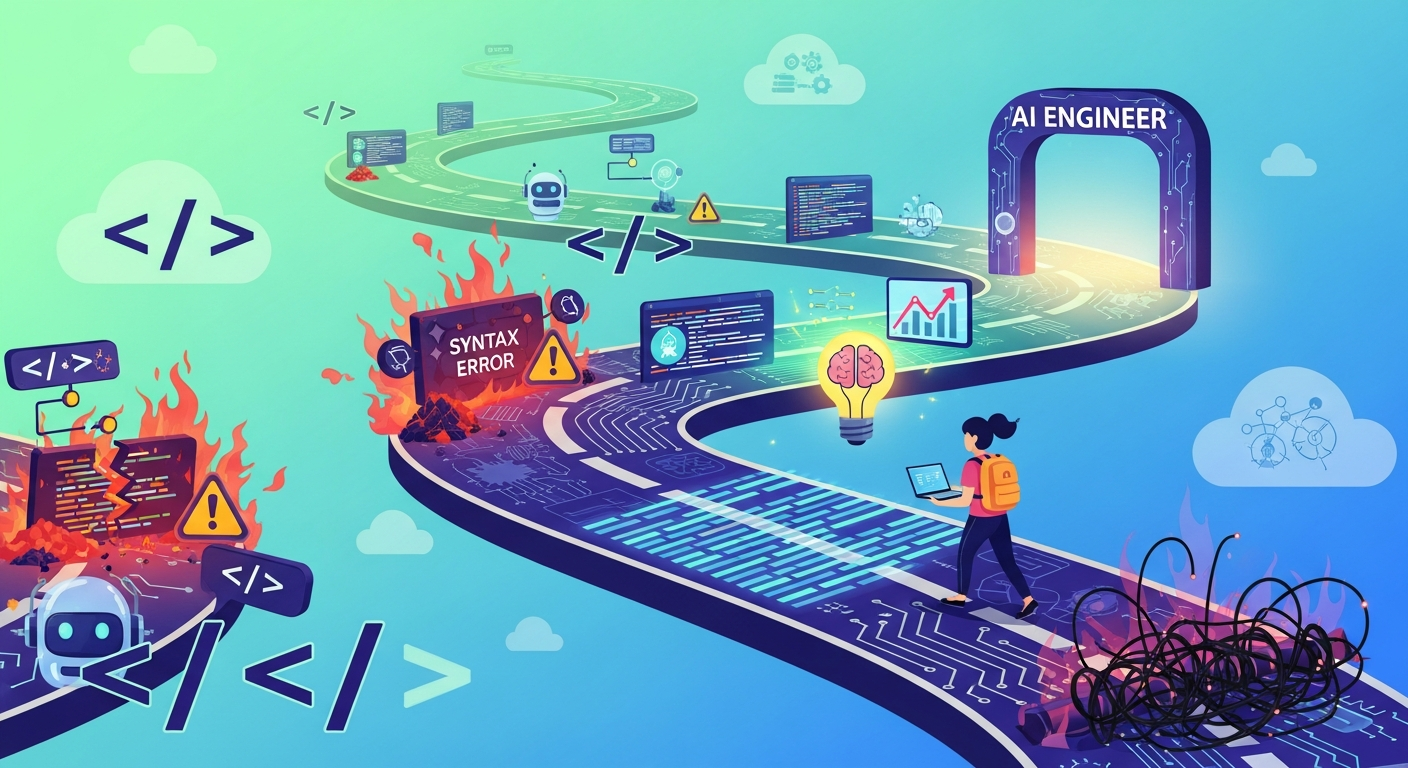 If you want to get started in ai engineering, you need to know some common mistakes that might slow you down. The best way for a software developer to switch paths is to follow a simple plan and not fall into these traps. Many people who want to work in this field get stuck. It's often because they focus on the wrong things or feel lost with so much to take in.
When you know about these mistakes, you can do better in your learning and not lose focus. This will help you get an ai job faster. It is true that continuous learning is important, but you should try to learn in a smart way too. Here’s a look at some of the mistakes people make often and what you can do to stay on the right path.
Over-Focusing on Theory Instead of Practice
One mistake that many beginners make in the ai field is spending too much time on theory. While it is good to know the ideas and math behind AI, you should not get stuck just reading. The ai field is about putting things to use, so practical skills matter most to people who hire you.
Instead of trying to know every small detail, learn just enough to start building something. You really start to understand AI when you work on real problems. You might have issues and get things wrong, but that is the fastest way for you to gain a sense of how things work and grow your knowledge.
Keep in mind, your main goal is to be an ai developer, not a research scientist. Put your time into hands-on projects and keep up continuous learning by doing the work. This will help you get practical skills and also make you better and more wanted in the job market.
Neglecting Project Work and Essential Deployment Skills
Following tutorials can help you learn, but just copying code is not enough to be an AI engineer. If you want real job opportunities, you need a portfolio with your own projects that are different from others. A lot of people stop after they train a model, but that is not where you should end.
It's a big mistake to leave out model deployment. In the real world, the model only matters if some app can use it. If you are a developer, you have an edge in this. Spend time to practice how to send your models out as APIs and put them into simple web apps.
Doing everything from data engineering to deployment is what gets you hired. This shows you can make models work in the real world and give people full AI systems that are ready to use.
Trying to Learn Too Many Tools Simultaneously
The world of AI is packed with many deep learning tools, libraries, and frameworks. There is a lot out there, and people often want to learn all they can. But if you try that, you can get burned out fast. One mistake many people make is jumping from one thing to another without really getting good at any of it. This can hurt how much you learn and leave you with only a light idea about everything.
Instead, you should pick the right tools and work on them one at a time. For example, pick PyTorch or TensorFlow and stick with it until you know it well. When you have a strong foundation, picking up other new tools will not be as hard. Your first step should be:
Python and its main data science libraries.
One deep learning tool, like TensorFlow or PyTorch.
Simple deployment tools, for example, Flask and Docker.
Getting good at these important technical skills will help you set up a strong foundation. Then you can add more to your toolbox over time.
AI Career Roadmap for Developers: Growth Pathways
An ai career gives you a lot of room to grow. When you start working as an ai developer, you take the first step on a path with many interesting and high-level jobs. Becoming an ai engineer in one year is just the start. You have only got your ticket to begin your journey.
Where you go next will be based on what you like, the skills you get, and the work you do. You might want to pick one area of ai and get really good at it, or you could move into leading teams or planning big ideas. This part will show you some usual career paths and what kind of growth you can find as you work in this field.
From Junior AI Engineer to AI Architect
Your AI career will most likely start as a Junior AI Engineer. In this job, you will help with different tasks on an AI project. This can include things like getting data ready, training models, or making APIs. This is the part where you use your technical skills and get good experience by doing real work.
After some time, you will get more skills and can move to a mid-level or Senior AI Engineer job. At this level, you get more done, lead teams, and help pick how things are done. This is an important time for your ai career, as you build your know-how.
When you get enough experience and know how ai systems work, you can become an AI Architect. In this role, you plan out the full AI system. You pick the best tools, and make sure everything works well, grows, and meets the needs of the company.
Progression Through Machine Learning and Senior Roles
Another job that many people go for is to become a Machine Learning Engineer. This job is a lot like an AI Engineer, but Machine Learning Engineers usually spend more time working on getting machine learning models ready to use in real products. They know how to build ML systems that many people can use, and those systems work well and don't fail.
After you have some experience, you can move up and become a senior ML engineer. In this role, you help teach and guide other ML engineers, manage big projects, and help shape the machine learning work your company does. To be good at these jobs, you need to know a lot about machine learning and also have a strong software engineering skill set.
If you want to get these senior jobs fast, you should keep learning, try out new technologies, and never be afraid to take on tough projects. The better you get at mixing software engineering with deep machine learning, the more your company will need you. If you build up your skills and experience, you will always have good opportunities in this field.
Comparing the AI Engineering Path vs Traditional Development Careers in India
Choosing a career path is a big step. Developers in India often think about if they should stay in software engineering or start working as an AI engineer. Both options are good, but they are different when we look at the skills you need, how much you can grow, and how many companies are hiring.
The career path of an AI engineer in India is growing fast. This is because the tech world in India is changing quickly. The world also wants more people to start building and using AI. Here, you can find a look at both software engineering and AI engineering, so you can pick what’s best for you. We will talk about the main points that set the two career paths apart and share what you may find if you pursue each one.
Differences in Skill Requirements and Learning Curves
The skill set for an AI engineer builds on what a software engineer already knows. Both need strong programming skills. Still, ai engineering goes further. You need to know more about mathematics, statistics, and machine learning. A traditional software engineer makes systems that do the same thing each time. An ai engineer works on systems that can learn from data.
The learning curve to move into AI can be tough, but a developer can do it with some work. You will get tips and use new tools, but your background in engineering helps you. Here are the main differences in what you need to know:
Mathematics: To do AI, you need to know more about linear algebra, calculus, and probability.
Data Skills: AI engineers use a lot of data, so you need skills in data analysis and cleaning up data.
Modeling: You build and train models that predict things, which is not something a traditional developer always does.
Experimentation: AI engineering is more experimental. You build, test, and improve things over and over.
In India, companies focus on hands-on skills that help you get jobs right away. People who can learn ai engineering and add machine learning skills are in high demand.
Career Growth Potential and Industry Demand
The career growth in AI is now higher than in many standard software development jobs. The AI job market is growing fast, and not enough people have the right skills. Because of this high demand, most jobs pay well and there are more job opportunities to go after.
While software development is still needed, these jobs are turning into basic tasks that many people can do. AI stands out as a new field where you get to solve big problems and make a real difference. The best way for a developer to get into this growth is to learn more and show they can be a specialist.
In India, companies in every area, from new startups to big businesses, are putting a lot of time and money into AI. This means the job market is lively and there are many chances to find a role and grow faster in your career.
Future of AI Careers in India: Trends for 2026
The future of AI in India looks very good. By 2026, there will be important trends that will shape the AI job market. As businesses use AI more in their day-to-day work, the need for people with the right skills will keep going up. If you are a developer, it is smart to know about these trends. This is the best way to make sure you have a job in the future and stay ahead in your work.
The rise of generative AI, AI agents, and roles that mix different skills will open up new and good career choices. The work will move away from just making simple predictive models. It will go toward building smart systems that can do complex jobs and talk with the world in better ways. Let's see what the future of AI careers will look like.
Rise of Generative AI, AI Agents, and Automation
Generative AI is set to be the biggest change in the AI industry. By 2026, knowing how to build things with Large Language Models will be a skill that many companies want. Jobs such as ai engineer for generative ai will be more common. People in these roles will make chatbots, write tools for content generation, and help create other new AI tools.
Another area to watch is the growth of autonomous AI agents. These tools can think, plan, and do tasks to reach a goal. Developers who know how to work with this will be leading in AI automation. They will build smart tools that help make work easier and faster in businesses.
This shift will make the gap between software development and AI smaller. The best way for any developer to keep up is to learn these new technologies and start to use them every day. A generative AI course in Hyderabad can help give you the right skills for this new time.
Evolving Hybrid Developer + AI Roles
The mix of old developer jobs and new AI roles is opening up great chances in tech. More and more, companies use artificial intelligence for things like fraud detection and data analysis. Because of this, the need for skilled AI engineers has never been higher. This change pushes developers to learn more. People add machine learning models and neural networks to what they already do in software engineering.
Jobs in AI now need a strong base in programming languages, data science, and deep learning. People who build this mix of skills will be ready to solve real problems. They can also make user experiences better using new ideas. If you keep up with continuous learning by taking online courses and working on hands-on projects, you can do well in the fast-changing AI field.
Conclusion
Finishing the journey to be an AI engineer takes hard work and a focus on the right skills. The best way to do this is to follow a clear roadmap. This helps you use what you already know about programming to quickly get the main ideas of machine learning and deep learning. When you work on real projects and keep learning about new tools, you set yourself up to do well as an AI engineer. The need for skilled AI engineers is going up. So, now can be a good time to go for this exciting career choice.
Frequently Asked Questions
What is the fastest way for a developer to become an AI engineer in India?
 The best way for someone in India to become an AI engineer is to take online courses. You should also work on real projects and join hackathons. This will help you use what you learn. Get to know people who work in the industry. If you work on open-source projects, it can help you learn more and find good jobs too.
Which skills should I focus on first to follow the AI engineering path quickly?
If you want to get on the AI engineering path fast, start by learning programming languages like Python and R. You should also know about machine learning, including different types of algorithms. It is good to understand data structures too. Try to work with AI frameworks and use cloud platforms as well. Doing this helps you build your practical skills quickly.
Do I need a strong math background to start a career as an AI engineer?
You do not always need to have a strong math background to get started as an AI engineer. While math can help, what matters more is having practical skills like programming, data analysis, and knowing about machine learning. If there are things you do not know, continuous learning and hands-on work can help you make up for it.
What practical projects best demonstrate developer AI skills to employers?
To catch the eye of employers, developers should work on hands-on projects. This can be building apps with AI, making chatbots, working on machine learning models, or using AI to automate tasks. These kinds of projects show that you know how to solve problems. They also prove you can use machine learning and other AI tools to create real solutions.
how do I actually become an AI engineer? : r/developersIndia
To become an AI engineer, start by gaining a solid foundation in programming languages like Python and R. Next, study machine learning algorithms and frameworks. Pursue relevant courses or certifications, work on hands-on projects, and build a portfolio to showcase your skills in AI development and implementation.