







.png%3Falt%3Dmedia%26token%3D4c256583-349d-4114-8801-47b1f35864d6&w=3840&q=75)
Machine Learning for Developers: A Beginner Friendly Guides
Key Highlights
Here's a quick overview of what you will learn in this guide:
Machine learning is a part of artificial intelligence that teaches computers to learn from data without being explicitly programmed.
Developers should learn ML due to growing demand, better career opportunities, and its integration into modern applications.
The main types of machine learning are supervised, unsupervised, and reinforcement learning, each solving different kinds of problems.
Python is the top programming language for data science, supported by powerful ML frameworks like Scikit-learn, TensorFlow, and PyTorch.
Building simple projects is the best way to practice and solidify your understanding of deep learning and other ML concepts.
Introduction
Welcome to this simple guide to machine learning for developers. If you have ever wondered about artificial intelligence or how it works in things like computer vision and tools that suggest what you might like, you are in the right place. This guide is here to break down big ideas into easy facts. Here, you will see what machine learning is and why every developer can get good things from it. You will also find out how to start learning right now. Let’s get started.
What is Machine Learning? (A Developer’s Perspective)
 From a developer’s side, machine learning is a cool area in artificial intelligence. Here, you make systems that learn and get better as they use data. Instead of giving clear instructions for every job, you use machine learning algorithms to find patterns in what you have.
This changes the old way of computer science and lets you build an ai system to make guesses or choices. We will talk more about how this works. We will look at how it is not the same as basic programming. There will be some real-life examples, too.
Defining Machine Learning in Simple Terms
Machine learning is part of artificial intelligence. It lets computers learn on their own, without someone telling them every step. You can think about it like this. You don’t teach a child every rule to spot a mango. Instead, you show examples of ripe and unripe mangoes, and after some time, they figure it out.
In the same way, a machine learning system learns from input data. This learning process acts a bit like a human brain. It looks for patterns and connects ideas. You do not need to tell the computer every single rule. You just show it examples, and it gets what to do.
The more data the machine gets, the better it does the job. This leaves machine learning as a good way to solve tough problems. It helps a lot in cases where making clear, fixed rules would be too hard or just cannot be done.
How Machine Learning Differs from Traditional Programming
In regular programming, you give the computer some data and clear rules so it can find an answer. For example, if you want to figure out sales tax, you set up a program that has the tax rate as the rule and the price as the data. Then, you get the total cost. With this, the developer sets the logic.
Machine learning works the other way around. Instead of giving rules, you give the computer data and the answers you want it to match, called labeled data. It then learns the rules by itself. The result is a "model," which is just what the computer learned about the rules. After that, the model can make guesses or predictions using new, unlabeled data.
Think of a spam filter. It learns what makes an email spam by looking at lots of emails that people have already marked as spam or not, which means labeled data. The computer keeps changing its model parameters so it can spot spam in these emails. This lets it sort future emails for you, and a developer doesn't need to write rules each time a new type of spam shows up.
Real-World Examples of ML Systems in India
The applications of machine learning are seen everywhere. They are changing the way we use and see technology every day. Many services that people use are made better and more personal because of machine learning. In India, machine learning helps many sectors work faster and gives people a better experience too.
These systems use things like speech recognition and image recognition so they can understand and answer when people speak or give other types of input. The impact goes from entertainment to finance, and touches all parts.
Here are some usual examples:
Recommendation Engines: Websites like Netflix and Amazon look at your watching or shopping history. They use machine learning to suggest shows or things you may like.
Fraud Detection: Banks use machine learning to check how you spend money right as it happens. They can spot and stop anything strange to block financial fraud.
Social Media Feeds: Social media picks and shows your feed by learning what you read, watch, or like most.
Voice Assistants: Devices that use Alexa or Google Assistant use machine learning. They can know what you say and answer your spoken commands.
Why Developers Should Learn Machine Learning in 2026
 If you want to do well as a developer in 2026, you should add machine learning to your skillset. More and more workplaces need people who can build and use an AI system. Knowing how to make an ml model and do data analysis is not just a special skill now. It is a must-have for modern software development.
With a machine learning career, you can get jobs that are exciting and pay well. You get to work on new problems and help build smarter apps that are easier for people to use. Now, let's see why this path is a good choice for all of us.
Increasing Demand for ML Skills in India
The demand for machine learning experts in India is going up fast. More and more, you will see that small startups and big companies are using big data to get ahead. That is why they want people who can turn all this data into helpful tips and ideas. If you search on job boards like LinkedIn, you will find there are thousands of open jobs for machine learning roles at top companies.
This rise in machine learning jobs comes because people now know that data is worth a lot. If you pick a machine learning career, you step into high-growth areas like data science. In these jobs, you help fix tricky business problems. Companies want people who can build tools that see future trends, make work automatic, and give a more personal touch to customer needs.
The U.S. Bureau of Labor Statistics says that jobs for data scientists, and work like it, will grow a lot in the coming years. What they see happening around the world is clear in India, too. Now is a good time to think about joining the field of machine learning and data science.
Integration of ML in Modern Software Applications
Machine learning is now a common part of today’s software. Developers are not just making simple apps anymore. They build systems that can change and learn with time. Because of this, people who work with software need to know about data analysis and machine learning. These skills help make better products for the future.
With machine learning, software can give you experiences made just for you, make smart guesses, and do hard work on its own. This can make people happy with their apps and give companies something extra over others. Having an ml model inside a program often turns a good app into a great one.
Machine learning is being used in the following ways:
Personalized Recommendation Systems: Sites for shopping and streaming use it to pick out products or shows for you.
Predictive Analytics: Apps make use of time series to help tell what might happen with sales, customer needs, or even what users do.
Smart Assistants: Apps add things like chatbots or voice helpers to answer questions fast.
Enhanced Security: Machine learning finds strange actions or problems, and helps protect your software.
Career Growth and Future Opportunities with ML
Learning machine learning helps you grow your career a lot. It gives you the chance to take on many different roles. These roles pay well and are needed in today’s job market. As you get more experience, you can start in an entry-level job. Later, you may move up to lead a team and help shape the AI plans for the company.
A machine learning specialization lets you go after jobs like machine learning engineer, data scientist, or AI specialist. These jobs usually come with good pay. You also get to work on new projects that really make a difference for people. This field changes fast, so there will always be a way for you to learn more and grow your skills.
You may want to be a data scientist who finds useful information for a business. Or you could be a machine learning engineer who creates models for real use. No matter which way you go, the things you learn in this field will matter a lot. The future is moving toward smart software, and people with machine learning skills will play a big part in what comes next.
Types of Machine Learning Explained for Beginners
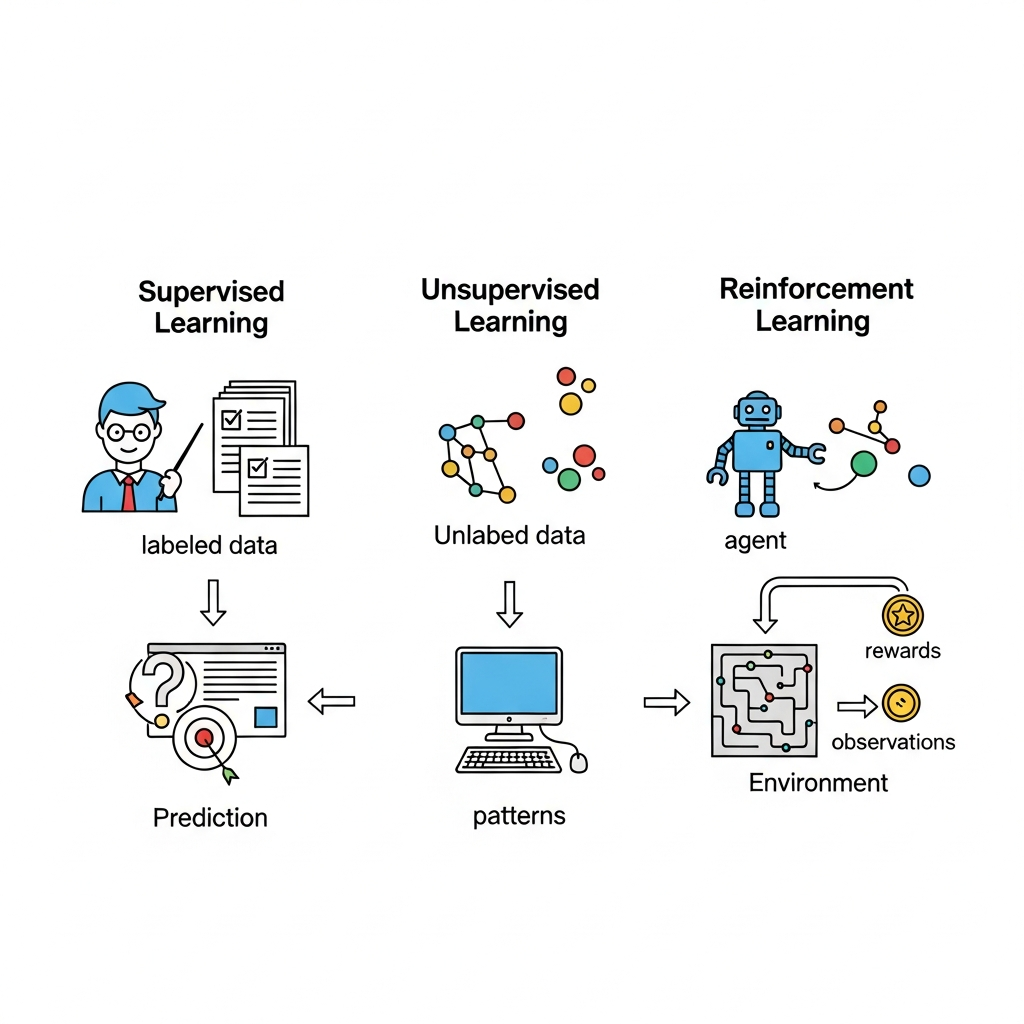 Machine learning can be grouped into a few main types. These types depend on how an algorithm learns from the data you give it. Knowing these types of machine learning is important if you are new to this field. The top three types are supervised learning, unsupervised learning, and reinforcement learning. Each one fits different problems. They also let you use data in their own special ways.
There are also some newer tools, like deep learning. Deep learning can help handle even more complex problems. You can use deep learning in any of these main types. Now, let’s look at these types with easy examples, so you can know how each works.
What is Supervised Learning? Simple Use Cases
Supervised learning is the type of machine learning people use most often. In this method, the machine learning model learns from labeled data. Each piece of training data has the correct answer added to it. The model tries to figure out how to turn input stuff into the right output.
This setup is like having a teacher for the model. The labeled data works as the teacher. It gives feedback to the model and tells it if its prediction is right or wrong. The model then changes what it does to get better at making good guesses.
Common uses for supervised learning include:
Image Classification: The model trains to tell if an image shows a cat or a dog. It uses thousands of pictures with labels, like "cat" or "dog."
Spam Detection: The model sorts emails as "spam" or "not spam" by looking at examples with labels.
Price Prediction: The model uses things like linear regression or decision trees to guess house prices based on details like size and place.
This is a big part of machine learning. It uses labeled data and a machine learning model to learn from training data. Methods like linear regression and decision trees help with these jobs.
Unsupervised Learning: Concepts and Examples
Unsupervised learning comes into play when you have unlabeled data. This means the data does not have any correct answers or labels attached. The main goal for the algorithm is to look at the data and try to find structure or patterns in it. It does this on its own, without help.
Think of it this way: if you have a box of mixed fruits and no one tells you what the fruits are, you still try to sort them. You might group them by color, shape, or size. You do this naturally. Unsupervised learning works like this, and it is called clustering.
Some examples of unsupervised learning are:
Customer Segmentation: This sorts customers into groups by looking at how they shop. Companies do this so they can send different marketing to each group.
Dimensionality Reduction: This uses tools like principal component analysis to make big and complex data sets smaller. It keeps the important parts of the data while using fewer variables.
Anomaly Detection: This finds odd data points in a data set. These strange numbers might show things like fraud or problems in a system.
Core ML Basics Every Developer Must Understand
 To start with machine learning, you should know a few main things. These basics will help you build your projects. It is also important to learn words like data, features, training, and testing before you write any code.
These simple ideas, like feature engineering and model evaluation, are the base for good and steady models. Let’s look at these ideas one at a time. This will give you a good place to start your work in machine learning.
Understanding Data, Features, and Datasets
In machine learning, the data you use is very important. A dataset is made up of data points. Each data point has features. Features are the things you measure about something and put into your model. For example, when you want to predict house prices, you may use features like the house's size, the number of bedrooms, and the location.
How good and how much your data is makes a big difference in how well your model works. Picking which features to keep is called feature selection. If you have too many features, it can make things hard for your model. This trouble is known as the curse of dimensionality.
Here's what some key words mean:
Data Points: One single record in the dataset, like one house.
Features: The columns about each data point, such as square footage.
Data Visualization: Making charts to see how features connect.
Dimensionality Reduction: A way to lower the number of features and keep the most important details.
Keywords used: machine learning, number of features, feature selection, dimensionality reduction, data points, data visualization
Overfitting, Underfitting, and Model Evaluation Metrics
When you train models, you may run into two big problems. These are called overfitting and underfitting. Overfitting happens when the model learns the training data too much. It even picks up the noise and random changes. This makes it do poorly on new data. Underfitting is the other way around. The model is too simple, so it does not pick up the real patterns in the data. This causes it to not do well on both the training data and the test data.
You need to find a good balance. Model evaluation helps with this. There are certain metrics you use to see how accurate the predictions are. The metric you pick depends on the problem you work on.
Accuracy is a common metric. But in some cases where the datasets are not balanced, accuracy may not give a true picture. If this happens, precision and recall may be better to use. By checking these metrics, you can change model parameters and stop overfitting or underfitting. This helps you build a model that works well and creates accurate predictions even on new data.
AI Programming for Machine Learning: The Basics
When you talk about AI programming, picking the right tools is important. There are many programming languages you can use for machine learning. But one language is above the others. Python is now the main language for machine learning because it is simple and there are many libraries for it.
If you are new to this area, learning Python is your first step. It is the base for things like data engineering or making neural networks. Many people use Python for these jobs in machine learning. Now, let's look at the reasons Python is so well-liked, and also share some main libraries you need to know.
Essential Libraries: NumPy and Pandas for Data Handling
For any developer who wants to learn machine learning in Python, NumPy and Pandas are the first two libraries to use. They help with data and are needed for almost every data analysis job.
NumPy stands for Numerical Python. It is the main library for working with numbers. It lets you use big and multi-layered arrays and also gives lots of math functions to use on these arrays. Many ML libraries start with NumPy.
Pandas uses NumPy and gives easy tools to deal with data. Its main tool, the DataFrame, works well with data in tables, like spreadsheets and SQL tables. With Pandas, you can read, fix, change, and study your data with ease.
NumPy: Needed for number work and handling arrays.
Pandas: Great for fixing, changing, and looking at data.
When you use them together, they help you get data ready before putting it into an ml model, even with big data.
Writing Your First Simple ML Program
Writing your first machine learning program can be a big moment. With Python and the Scikit-learn library, you get to build a simple model using just a few lines of code. Let’s walk through the main steps with a practical example, such as predicting house prices.
First, you need your input data. For house prices, this might be things like house size or how many rooms there are, and the price is what you want to find out. You will use Pandas to load this data. Then, you will break the data into training data and testing data.
After that, you need to pick a model. This is where something like linear regression comes in. You use your training data to train the model. When that’s done, you can use your model to make guesses about your test data. When you finish, you look at what your model got right and what it got wrong.
Load the data: Use Pandas to read your dataset.
Split the data: Divide it into training and testing sets.
Train the model: Fit a model (e.g., linear regression) on the training data.
Evaluate: Check the model’s accuracy on the test set. This basic plan is where almost every machine learning project begins.
Popular ML Frameworks Developers Should Know in 2026
As you start to learn more about machine learning, you will find many ML frameworks that make it easy to build models. These frameworks give you tools, libraries, and ways to work that help with hard parts like complex algorithms. If you are a developer in 2026, you will need to know which framework to use for your projects.
Some frameworks are good for people who are just starting out, like Scikit-learn. Others, such as TensorFlow and PyTorch, are strong deep learning tools and help when you need to do more. There are even frameworks like Hugging Face that are best for natural language processing or natural language work. Now, let’s see the most popular ones that you should know about.
Scikit-learn: The Best Starting Point for Beginners
For anyone new to machine learning, Scikit-learn is the perfect place to start. It is one of the most user-friendly ML frameworks available and is built on top of Python's scientific computing libraries. Scikit-learn focuses on classical machine learning algorithms and provides a consistent and simple API for tasks like data preprocessing, classification, regression, and clustering.
Its excellent documentation and straightforward approach make it incredibly accessible for beginners. You can quickly implement various models and perform data analysis without getting lost in complex configurations. It's ideal for building your foundational understanding of the entire ML workflow, from data preparation to model evaluation.
Scikit-learn is an excellent tool for most traditional ML tasks. Here's a quick look at some of its key functionalities.
Task | Scikit-learn Modules |
|---|---|
Classification |
|
Regression |
|
Clustering |
|
Preprocessing |
|
Model Selection |
|
TensorFlow and PyTorch: Advanced ML Frameworks
When you are set to go further than classic machine learning and step into deep learning, you will see TensorFlow and PyTorch as the main tools. These two are open-source and made for making and training neural networks. Neural networks are important for most AI system improvements you see today.
TensorFlow is from Google. Many like it because it grows well and is ready for real-world work. It gives a complete setup that helps you use models in real jobs and apps. PyTorch is made by Facebook's AI team. People talk about how flexible it is and the way it feels a lot like regular Python. Many choose it when they want to try new things and do research easily.
You pick between these two based on what you want or what the project asks for.
TensorFlow: Great pick for big, real-life use and office work.
PyTorch: Many use it in research because it is flexible and easy to understand.
Both tools work well for anyone who gets deep learning. Most people start by taking a good machine learning course in Hyderabad to get strong at using these frameworks.
Beginner’s Guide: How to Start with Machine Learning as a Developer
 Getting into machine learning can look hard at first. But if you follow a step-by-step plan, you can manage the learning process well. You should build a strong base and use real examples. This will help you face real problems and handle new data.
In this part, you will see a clear guide on how to start with machine learning. We will share the main tools and a simple learning path. You will learn the steps to move from being new to being able to make and launch your own models.
What You’ll Need to Get Started (Tools, Software, Resources)
Before you start coding, it helps to know which tools, software, and resources you will need. Most things for machine learning are open-source and free.
You must know at least one top programming language. Python is the most recommended. You will also need a code editor like VS Code, or a place to try things out like Jupyter Notebook or Google Colab. These are good for testing your code. You need access to public data sets. Sites like Kaggle are good for this, so you can practice with real data.
Here's a list of what you need to start with:
Programming Language: Python 3.
Software: Jupyter Notebook or Google Colab for writing and running code.
Libraries: NumPy, Pandas, and Scikit-learn.
Resources: Online tutorials, documentation, and a quality generative AI course in Hyderabad can give you a clear way to learn.
This setup will get you going in machine learning by using these tools, programming languages, and data sets.
Step-by-Step Guide to Learning Machine Learning
Following a step-by-step guide makes it much easier to learn. When you follow a plan, you will not jump from one topic to the next in a random way. You get to learn in order, so you build a strong base before moving into machine learning topics that are harder. This kind of path takes you from the basics all the way to making your very first project.
You start by learning a programming language. After that, you pick up the most important theory. In the end, you use all that for hands-on practice. Every stage adds to what you have learned before, so there is a smooth way to move forward. This way is all about learning by doing, which really helps when it comes to data analysis and building an ml model.
Here is a recommended learning path:
Learn Python programming basics.
Grasp core ml concepts and terminology.
Practice with sample datasets.
Explore and use ml frameworks.
Build and experiment with simple projects.
Learn to deploy a basic ml model.
This practical example of a learning process will help you get ready for success.
Step 1: Learn Python Programming Basics
The first step to getting started in machine learning is to learn Python. You do not have to be an expert, but you should know the basics of programming. Python is easy to read, and that helps you learn fast.
Try to get good at using things like variables, data types, loops, and functions. You should also know how to use lists, dictionaries, and tuples. These are important parts you will use in all machine learning projects.
When you understand how to code in Python, you can start using the libraries needed for machine learning. If you are strong in Python, the ml concepts and tools will be much easier for you to learn.
Step 2: Grasp Core ML Concepts and Terminology
Once you are okay with Python, the next step is to get to know the key machine learning ideas and words. You do not have to get into deep math now, but you should try to have a general idea of what goes on in the background.
You should learn about the types of machine learning. The main ones are supervised learning, unsupervised learning, and reinforcement learning. It's good to know the meanings of words like features, labels, training set, and test set. You should also get what overfitting and underfitting mean, as they are important to understand right from the start.
This kind of basic knowledge helps to set the scene for the work you will do. If you know the terms, it is much easier to follow tutorials, read guides, or look at research papers. It also helps you to talk clearly with other people who work in this area.
Step 3: Practice with Sample Datasets
Theory helps, but machine learning is best learned by doing. You need to work with data to really get it. It is good to start with easy, clean datasets. There are many you can find on Kaggle, the UCI Machine Learning Repository, or sometimes inside libraries like Scikit-learn.
Use these datasets to work on your data analysis skills. Load the data with Pandas. Then, look at the data points and try to find out how the different features are linked. This is when data visualization helps a lot. Make some charts and plots so you can find patterns and see what is going on in the data.
When you do this, you will feel more sure about the first steps of any machine learning project. You will learn how to look at, clean, and get data ready to use. These are main skills people need to have for machine learning.
Step 4: Explore and Use ML Frameworks
Once you feel good about dealing with data, it is time to build models using different ml frameworks. These ml frameworks help you skip most of the hard work, so you can focus on the steps needed to finish your project right.
If you are new to this, you should start with Scikit-learn. Use Scikit-learn to try out the things you have learned. Train models for tasks like classification and regression, play with data cleaning, and check your models using different ways to measure results. The point is to get used to everything from training to testing a model.
Once you know how to use Scikit-learn and basic machine learning, look at some other ml frameworks.
Scikit-learn: Learn this well for basic machine learning jobs.
TensorFlow/PyTorch: Try these when you want to learn deep learning or do harder work.
Playing with different ml frameworks builds your skills and gives you more ways to work on tasks.
Step 5: Build and Experiment with Simple Projects
Now is the time to bring everything you learned together. Build your own simple projects from start to finish. This step is key in the learning process. When you work on a project, you solve real problems and make choices. Tutorials can’t teach you that.
You can start with easy project ideas, like using machine learning to predict house prices or to sort spam emails. The goal is not to make the best model ever. It is about doing the full machine learning workflow by yourself. You gather and clean data. You try feature engineering. You train predictive models and check how they do.
Don’t worry about making mistakes. Try new algorithms. Change the hyperparameters. See how these changes help your work. Making a group of simple projects also shows others that you have skills, and it can be good for your career.
Step 6: Deploy a Basic ML Model
Training an ML model is one thing, but getting it ready for people to use is a different step. In the beginner's path, the last thing to do is to deploy a basic ML model. This means you take your machine learning model and put it in a real system. That way, it can take in data and give back answers.
You do not have to make it hard for your first time. You can set up a simple web app with a tool like Flask or FastAPI. This lets your trained ml model run so users can reach it right on the web.
Learning how to deploy a model is the next step that finishes the machine learning process. You move from just building to making something that works for other people. This is a good skill to have in the tech world and one all employers value. It can really help you take your work to the next step.
Simple Project Ideas for ML Beginners in India
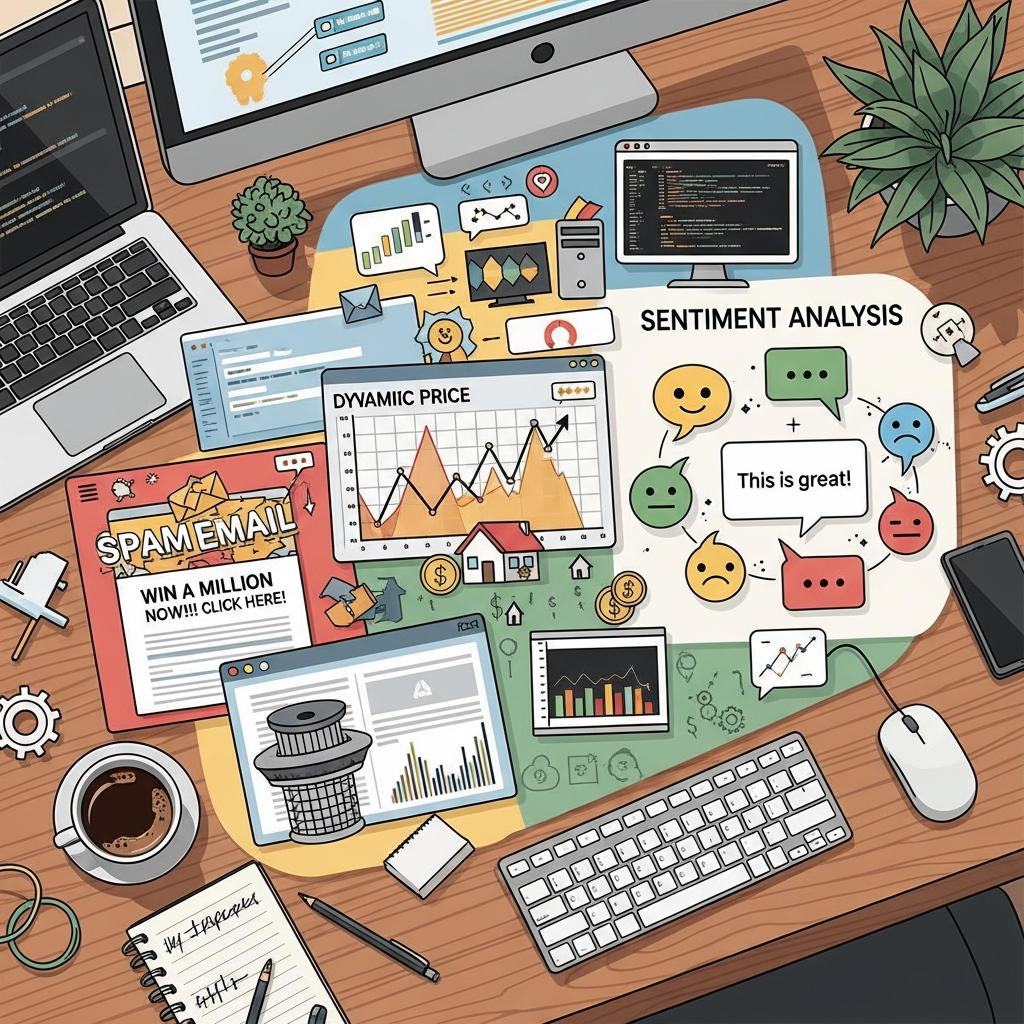 The best way to learn machine learning is by working on real projects. Doing hands-on project ideas helps you understand things better. You can build a portfolio with the work you do. If you are a beginner, it is good to start with simple problems. These should be clear and cover basic ideas like regression, classification, and recommendation systems.
This section has a list of important projects for people who are just starting with machine learning. These projects use data you can find easily. They will take you from beginning to end of building and checking a model. The focus is on using these projects in areas that matter in India.
House Price Prediction (Regression Project)
A house price prediction project is a good place to begin if you want to learn about regression problems. The main aim is to make a model that can guess the selling price of a house. You do this by looking at things like the size of the house, how many bedrooms there are, the location, and how old the house is.
There are many data sets on house prices, and you can find some with information from big Indian cities. This lets you use real historical data. Your first step will be to explore this data, clean it up, and choose the features that matter most when you try to predict the price.
You can start with a linear regression model, which is simple and easy to try out. When you feel ready, you can get into more complex algorithms to make your predictions better. By doing this project, you will get real experience using the whole regression workflow.
Email Spam Classifier (Classification Project)
Building an email spam classifier is a simple way to learn about classification problems and natural language processing. The goal is to make a model that can look at an email and decide if it is "spam" or "not spam" using the words in it.
You will use text as your input data. You need to clean it before you use it with your model. This means you will turn all letters into lowercase, take out all punctuation, and change the words into numbers so the model can use them. The labels will show if the email is spam or not.
There are many public data sets you can use for this work. At first, you can try simple classification tools like Naive Bayes or decision trees. Doing this project will help you understand text cleaning, see why natural language is important, and also make something useful that many people need.
Customer Churn Prediction
Customer churn prediction is a big business problem, and it’s great to have this in your portfolio. The main goal in this project is to find out which customers may stop using a product or service. Businesses like telecom and banking in India use these predictive models a lot.
In this project, you get a dataset with customer details. This can include how customers use the product, what kind of contract they have, and other information like age and where they live. The main task will be to use feature engineering to make new variables. These new variables will help show if a customer might leave.
After feature engineering, you can build a classification model that helps find the customers who are at a higher risk of leaving. Then, a business can try to keep them by giving some incentives. This project helps you see how machine learning can help solve day-to-day business problems using real data.
Sentiment Analysis for Social Media
Sentiment analysis is a common task in natural language processing. It is about finding the feeling or mood in a piece of text. One good way to get started is by doing sentiment analysis on social media. You can use tweets or product reviews and put them in groups like positive, negative, or neutral.
This project will help you get better at working with natural language. You will see real social media posts, which can be messy. You will learn ways to clean up and handle this kind of text. There are many data sets you can get online. You can also use APIs to collect your own data from places like Twitter.
Making a model for sentiment analysis can help in many ways. You can find out what people think about a subject or see what they say about a product. This project is a good way to see how machine learning can help us understand the way people use language.
Building a Recommendation System
Building a simple recommendation system is not too hard, but it is a great project for a beginner to learn more. You see these systems in a lot of places on the internet. For example, Flipkart uses them to show products you may like. Hotstar uses them to tell you what movies to watch next.
You can start by using a basic content-based filtering method. This way, the system will recommend things that are close to what a user likes. For instance, if someone watches many action movies, the system will show them more action movies. To do this, you need to look at the features of each item. This will help you do the right data analysis.
To work on this project, you must have a dataset with items and details about them. The goal is to use ML algorithms to find out how close one item is to another. Then, you give the user the best recommendations. Working on this idea will let you see how machine learning brings a new level of personalization in recommendation systems. It is a good way for people to learn about data analysis and how to use ML algorithms.
ML Career Path for Developers in India
For people working as developers in India, choosing a career in machine learning can be a good choice. It can help you earn more and feel good about your work. More companies than ever before use data. Now, there is high need for people who know how to make smart computer systems. You can pick from many roles. Each one has its own work and skills you need to have.
You can be a data analyst. In this job, you look at data and find useful ideas. Or, you may want to be a machine learning engineer. A person in this job builds and sets up models for real use. The field gives many options. There is work for people who want different types of jobs. You might want to be a data scientist or an AI engineer. There is room for all these roles. This can help you pick what job will work best for you as you go along your career path in machine learning.
Data Analyst vs. Machine Learning Engineer
While both of these jobs work with data, a data analyst and a machine learning engineer are not the same. A data analyst looks at historical data. They try to find insights in old numbers and trends. The goal is to answer questions for the business. They use tools for data analysis and data visualization.
A machine learning engineer builds and puts predictive models into use. They have strong programming and software engineering skills. They handle the life of an ml model from data engineering, training the model to putting it out in the world. They often use big data tools when working because they need their systems to be able to grow.
Here's a simple comparison:
Data Analyst: Looks at past data to find insights. Needs to know data analysis tools, SQL, and data visualization.
Machine Learning Engineer: Builds and deploys predictive models that work for the future. Needs software engineering skills and strong programming.
A data science course in Hyderabad can give you the basics for both these paths.
What Does an AI Engineer Do?
An AI engineer is someone who works with artificial intelligence. They build and add AI features to apps and systems. The role can be broader than what a machine learning engineer does. AI engineers use many AI tools like machine learning, natural language processing, and computer vision.
The main job of an AI engineer is to design, build, and look after an AI system. They make complex algorithms and models. They also help get the models ready to use and make sure the system works well every day. They are very good at making smart and automated tools.
So, an AI engineer uses AI ideas to fix real problems. They turn these ideas into products and services people can use. If someone wants to become an AI engineer, taking an AI engineering course in Hyderabad is a good way to learn the needed skills in artificial intelligence and machine learning.
Data Scientist Roles and Responsibilities
A data scientist is someone who uses computer science, statistics, and business skills to look at data and find useful answers. This job is a mix of what a data analyst and a machine learning engineer do. They ask the right questions, bring together data, and build a machine learning model to help solve problems.
A big part of what a data scientist does is data analysis and sharing the story behind their results. They use data visualization so they can show people, who might not be tech experts, what the data means. This way, they can help people make smart business choices with what they find.
Making data clean and putting it into order is part of the work too. Data scientists train and check machine learning models to see if they work well. To do this job well, they must know both the tech side and the business side of the problem. This helps them use machine learning and data analysis to find good answers.
Common Mistakes Developers Make When Starting ML
When developers get into machine learning for the first time, they usually make some mistakes. It's normal to have trouble at the start, but knowing about these problems can help you avoid them. This will make your learning process easier and better. Many people just focus on tools, but they don't spend enough time learning the basics.
Some people do not see how important it is to understand data. Others skip doing hands-on work with machine learning. These mistakes can make your progress slow. Let’s talk about a few of these errors so you can start strong with ML concepts.
Ignoring the Fundamentals of ML Basics
One of the most common mistakes beginners make in machine learning is to try complex algorithms and tools before they know the basics. Many people want to jump into building a deep learning model at once. But if you do not understand the basics, you may not know why your model works or what to do when it does not work.
The learning process should take some time. You need to get familiar with the main machine learning ideas, like the types of learning, bias-variance tradeoff, and how to check if your model is good or not. These are the foundation for all the advanced topics you will use.
If you rush the basics, you will get confused later. When you know the main ideas well, you will become a better and more skilled person in machine learning. You will feel sure about how to solve problems with deep learning and complex algorithms.
Not Understanding Data and Its Importance
A common mistake in machine learning is not seeing how important data is. Many people new to machine learning look at just the model and the algorithm. But in machine learning, if you put in bad data, you get bad results. The quality of your data will make or break how well your model works.
It is important to spend time on data analysis and understanding your dataset. You need to clean the raw data and deal with missing values. You should also use feature engineering, which means you turn the raw data into inputs your model can use. Your model can only be as good as the data you give it.
Don’t think data preparation is a small or unimportant step. If you know your data well, you often get better results than if you pick a more complex algorithm. People who do well with machine learning always know how important data really is.
Jumping into Tools Without Practice
Many new people in machine learning often try to learn too many tools at once. They might check out TensorFlow or see a tutorial. But reading or watching is not the same as working on a real project. Machine learning is a skill you get better at by doing it.
It is good to stick with one tool at a time. Start with Scikit-learn. Use it to build a few small projects before you start using other things. Your learning process should give you real practice. It's not about just adding names of tools to your resume.
Every practical example you work on will help you get better. You learn new things and grow much more sure of yourself. If you practice often, you will build skills that help you in real jobs. Do not just learn about the tools. Know how to use them to fix problems in the real world.
Future of Machine Learning for Developers in 2026 (India Outlook)

When we look ahead to 2026, we see that the future of machine learning for people who write code in India is full of hope. There are many new things coming for machine learning. The field is changing fast. New tools like Generative AI and AutoML are now shaping how we make and use models. To stay on top, every developer should know about these new things in the machine learning world.
The work is moving toward more easy ways of doing things and being able to put machine learning systems into use faster. Now, let's look at some of the big things that will help shape how people use and work with machine learning over the next few years.
Generative AI and Industry Trends
One big trend in the industry now is the growth of Generative AI. This area of artificial intelligence is about making new content. It can be text, pictures, or even code. Models like GPT have shown the great power that these generative models can have. More software products now use them.
For developers, there are a lot of new things you can do with this. You can make apps that write stories, draw art, or make pieces of code. If you know about deep learning and the basics of transformer models, you will have a good skill for the future.
As this technology gets better, there will be more tools and platforms to help developers bring Generative AI into their work. If you want to work in artificial intelligence, it's very important to keep up with what is new..
The Role of ML Frameworks in the Future
ML frameworks will still be very important for the future of machine learning. But, the way we use them might change over time. As machine learning gets better and grows, these frameworks are becoming easier for people to use. They are being made with simpler features that let you build complex models without having to know everything about how they work underneath.
Frameworks like TensorFlow and PyTorch are always updating to keep up with new ideas, research, and trends in this field. We can see that they will give us better ways to train on lots of computers at once, let us run machine learning on small devices, and help us to put our models on many platforms without problems. The rivalry between them means they keep getting better, which is good for all users.
For developers, this says that models will become more complex, but making them will get more simple thanks to these tools. It is important to keep learning about the top ML frameworks if you want to stay up-to-date with machine learning changes.
Conclusion
To sum up, machine learning opens up many chances for developers. When you understand basic ideas and start using them, you can make models that help give accurate predictions. You just need to get started and keep trying. We know that there will be more jobs and bigger needs for machine learning as time goes on. So, developers have to learn new things to keep up and do well.
You can use machine learning to make the programs you already have better, or you can try out new things like computer vision or natural language processing. No matter which way you choose, a path in machine learning will help grow your career. You will also get the chance to bring new things into the world in this busy and exciting field.
Frequently Asked Questions
Can I learn machine learning if I’m new to programming?
Of course! You can learn machine learning even if you are new to coding. Begin with simple ideas and grow your knowledge step by step. Use online lessons, guides, and real projects to help you. If you work hard and keep practicing, you will understand how machine learning works.
What are the main steps to build an ML project?
To build an ML project, you first need to make clear what problem you want to solve. Then, you collect the data you need. After that, you get the data ready and pick the right algorithms for the job. Train the model, then see how well it works. In the end, deploy the model and keep an eye on it to make sure it stays accurate and gets better over time.
Which ML frameworks are best for beginners?
For those new to machine learning, the best ml frameworks are TensorFlow, Keras, and Scikit-learn. You will find that these tools are very easy to use. They all have a lot of guides and active groups of people who can help you. This makes it good for anyone who is starting out. Pick the one that fits your project and your needs.
What jobs can I get after learning ML basics?
After you learn the basics of machine learning, you can go for jobs like data analyst, machine learning engineer, AI researcher, or business intelligence developer. People in these roles use machine learning skills to look at data and make predictive models for different fields.
Is Learning Machine Learning Worth It for Developers?
Learning machine learning is good for developers. It helps you solve problems better. You can get new jobs and also make smart apps. More people need machine learning in many jobs now. If you know it well, you can be worth more as a developer.
Effort vs. Rewards in the ML Career Path
In the machine learning career path, you put in effort to learn things like data work and how algorithms work. This work can give you some good rewards. You can get good jobs, help new ideas grow, and work on problems people face every day. It is important to balance your effort with what you hope to get. This helps you do well in a machine learning career.
Job Demand and Long-Term Opportunities
The need for machine learning developers is going up fast. New changes in technology make this happen. There are many jobs to be found for the long term. You can work in places like healthcare, finance, and robotics. This is a good field if you want to grow in your work. People in machine learning can also bring new ideas to these sectors.
Key Takeaways for Aspiring ML Developers
Machine learning developers should learn programming languages like Python and R. It is good to know how to clean and prepare data, and get used to working with different algorithms. Doing real projects and keeping up with what is new in the field will help you build a strong career.