







.png%3Falt%3Dmedia%26token%3D5e869e70-60da-43f8-bfa6-4378680f124f&w=3840&q=75)
From Software Developer to AI Engineer: The Complete Roadmap (2026 Guide)
Key Highlights
Here are the essential steps for a software developer to become an AI engineer by 2026. This guide details a clear roadmap for your transition into the AI field.
Leverage your existing software development skills as a strong foundation for your journey.
Master essential technical skills, including Python, core mathematics, machine learning, and deep learning.
Gain practical experience by working on hands-on projects like chatbots and recommendation systems.
Learn to use key AI tools like TensorFlow, PyTorch, and Hugging Face.
Understand the career progression from a junior AI engineer to specialized senior roles.
Introduction
Are you a software developer who wants to learn about artificial intelligence? You have come to the right place. Moving from software engineering to ai engineering is a good step for your career. This guide gives you a roadmap. It shows you the key skills you need to know.
You will learn about programming and the basics of data science. You will also look at advanced ideas in artificial intelligence. We will go over the tools, projects, and steps that help you build a strong career in this area. Get ready to start your AI journey.
Why More Software Developers in India Are Transitioning to AI Engineering
 The path from software developer to AI engineer is getting more popular in India. Many companies now use machine learning and AI in their products. Because of this, there is a strong need for people who can build and use ai models. The job market is now full of new chances for those looking to grow.
Software developers have a good base in things like programming and designing systems. This helps them be ready for be an ai engineer or work in data science. People are drawn to ai engineering because it lets them work with new technology and see their salary grow. Also, it is seen as a good long-term job for many developers in India.
The Rise of AI-Driven Applications and Job Demand
The AI field is growing fast because more businesses are looking to use artificial intelligence. The move to AI-driven solutions can be seen in healthcare, finance, and more. Companies use artificial intelligence to automate jobs, do data analysis, and offer new and smarter products. This rise in AI use means the job market needs more skilled AI engineers to build and keep up with these systems.
Generative ai has made the need even bigger. Now, more companies want people who know how to work with large language models (LLMs) and can come up with new ideas. There is also a bigger call for those who bring both software engineering and artificial intelligence skills. As artificial intelligence becomes a bigger part of our lives, we will need engineers to take this ai research and turn it into things we use every day.
This demand is only going up. By 2030, the use of ai is expected to add a lot to the world’s economy. This will make even more job chances for those good at working in this field. This is a good time for software developers to pick up artificial intelligence and data analysis skills. Moving into the ai field now can help you with a stable career in the future, especially in places like healthcare where technology is growing fast.
Salary Trends and Long-Term Career Growth for AI Engineers
The transition to an AI engineer role often comes with a significant increase in salary and promising long-term career growth. Due to the high demand and specialized skills required, AI engineers typically command higher salaries than traditional software developers. As of October 2025, the median total salary for an AI engineer in the United States is around $138,000, which reflects the value companies place on AI expertise.
Employment trends show that the job growth for AI engineers is projected to be much faster than the average for all occupations. This indicates a sustained demand for professionals who can build intelligent systems. Your existing software engineering skills provide a strong foundation, but acquiring new AI skills is what unlocks this higher earning potential.
Here’s a look at how salaries can progress with experience:
Role Level | Average Salary Range (USD) | Key Responsibilities |
|---|---|---|
Junior AI Engineer | $90,000 - $120,000 | Assisting with model development, data preprocessing, and infrastructure support. |
Mid-Level AI Engineer | $120,000 - $160,000 | Building and deploying AI models, managing ML pipelines, and API integration. |
Senior AI Engineer | $160,000+ | Leading AI projects, designing complex AI systems, mentoring junior engineers. |
What Does an AI Engineer Actually Do?
An AI engineer is a tech expert who does work with software engineering, data science, and machine learning. The main job for an AI engineer is to build and set up AI models. They help turn AI ideas from the lab into something you can use in real life. To do this, they need a mix of technical skills. The job uses coding and also some work with algorithms.
On a normal day, their tasks can be different. They may build AI systems or set up deployment pipelines for machine learning models. They often use big datasets and do work with numbers. AI engineers also talk with data science teams to bring artificial intelligence to life. In short, they help make AI work in the things you use each day.
Key Responsibilities in AI Model Development and Deployment
An engineer plays a key part in the lifecycle of ai models. They help turn ideas into working things. At first, the engineer will build ai models from nothing or update ones that are already made. To do this, they use different programming languages and frameworks. Their good technical skills let them solve business problems.
After the model is made, the next big step is deployment. The engineer has to turn the models into APIs. These are tools that make it easy to add ai to other apps. This lets other parts of the software work with the ai models. It is important to use good project management here so everything moves well from start to finish.
Some main things they do are:
Build and manage the machine learning and production workspace.
Set up and run automated ai tools to help the data science team.
Turn machine learning models into easy-to-use APIs.
Work closely with others to talk about plans and how to make things happen.
AI Integration, System Design, and Real-World Applications
Bringing AI models into real-world systems shows what an AI engineer can really do. It is not just about putting a model in place. The process is about building strong workflows. These steps help with data manipulation, handling what users ask for, and making sure the results are dependable. The aim is to let artificial intelligence become a useful part of a bigger app or tool.
For instance, think about when you use a streaming service and get movie or show suggestions. The ai engineer is behind this. They design how the system works so that your watching history goes into a machine learning model. Then, the model uses that data and gives you neat, custom tips on what to watch next. It is about making the ai models work together with user databases and the display you see. This helps the system stay quick and right on target.
This job of mixing artificial intelligence into tools is what makes it real in our daily lives. From self-driving cars to talking to a chatbot for help, the ai engineer sets up everything to make these things go. That is how we solve real world problems and make things better for people using them.
Transferable Software Development Skills That Help in AI Engineering
If you have some software engineering experience, you already have what you need to start working in the ai field. The skills you get from software engineering match up well with ai engineering. You know how to do programming, backend development, and design systems. These things put you ahead of someone who is just starting out.
This knowledge helps you build ai models that can handle many users and stay in good shape over time. This is very important when you put ai models into use. When you start, your skill in solving big problems and writing good code will help you the most. Now, let’s talk about how these skills can be used right away in ai engineering.
Programming Expertise and Backend Knowledge
Your skill in programming is one of the most important for anyone wanting to be an ai engineer. Python is the top language in the ai field. But you should also know other programming languages. Java or C++ can be useful too. This will help you learn how to use the syntax and libraries needed to build and train ai models.
It is good to have backend development skills as well. An ai engineer needs to build APIs for their ai models. You also will manage databases and keep the system working. When you know backend frameworks, server setup, and how to work with data, you can put ai solutions into production much easier.
You need to be able to write clean and simple code. Efficient code matters. Well-structured code will give you a good start. Whether you work on data analysis or complex neural networks, having strong basics in programming will help you solve problems and feel sure of yourself as you work in ai engineering.
System Design, Debugging, and API Experience
System design is a key part of both software engineering and ai engineering. It helps you think about how all of the parts need to fit together when you build ai applications. This includes getting data, training your ai models, deploying them, and then checking how they do. If you know how to make systems that handle a lot and keep working even when things go wrong, you will have a good way to set up deployment pipelines for ai models.
Your debugging skills are also very important. AI systems can be hard to work with, and problems can come from the data, the ai model, or the systems they run on. You need to find and fix any problems so your ai applications work well and stay up. You will spend your time looking at everything from model behavior to how api integrations work.
If you know about apis, you will find it helps a lot in ai engineering. Many machine learning tasks need you to make or use apis so other software can use your models. If you know about REST apis, data formats like JSON, and how to keep things safe, you can easily bring new ai capabilities into old workflows and business apps.
Beginner’s Guide: Getting Started on the Developer to AI Engineer Roadmap
 Starting out in the AI field can look hard, but having a clear learning path can help beginners make it easier. The first thing to do is get strong at the basics. You will need to know some important programming skills and learn the main math ideas behind AI.
You are not on your own for this. There are lots of good online courses and tutorials that can help you. If you want extra help, you can look for an AI training institute in Hyderabad for classes with a plan. The most important thing is to focus on the basics before you move on to more advanced topics.
Essential Resources and Prerequisites for the AI Learning Path
To start your AI learning path, you have to make sure you have the right things in place. Knowing Python well is the most important thing. Python is the main language people use in AI projects. You should really understand data structures, how to use object-oriented programming, and how to write code that runs well.
You also need to get the basic ideas from math right. Try to learn about linear algebra, probability, and calculus. These are needed for many machine learning algorithms. You do not have to be a math genius, but you should know what is going on behind the ai models.
There are many good resources out there to help beginners on this journey. Try using a mix of free resources and online courses to learn more about AI and coding.
Online Courses: Platforms like Coursera have special courses for this. For example, the University of Michigan's "Python for Everybody" is a great pick.
Tutorials and Documentation: If you want to work with tools like TensorFlow and PyTorch, their websites have step-by-step tutorials made for beginners.
AI Engineering Courses: If you want a straight and full learning plan, signing up for an AI engineering course in Hyderabad is a good move. You get expert help through the process.
Books: Practical books, for example, "Automate the Boring Stuff with Python," show you how to use Python at work and learn to code for the real world.
Step-by-Step AI Engineer Roadmap for Developers
Here is a simple, step-by-step guide that will help you move from being a software developer to becoming a good ai engineer. This learning path is put together to build on the skills you already have. It will also bring you the main ideas you need to know about artificial intelligence. If you follow these steps, you will get the knowledge and technical skills you need to change your job in a good way.
Every step in this roadmap looks at one area of artificial intelligence, from the basics to how to use them in real life. When you go through each stage, you will gain the technical skills to make and use real ai systems. Let’s look at the steps you need to take on your journey with this learning path.
Step 1: Master Python Programming and Core Mathematics
The first thing you need to do on your AI engineer roadmap is to get good at Python and core math. Python is the main language for AI. Most tools, libraries, and frameworks in machine learning, deep learning, and AI models use Python. You should try to write Python code that is clean and well-made. This is one of the key technical skills for any AI engineer.
You also need to be okay with math basics. You do not need a Ph.D., but you should know linear algebra, probability, and calculus. These ideas are used in algorithms and help people understand how neural networks and other AI models really work.
Getting good at these basics is very important. If you are not strong with Python and math, learning more about deep learning, neural networks, and other advanced AI topics will be hard. A strong start in these will help you solve problems and build good solutions as you move up in your roadmap.
Step 2: Learn Machine Learning Fundamentals and Algorithms
With your foundation set, now is the time to get into the basics of machine learning. Here, you will learn how systems spot patterns and use them to make guesses from data. Before you try out hard ideas like neural networks, it helps to know about the basic algorithms that make many AI systems work.
Start with the two main types of machine learning: supervised learning and unsupervised learning. With supervised learning, you get into algorithms for regression and classification. Regression is about predicting numbers, while classification is about sorting things into groups. In unsupervised learning, you'll look at clustering. This finds hidden groups in data that are not labeled.
To really understand these ideas, think about taking a machine learning course in Hyderabad. These classes give you time to practice with data analysis. You will see how different algorithms work. This step is about learning the why behind AI, and how to check if your model does a good job.
Step 3: Explore Deep Learning and Data Handling Skills
Now you are set to learn about deep learning. This is the technology behind the most advanced AI applications today. Deep learning is about neural networks. These are mathematical systems that work like the human brain. First, get to know how a neural network is built. Learn about layers, activation functions, and also optimizers.
Next, get familiar with the main deep learning concepts. One is convolutional neural networks, also called CNNs. They help in image recognition. There are also recurrent neural networks, or RNNs, which work well with sequential data such as text. Learn about transformers too. This setup is behind most modern natural language and natural language processing (NLP) models.
As you focus on deep learning, you should also get better at data manipulation and handling. An ai engineer must know that AI models depend on the data they use to learn. So, you need to be good at cleaning, working with, and changing big sets of data. This is a needed skill for anyone who wants to be an ai engineer.
Step 4: Work on Real-World AI Projects and Model Deployment
Theory helps, but real hands-on experience is what you need to be an AI engineer. At this step, you use everything you know to fix real problems. Working on AI projects from the start to the finish, like collecting data, training your models, and setting up model deployment, is the best way to get useful skills and show employers what you can do.
Try starting with small and simple AI projects that make you think like an engineer. If your models mess up or your data is wrong, you will learn a lot—more than what you get from tutorials. The main goal is to build a portfolio that shows you can give working AI solutions for real problems.
Put your attention on making deployment pipelines so your models are easy to use and people can count on them. This can mean putting your model inside an API, then putting it on a cloud server. Doing this shows you can build models and make them work in a real work environment, not just for practice.
Must-Learn Tools and Technologies for the AI Career Roadmap
To do well as an AI engineer, you must learn the basic AI tools and technology. You will use these frameworks and libraries every day to build, train, and launch ai models. Knowing the top tools in the field is good for getting your work done fast and working well with other people who do the same job.
You will find both deep learning frameworks like tensorflow and pytorch, and older machine learning libraries, like scikit-learn. Each one helps with a different step of making and updating AI. The next section will cover the most important technology for any ai engineer to know. These will help you create a solid roadmap for a good career in this field.
Python Ecosystem, TensorFlow, PyTorch, and Scikit-learn
The Python world is the base for AI engineering. There are many libraries that help you get things done. NumPy and Pandas are very useful for data manipulation and working with numbers. Most jobs in data science and machine learning use these. Matplotlib and Seaborn help you see what your data looks like. This makes it easier to understand your data before you start building models.
When you are ready to build models, you will see some key tools again and again. Scikit-learn is great for classic machine learning algorithms. If you want to work with deep learning, the top choices are TensorFlow and PyTorch. TensorFlow is known to be stable for pipelines and being ready to use in a company. PyTorch is flexible and easy to use, so people like it for research and trying out new ideas.
You have to master these things if you want to be a good AI engineer.
Python Libraries: Use NumPy for number work and Pandas to handle your data.
Machine Learning: Use Scikit-learn for well-known machine learning algorithms.
Deep Learning Frameworks: TensorFlow is good for big and scalable pipelines. PyTorch is good if you need things to be flexible for research or any new work.
Visualization: Matplotlib and Seaborn help you look at your data and share what you find.
Hugging Face, AI APIs, and MLOps Tools
Beyond the main frameworks, modern AI engineers use special tools that make work faster and easier. One big name in natural language processing is Hugging Face. Its Transformers library gives you lots of pre-trained models. You can use them to build natural language applications, such as chatbots or tools that can sum up text, without spending a lot of time.
When you get ready to put your work out for others to use, you also have to learn about MLOps tools. MLOps stands for Machine Learning Operations. These help you with things like version control, monitoring, and making strong deployment pipelines. Knowing how to use MLOps is important to create machine learning and AI systems that work well and can handle growth.
Here are some main tools to check out:
Hugging Face: To get and adjust pre-trained NLP models.
AI APIs: For adding strong, large natural language models from places like OpenAI into your apps.
MLOps Tools: For building steady deployment pipelines and watching your machine learning models in use.
Hands-On Projects to Build a Strong AI Portfolio
Building a strong AI portfolio is important to show your skills to possible employers. When you work on hands-on projects, you show that you can use what you know to solve real problems. This is better than only writing courses on your resume. Your portfolio should have different projects that show your skills in machine learning, deep learning, and data analysis.
The best projects are end-to-end. This means you take care of everything. You collect data, build models, and handle deployment. This shows you have the practical skills to work as an ai engineer. Let's look at some project ideas that can help you build a good portfolio that stands out.
Recommendation Systems, Chatbots, and AI Document Summarization
Building real-life apps is a good way to show what you can do. A recommendation system is a classic project that lets you work with user data and figure out what people like. You can make a system that recommends movies, products, or articles. It shows you know about collaborative filtering or content-based filtering.
Chatbots are another good project. The use of generative AI is getting bigger these days. You can use natural language processing to build a chatbot. It can answer people’s questions, help with customer service, or even tell jokes. This shows you know how to work with text data and build interactive AI models.
AI document summarization is a smart NLP project. With it, you show you can handle a lot of text and cut it down to the main points. That skill is useful in many kinds of work.
Recommendation Systems: Build a movie or product recommender.
Chatbots: Create a customer service or personal assistant chatbot using LLM APIs.
Document Summarization: Develop a tool that summarizes long articles or reports.
These projects let you show off what you can do with real-world applications.
Fraud Detection Models and Image Classification Projects
Fraud detection models can be a strong way to show your data science skills. In this type of project, you get to work with imbalanced data and use classification methods to find strange or risky transactions. It helps show that you can work with tough data problems in the real world. You also get to build systems that can help a business in a direct way.
Image classification projects are a good way to let others see what you can do with deep learning. One old but good project is to build something that tells if a picture is of a cat or a dog. By doing this, you work with things like convolutional neural networks. It lets people know that you can build, use, and train advanced neural networks for things like computer vision.
These projects show some of the key things that matter in ai engineering:
Fraud Detection: You get to work with real life, messy data. You also make models that are needed for business.
Image Classification: This work points to your deep learning skills. It shows you can use neural networks to help solve picture or visual questions.
Both of these projects can be great to have on your portfolio if you want to stand out to future employers.
AI Engineer Career Pathways: Progression from Junior to Advanced Roles
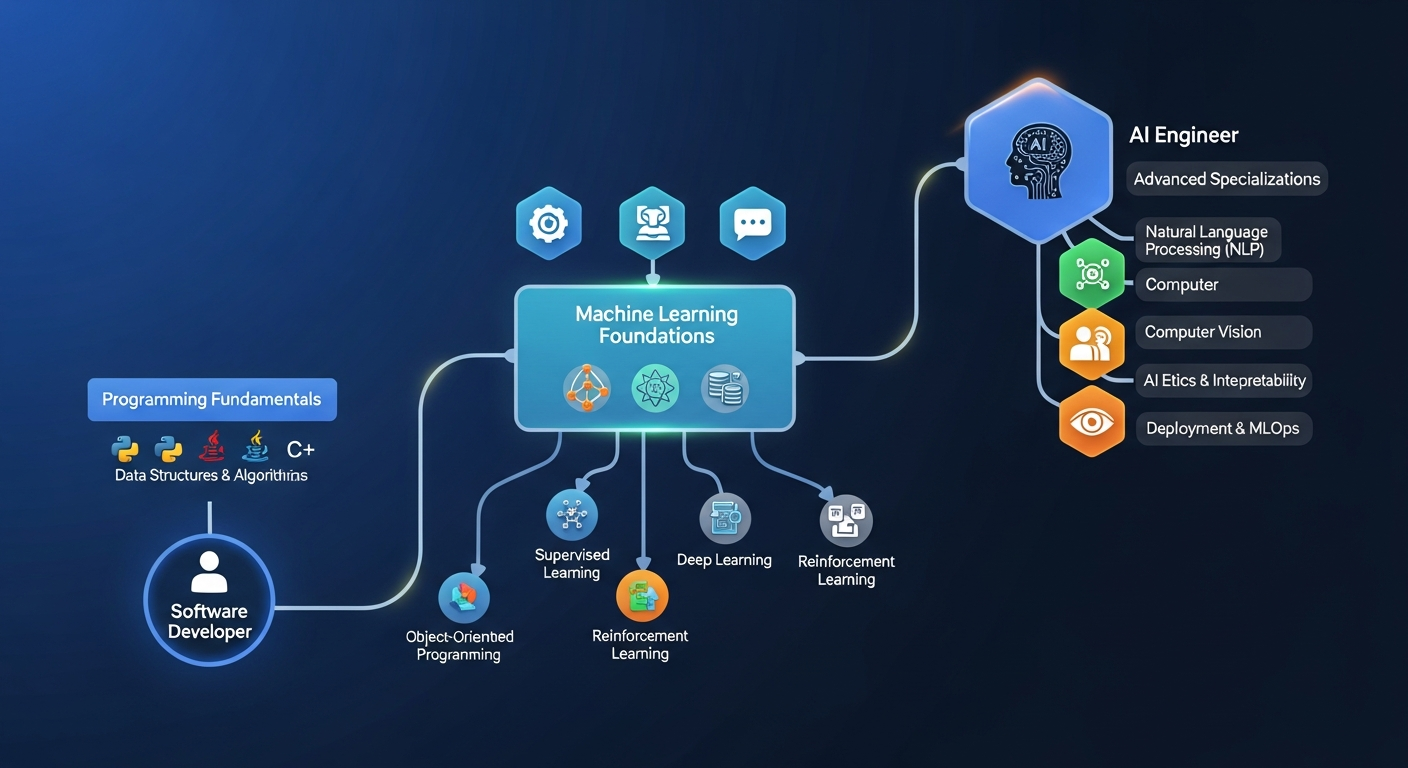
The career path for an AI engineer is lively with lots to offer. When you start as a junior ai engineer, you mostly help the team and learn how things work. As time goes on and you get more skills, you will handle bigger tasks. You can move up to senior jobs where you guide projects and build tough AI systems.
This job lets you pick a focus area. You could decide to work in natural language or natural language processing. Or, you might go to a bigger role and help shape plans. Let's take a look at how a career grows, from your start as a junior ai engineer all the way to senior or special jobs.
Junior AI Engineer, Machine Learning Engineer, and Senior Positions
Your career progression in the AI field will likely start as a junior AI engineer. In this role, your primary focus will be on learning and execution. You'll assist with tasks like data preprocessing, training models under supervision, and maintaining AI infrastructure. It's a foundational role where you'll build practical skills and gain exposure to real-world projects.
As you gain experience, you may move into a machine learning engineer role. Here, you'll have more autonomy and responsibility. You'll be expected to build and deploy models independently, design and manage ML pipelines, and work more closely with business stakeholders to solve problems.
With several years of experience, you can advance to senior positions. A senior AI engineer leads projects, mentors junior team members, and makes high-level architectural decisions. This role requires deep technical expertise and strong leadership skills. The progression reflects a shift from executing tasks to owning and strategizing AI initiatives.
Role | Primary Focus | Key Responsibilities |
|---|---|---|
Junior AI Engineer | Learning and Support | Data cleaning, model training assistance, running tests. |
Machine Learning Engineer | Building and Deploying | Developing models, creating APIs, managing ML pipelines. |
Senior AI Engineer | Leadership and Strategy | Designing AI systems, leading projects, mentoring others, technical oversight. |
Specialized Roles like AI Architect and Research Engineer
After you get a higher role in AI engineering, you can choose to focus more on one area. One way is to be an AI architect. This person builds the main plan for how a company’s AI will work. You need to know a lot about both AI and how software is made. In this job, you pick important things, like what tools to use, how data moves, and how the system grows.
There is another way to go. You can become an AI research engineer. This is a job where you mix building things and looking for new ideas. In this job, you read a lot of new research papers, work on new problems, and come up with new algorithms or help make better ai models. You will enjoy it if you want to move AI forward and see what more you can do.
These jobs are top spots for anyone who wants to go far in ai engineering. They need a lot of skill and you have to be ready for continuous learning. But you will get to help solve some of the biggest and most exciting problems out there.
Common Challenges and Mistakes in the Developer to AI Engineer Journey
The move from being a software developer to becoming an AI engineer is exciting. At the same time, it can be hard. Many of those who want to work as an AI engineer make some common mistakes. These mistakes can slow them down. If you know about these problems, you can go through your AI path in a better way. You can also avoid extra trouble.
Sometimes you may miss basic knowledge. Or you may focus only on theory. These things can stop you from getting good practical skills that most bosses want. Continuous learning matters a lot. You need to use the right way with it. Here are some normal mistakes, and how you can stay away from them.
Overlooking Math Basics and Skipping Deployment Skills
One of the biggest mistakes that people make when working with AI models is missing the math basics. You do not have to be great at math, but you should know the basics of linear algebra, probability, and calculus. These are needed to really see how ai models and algorithms work. If you skip this, it will be hard to fix problems in models or to pick what steps to take for your work.
Another common problem is forgetting to learn how to put models out into the world, which is called deployment. It is easy to focus only on building and training ai models, but if you do not deploy them, they will not help people in real life. The skill of model deployment is something that companies want to see. It shows that you can take ai models and algorithms from start to finish and make them useful.
To stay away from these mistakes, you should:
Spend time with the math ideas of AI.
Try deploying your models, even when they are easy projects.
Remember, creating a model is just part of the job; making it help people is just as important.
Focusing Only on Theory Without Hands-On Practice
Focusing only on theory is a common mistake that can slow down someone who wants to be an AI engineer. Knowing the ideas behind machine learning matters, but real hands-on practice is what helps you build the practical skills you need for the job. You can read all the books on AI, but if you don’t build projects, you won’t know how to solve real-world problems.
Employers want people who can show their skills in a portfolio of hands-on projects. This proves you can not just talk about AI, you can build things with it too. Working on projects teaches you how to deal with messy data, fix tough model issues, and deal with challenges that come up during development.
The best way to learn is by doing. Start building projects as early as you can and keep going. Don’t be afraid to fail. Learn from your mistakes. Doing hands-on work is a lot more valuable for your career than simply remembering theory. Your skill in using what you know is what will help you become a good AI engineer.
Future Outlook for AI Engineering Careers in India (2026 and Beyond)
The future of AI in India is set to be very good. The job market for skilled AI engineers will grow a lot in 2026 and after that. Many companies in the country want to use AI to make things new and work faster. So, there will be more jobs for people who can build and run these systems.
Generative AI and automation are now growing trends. They are opening up new roles and chances in the tech world. If software developers want to move into AI, it is a good path. They can get jobs that last and may grow over time. The skills you get now will be useful as India’s tech world keeps changing.
Generative AI, Automation, and Enterprise Adoption Trends
The rise of generative AI is changing the job market for artificial intelligence in India. Many companies now want engineers who can make applications that use large language models (LLMs). Because of this, there is a high need for skills in prompt engineering, fine-tuning ai models, and working with rag systems. Taking a generative AI course in Hyderabad can help you stand out in this fast-growing field.
Automation is another big trend in the ai field. Businesses use artificial intelligence to make their workflows faster, cut costs, and be more efficient. This gives more chances to ai engineers who can build and set up automation solutions, like chatbots and robotic process automation.
As more businesses start to use artificial intelligence, the ai field will move from just research and development and go into main business operations. This change means there will be a long-term need for ai engineers. Companies will want people who build new ai models and also use them with their business systems to give real value.
Industries Actively Hiring AI Engineers with a Software Background
The need for people who work in AI and have a software engineering background is not just in the tech world. Many fields today want experts who know both software engineering and data science. If you know how to make systems that can grow and handle more work, you are very useful to any group that wants to use AI.
Take healthcare, for example. Hospitals and clinics use AI for things like looking at medical images and finding health problems before they get worse. In finance, banks use AI to check for fraud and run trading with smart computer choices. Online stores use AI for better recommendation systems and to make their supply chains work well. Finding a great data science course in Hyderabad can help you get ready for these jobs.
Here are some areas where the need is high:
Technology: Businesses like Google and Meta hire the best AI people all the time.
Healthcare: Hospitals and companies that work with medicine want AI experts for their labs and to help doctors.
Finance: Banks and companies in financial tech need AI engineers to make smarter and safer money systems.
Conclusion
In the end, moving from being a software developer to an AI engineer is not just a change in your job. It is a chance to be part of new tech that is shaping the future. If you follow the roadmap, you can use the skills you already have and pick up the new ones you need for the AI field. You start by learning core programming languages and work on projects. Each step helps you build a good base for what will come next. The need for people in AI is growing fast, so now is a great time to start. If you want to be an AI engineer, you can get a free talk with our experts who will help guide you.
Frequently Asked Questions
How much experience in machine learning is required to start as an AI engineer?
You do not need to have a lot of experience with machine learning to work as a junior AI engineer. It is better to have a good understanding of programming. You should also show that you know how to do real work by making a portfolio of your practical skills. There are many companies that will hire people who have potential in the ai field and who care about this kind of work.
What programming languages are most important for aspiring AI engineers?
Python is the main programming language that the AI engineer needs today. You will find many libraries and tools in Python. These are great for machine learning and deep learning. That is why the industry likes it the most.
Knowing some languages like C++ or Java can be useful. But, being good in Python is a must to be an AI engineer.
How long does it take to become proficient as an AI engineer after software development?
The time it takes to be a good AI engineer is different for everyone. If you work hard at it, you can get to a good level in about 9 to 12 months. If you already know about software development, you will learn faster. This means you can spend more time on learning AI things and the tools that go with them.
What are the best resources for learning the AI engineering skills needed in 2026?
The best resources for learning include online courses, hands-on tutorials, and well-structured programs. You will find good online courses on sites like Coursera. Tool documentation can help with easy to follow tutorials, too. If you want training from experts, you should check out an AI engineering institute in Hyderabad such as SocialPrachar. They have detailed programs to help people get the AI skills most needed for the future.