







.png%3Falt%3Dmedia%26token%3Dfb5acc0a-8e5d-4d2c-af25-90a6ce182cc4&w=3840&q=75)
How Developers Can Transition into AI Engineering in 6 Months
Key Highlights
Discover how your software development skills give you a head start in your AI career.
Follow a 6-month roadmap to transition from developer to AI engineer.
Learn essential skills in machine learning, data science, and deep learning.
Find out which tools like Python, TensorFlow, and Hugging Face you need to master.
Explore practical AI projects to build a strong portfolio and land your dream job.
Understand the future outlook and career paths in the exciting field of AI engineering.
Introduction
Are you a software developer who wants to move into artificial intelligence? You are in the right place for that. Artificial intelligence is growing fast right now. People who work in software engineering, like you, are in a good spot to make this change. This guide gives you a clear plan that covers six months. It is made for people with a background in software engineering. We will show you the essential skills, tools, and projects you need to step into ai engineering. This will help you start out strong and find your way. Let’s get going on your journey.
Why More Developers in India Are Considering an AI Career Switch
 The tech industry is excited about artificial intelligence right now. Many software engineers in India are starting to see this, too. There is strong demand for people who can make and run AI-powered apps. Because of this, ai engineering has become a top job choice.
This change is not just about going with the crowd. It's about making sure your job is safe for the future. As artificial intelligence grows in the tech industry, people who know how to use it well will be needed a lot. That is why more and more software engineers want to learn these skills.
Growing Demand for AI Engineers Across Industries
There is now a high demand for AI engineers. This is why more developers are going into this field. The use of AI is going up in finance, healthcare, retail, and manufacturing. Companies in these areas are adding AI to the way they work. Because of this, there is a need for tech professionals who have skills in software development and machine learning.
Many developers want to be in ai engineering because the number of real use cases keeps growing. For example, hospitals use AI to predict patient outcomes. In banking, companies use it to catch fraud. The field of ai is growing fast.
You can make a big impact when you work in AI. For example, in healthcare, ai engineering is used to build systems that help with medical diagnostics. In finance, AI engineers create models to help with algorithmic trading. These aren't just ideas; they are out there helping people and making work more efficient.
Because so many companies are using AI, ai engineering roles are now in both startups and large companies. Both new and long-standing businesses need people who know machine learning and software development. This means tech professionals and developers now have more chances to work on new and exciting projects.
Career Growth, Salary Potential, and Future-Proofing Your Skills
An AI engineering career comes with many benefits. You get to work on cool projects, but that’s not all. There is good growth for your job and better pay, too. In the tech industry, having AI skills means you are one of the most wanted and top-paid people. The salary expectations for these roles are often higher than what you see in traditional software development.
Switching to AI is a smart move if you want to keep your skills up-to-date for the future. AI will change the way we live and work, so knowing about machine learning and data science helps you stay ahead. These days, best practices in software development now include AI skills, and this skill set is something that most employers look for.
Here are some key benefits of an AI engineering career:
Higher Earning Potential: AI and ML engineers are some of the highest earners in the tech industry.
Rapid Career Growth: High demand and not enough talent mean you can move up in your job fast.
Intellectual Stimulation: You get to work on tough problems, which makes the work interesting and helps you learn new things.
Can Software Developers Really Transition to AI Engineering in 6 Months?
 Making a switch to a career in artificial intelligence in six months may sound big, but it can be possible for a software developer. If you have a background in software engineering, you already know how to code and fix problems. These skills are very important for learning machine learning and artificial intelligence.
Still, you must work hard and follow a clear plan. You do not need to start over from the beginning. Instead, you will use your current skill set and build on it. Let’s look at what you will need to do to make this change work. Your experience as a developer will give you a head start.
Realistic Expectations and Required Commitment
So, how long will it take you to move into an AI engineering job? If you are already a developer, you can do it in about six months. But, you need to have real and fair ideas about what this means. You have to give a lot of your time, and you must focus on getting practical skills in machine learning and ai engineering. You are not going to turn into a senior level expert right away, but you can get the knowledge you need to start in an entry-level job.
The best way is to pick a set way to learn and stick with it. Try to use what you learn in real life. You will need to spend a few hours, every week, to study and work on tasks. It’s like going to bootcamp. You use what you already know, then add this new skill on top of it.
Here’s what you need to know for a good move into machine learning or ai engineering:
Consistent Effort: You should give at least 10-15 hours every week to learning.
Project-Based Learning: You must learn some theory, but working on real projects will help you get skills that last.
Focus on Fundamentals: Do not hurry to go to hard topics. First, get very good at the basics of machine learning.
The Advantage of Developer AI Skills in Making the Switch
As a software developer, you already have many technical skills that you can use in AI engineering. When you know programming languages like Python or Java, you have a big head start. These two languages are used a lot in machine learning and AI engineering. You do not need to learn how to code from the beginning. That step is really tough for most new people, but you are past it.
You also understand software development ideas, such as how to design systems, use APIs, and manage version control. These things are very important in AI, too. AI engineers do not only build models. They also put these models into other systems, send them live into the real world, and keep them working well over time. You do this kind of work already, so that makes it easier for you.
So, you do not start from nothing. You add machine learning as a new area to your skills in software development. This is why developers like you can move into AI engineering a lot faster than those without a background in tech. Your past work means you can learn more about the things that are just about AI, instead of going over programming basics again.
Transferable Skills Developers Bring to the AI Engineer Path
Your background in software engineering gives you many important skills for becoming an ai engineer. You already know the basics of programming, how to use data structures, and ways to solve problems. These are very useful in machine learning.
Because you have these skills, you will not need much time to learn how to code. You can focus more on learning machine learning ideas. Knowing about software engineering and how to solve problems helps you start strong as an ai engineer. This gives you a big edge as you move ahead in your ai journey.
Programming Fundamentals and System Design Concepts
Your strong skills in programming basics are a big strength. When people ask, "What programming languages do you need to start as an AI engineer?" the answer is usually Python. Many developers already know this language. If you write clean and fast code, and you know a lot about how software works, you will learn AI libraries and tools fast.
Also, what you know about system design is very important. AI engineering is not just about making a model. You need to build systems that can grow and work well, so the model can help many users. You know how to build APIs, use databases, and make systems that handle real users on the web. This is the kind of work AI engineers do every day.
When you mix your software development and data science skills, you bring something special as an AI engineer. You are not just a coder or just someone looking at data. You can build and run smart products from start to finish.
Data Structures, Algorithms, and Problem-Solving Strengths
You know a lot about data structures and algorithms, and this gives you a real edge. Being able to work with data well is a big part of machine learning. You may use things like NumPy to work with arrays, or Pandas to organize data into tables. Because of your past experience, it will be easier for you to pick up these tools.
Solving problems is something you do often as a developer. This skill is also very important in AI. When you train a machine learning model, you go through a loop of trying ideas, fixing mistakes, and making things better. You can break problems into smaller steps, find what is wrong, and fix them. This will help you make your models more accurate and work better.
This kind of clear thinking is part of what makes someone a good ai engineer. You may have to deal with things that are not set in stone, but how you solve problems will still help. Your experience with a few programming languages and other tools also means you can learn new tools fast. So you are ready for many parts of a modern AI project.
Beginner’s Guide: How to Start Your Transition to AI Engineering
Ready to start your move into AI engineering? The path begins with a clear plan. The plan should help you get practical skills. You should go past just learning facts and start working on real projects. Doing this will make you feel more sure about yourself. It will help you become stronger in the field.
A mix of online courses, steady practice, and continuous learning is the best way to do well. Next, let's go over the first steps you need to take. We will share resources to help you at each stage.
What You’ll Need to Begin Your AI Career Switch
To start a career in AI engineering, it is important to build the right skill set along with what you already know as a developer. First, you need to know which essential skills to learn. The main areas to focus on are programming, math, and learning about machine learning. Your technical skills help, but it is important to put time into what is needed for AI specifically.
The aim is to go from ideas and theory to real, practical experience fast. Don’t just watch videos—work on small projects so you can practice what you learn. Building things will help you remember more, get better, and feel ready for tasks you will face in real AI engineering jobs.
Here are the important steps to start this path:
Strengthen Math Foundations: Go back over ideas about linear algebra, probability, and statistics.
Master Python for Data Science: Focus on using key Python libraries like NumPy, Pandas, and Matplotlib.
Learn Machine Learning Concepts: Get to know how supervised and unsupervised learning work. Look into regression and classification.
Start Building: Make simple projects where you use these skills.
Taking these steps will help you with machine learning, data science, and ai engineering. You grow the skill set and practical experience you need for this new path.
Recommended Resources, Courses, and Learning Platforms for Indian Developers
What are the best online courses or certifications for aspiring AI engineers? For developers in India, there are many excellent resources available. Platforms like Coursera, Udemy, and edX offer specialized courses taught by industry experts and top universities. While advanced degrees can be beneficial, you can gain the necessary skills through a combination of online courses and certifications.
Institutes in major tech hubs also provide targeted training. For example, you can find a quality AI engineering course in Hyderabad that offers a structured curriculum and hands-on guidance. These local programs, like those from SocialPrachar, can provide community support and networking opportunities that are invaluable. A data science course in Hyderabad can also provide a strong foundation.
Here are some recommended learning platforms and what they offer:
Platform/Institute | What It Offers |
|---|---|
SocialPrachar | Specialized programs like a generative AI course in Hyderabad and machine learning course in Hyderabad. |
Coursera | Courses from top universities like Stanford's Machine Learning and DeepLearning.AI's specializations. |
Kaggle | A platform for data science competitions, datasets, and learning resources to gain practical experience. |
Udemy | A wide variety of affordable courses on Python for data science, deep learning, and specific AI tools. |
Step-by-Step AI Learning Plan for Developers (6-Month Roadmap)
A clear roadmap is needed if you want to move into data science and machine learning in six months. This plan gives software engineering professionals a step-by-step way to build up skills over time. You will learn from both lessons and real work too. By the end, you can make and launch machine learning models yourself.
This plan splits the big field of data science and AI into goals for each month. If you follow these paths, you can stay on track and get a strong base for your new job.
Step 1: Master Python for AI and Data Handling
In your first month as you start your AI engineering journey, you will build a strong base in Python for data handling. Even if you know how to use Python, you need to get used to tools that focus on data science. The answer to “Which programming languages are needed to start in AI engineering?” is Python, because it has so many tools and ways to help with machine learning and data science tasks.
You want to spend your time learning more about NumPy and Pandas. NumPy helps a lot with numbers, like working with arrays and doing math with big sets of data. Pandas is helpful to handle data, clean it, and look at it as tables or DataFrames.
By the end of the first month, you should be able to bring in a dataset, work with missing data, and do some basic data checks using Python. You will need to use these skills because handling data well is a big and important part of building any machine learning model. Good data work helps you get better results when you are making AI solutions.
Step 2: Learn Machine Learning Fundamentals
In your second month, you will jump into the main ideas of machine learning. This is the time when you move from working with data to building your own models. Your goal is to learn the most important rules that help AI systems work. This step brings together the fields of data science and AI engineering.
You should begin with supervised learning. It is the type you will use most with machine learning. Here, you get into regression, which helps you guess numbers, and classification, which puts things into groups. It is very important to know how the models do what they do, not just how to use a tool like a library to do the work for you.
You will also find out how to check how well your models do. Key things you should learn in this part include:
Supervised Learning: Learn what regression and classification are.
Unsupervised Learning: Find out about clustering, like K-Means.
Model Evaluation: Learn numbers like accuracy, precision, and recall to see how your models do.
Scikit-learn: Use this tool to build and test your early models.
These steps will help you get the base you need in machine learning, data science, and AI engineering.
Step 3: Dive Into Deep Learning and LLM Basics
Month three is when you start learning about deep learning and large language models. Deep learning is a part of machine learning. It uses neural networks with many layers. These are used in many of today's big advances in AI, mostly in natural language processing.
You will need to pick a deep learning framework. TensorFlow and PyTorch are two good choices. Make your first simple neural network so you get what the main parts are. After that, try out more deep models like Convolutional Neural Networks. People use these a lot to work with pictures.
This is also the right time to learn the basics of large language models. You do not have to make one by yourself. But you should know how these models work and how to use them with APIs. This will help you later when you want to make generative ai tools.
Step 4: Build Generative AI Projects and Practice Model Deployment
After you have the basics down, months four and five will be about building and launching real projects. Now you need to answer, "What hands-on projects can help me get experience for ai engineering?" The aim is to make real things you can show in your work samples. You stop only studying and start using your knowledge to make generative ai projects.
First, make a project with a pre-built model. For example, build a chatbot with an LLM API or create an app that sorts images by type. The main thing is to learn how to put ai models inside apps. When your project is done, the next big step is to share your model. This means you set it up with an API so other apps can use it, too.
Here are some ideas to try for your ai engineering journey:
AI Chatbot: Make a customer helper bot using a generative ai model.
Image Classifier: Build a web app that checks what is in a picture you send.
Recommendation System: Set up something simple that tells you products or movies you might like.
Text Summarizer: Use an LLM to make long articles or papers shorter.
Step 5: Create a GitHub AI Portfolio and Prepare for Interviews
The last month is all about showing what you can do and getting ready to find a job. If you want to be an ai engineer, your GitHub portfolio works like your resume. It's one of the best ways to get hands-on experience and let people see your skill in machine learning, software engineering, and ai engineering. Make sure all your work is clear. Use clean code and write a README file to say what each project does.
After this, start to get ready for interviews for ai engineering jobs. These interviews will ask you questions about software engineering and machine learning. You will need to talk about your projects in a clear way. Tell about the choices you made and any hard steps you had to get past. Practice explaining things that seem hard about AI in a way that is easy for people to understand.
Here’s a checklist for your last month:
Build Your GitHub Portfolio: Show off 2-3 of your best AI projects.
Update Your Resume: Make sure you add your new skills in AI and talk about your project work.
Practice Interview Questions: Go over things like data structures, algorithms, and machine learning.
Network: Talk with other AI professionals and find recruiters on LinkedIn.
Essential Tools and Technologies for the AI Engineer Path
To be a good ai engineer, you need to learn the right tools. Your work will have more than just writing code. You will use strong tools and libraries made for machine learning and data engineering.
Python is used a lot by people in this field. You will also use deep learning frameworks like TensorFlow and PyTorch. These tools will help you every day. Take time to learn the main technologies that help you grow in ai engineer, machine learning, deep learning, and data engineering.
Python Ecosystem, TensorFlow, PyTorch, and Scikit-learn
When people ask, "Which tools and libraries do you need for AI engineering?" the talk almost always begins with Python and the many options around it. If you are a developer, you might know Python. But, for AI work, you have to get to know some special libraries. Scikit-learn is the top choice for common machine learning models. It is also very easy to use and is great for jobs like classification, regression, or clustering.
When you move into deep learning, you have to pick up either TensorFlow or PyTorch. Google made TensorFlow. It is well-known for being ready for real work and grows well as your data gets bigger, so many businesses use it. PyTorch comes from Meta. This tool is easy to use and very flexible, which is why so many people in research like it. You have to spend time to learn one of these tools well.
These tools will be a big part of what you use day to day as an ai engineer working with machine learning and deep learning.
Python: The main language to use in ai engineering.
Scikit-learn: Good for classic machine learning models.
TensorFlow: A strong way to build and use models with lots of data.
PyTorch: A tool that is good for trying new things and for research.
Hugging Face, LangChain, and Leading AI APIs
To work with the latest AI, especially large language models, you should get to know platforms like Hugging Face and tools like LangChain. Hugging Face is now the go-to place for machine learning. You can find thousands of ready-to-use models, datasets, and other things for natural language and natural language processing jobs. With Hugging Face, it's easy to get a top model or change one a bit for your own use.
LangChain is a tool made to help you build apps that use large language models. It gives you a simple way to connect models, data, and other tools. You can use these to make things like AI chatbots or smart helpers.
It's also important to know how to use AI APIs from OpenAI (for GPT models) or Google. Today, much of ai engineering is mixing these strong pre-built models into your apps instead of starting everything from zero. These AI tools let you put in advanced features fast.
Practical AI Projects That Help Developers Stand Out
It is good to know theory, but having a group of real AI projects will help you stand out to employers. When you build apps that work in real life, you show that you can use your skills to fix problems that come up every day. This gives others real proof that you know what you are doing. It also gives you something to talk about when you have interviews.
Work on projects with clear use cases. Try to show the different things you can do, like data processing and getting your model up and running. The way you set up and write down your work will help people see your project management skills as well. Now, let us look at some ideas for projects that can help grow your portfolio.
Chatbots, Image Classification, and Recommendation Systems
Building different types of projects is a good way to show your skills. Chatbots are a strong choice to start with in data science. They help you learn how to work with natural language and use LLM APIs. You can make a simple Q&A bot or a bot that helps with customer service.
Image classification is a classic project if you want to get better at deep learning and neural networks. You can create a model that finds out if something is an animal, a plant, or even an object in a room. This project looks good and is simple for people to understand.
Recommendation systems are another good project to put in your portfolio. These are the systems big companies like Netflix and Amazon use. It lets you show that you know how to use user data to make things feel personal. It brings together data science and model building in one project.
Chatbots: Shows that you understand natural language and can use APIs.
Image Classification: Proves you know deep learning and the basics of computer vision.
Recommendation Systems: Shows that you can use user data and build models that guess what people will like.
Real-World Indian Use Cases for AI Project Portfolios
To make your portfolio stand out, you should work on use cases that are important for the Indian market. This tells employers that you have the skills to use AI for solving real problems in India. You could, for example, build a fraud detection model that helps digital payment systems like UPI. This project is a good way to tackle a big challenge that the Indian fintech space faces.
Another project idea is to make an agriculture app. You can use computer vision to help find diseases in crops. This can be a way to help farmers in India grow more crops and have better income. Your web development skills will be useful for building the simple interface of this app.
You can also try a project with Indian languages. For example, you can build a tool for finding out how people feel from reviews in Hindi, Tamil, or Bengali. This can show off your data engineering skills as you work to collect and handle a lot of text data.
UPI Fraud Detection: A good project for the Indian fintech industry.
Crop Disease Detection: A computer vision app that can help society.
Regional Language NLP: A tool for studying text in non-English languages.
Traffic Prediction System: An AI model that can guess traffic in a big Indian city.
Common Mistakes to Avoid During Your AI Career Switch
Moving into a new field is always hard at first, and you can make some common mistakes. If you know about these problems, you can stay focused and your move into an AI job will be easier. Many people who want to be AI engineers spend too much time on theory. Some get stuck just going through tutorials and never build up real practical skills.
You need to balance your learning with hands-on work. Using best practices from past work will save you a lot of time and effort. Don't spend all your time reading about machine learning models or just complex ideas. Make sure you also know the basics and how to use and share what you create. Let’s talk more about these mistakes.
Overlooking Math and Theory
A lot of people want to know, “Do you need to be really good at math to do ai engineering?” The answer is, you don’t have to be a math expert. But if you skip the basics, you will face problems. You need to know linear algebra, probability, and statistics to really see how machine learning models work.
You can use many libraries and tools that hide much of the hard math. But if you do not know the basic theory, you could have a hard time fixing your machine learning models. When they do not work the way you want, you might not know why. You also can't tune settings or see why one method works better than another in a data science project.
Don’t skip the math. Math is the language of machine learning.
Linear Algebra: You need this to see how data is set up and how neural networks work.
Probability and Statistics: You need these for model checking and to see how swarm rules work.
Calculus: This shows you how models get better at a task as you work with them.
Not Building or Deploying Projects
The biggest mistake you can make in ai engineering is to get stuck in "tutorial hell." You might spend all your time watching videos or reading about machine learning, but not building anything on your own. This can make you think you are making progress when you are not. True learning starts when you use what you know to build a final product. People need practical experience for machine learning, and there is no way around it.
When you build projects with machine learning models, you have to deal with real problems and messy data. Most tutorials do not go deep into these things. When you build something, you find out what it is really like to train and adjust machine learning models. Good project management means you can take an idea and finish it, turning it into a final product.
A project is not done until it is deployed. It is important to make your models live as an API or web application. Many people skip this step when learning. Deploying shows others you can make a full solution, not just something you ran in a notebook.
Apply Theory: Start working on real projects as soon as you can.
Build a Portfolio: Try to finish two or three full projects to show your skills.
Deploy Your Models: Practice how to make your machine learning models easy for any people to use.
Entry-Level Job Roles and AI Engineer Pathways in India
After you finish your 6-month change period, you will be ready to look for different entry-level jobs in the AI field. The good news is, there is now more demand for AI talent in India. Companies are hiring for many jobs, such as junior ai engineer or data scientist.
There are also new types of roles, like prompt engineers, being added. If you have a background in software development, this will help you a lot, and you will be a strong pick for these jobs. Here are some of the common paths you can follow in your career.
Junior AI Engineer, LLM Engineer, and Automation Engineer
There are many job opportunities for beginners who want to work as an ai engineer. When you are new, you can apply for jobs like Junior AI Engineer. In this job, you will follow the lead of other senior engineers while you help build, test, and use AI models. It is a good way for you to get hands-on experience in the field and put your skills to the test.
Another new role is called the LLM Engineer. If you choose this path, you will work on projects that use large language models. You will get to use APIs, adjust pre-trained models, and come up with new ideas with generative ai tools. In this role, software engineering, data science, and natural language processing skills all come together.
You could also try looking for jobs as an Automation Engineer. This kind of work lets you use ai engineering, machine learning, and your skill with building systems to make business tasks faster and less manual. Your background will help you fit well with these ai engineering roles.
Hybrid Developer + AI Roles Emerging in 2026
As we move closer to 2026, the world of software development and AI engineering will become even more mixed. You can see this happening now, with many jobs asking people to do both. These new "Developer + AI" jobs want you to be more than just an AI expert. They want you to be a software engineer who can add smart features to what you build.
There are many new tools and ways to use machine learning that make it easy to add AI to code. Because of this, a lot of companies want their engineers to know at least a little machine learning. If you already started working with AI, there will be a lot of new chances out there for you.
These mixed jobs are showing up in every part of the tech industry.
AI Product Engineer: A developer who works on products that use AI.
AI Automation Specialist: A developer who uses AI to make coding and business tasks better.
Full-Stack AI Developer: A developer who can build the model, add the frontend, and make the whole AI product work.
Machine learning, software development, AI engineering, the tech industry, and new tools will be even more important in these jobs.
Future Outlook for AI Engineering Careers in 2026
The future for an AI engineering career is very bright, especially as we move toward 2026. Right now, we can see the fast rise of generative AI and more companies using this technology. These changes show that there will be even more chances for growth and success in this field for those who choose to get into ai engineering.
But, things in ai engineering are also changing fast. To do well over the years, it will be important to focus on continuous learning about new research, tools, and ways to work. This is how you keep up, stay ahead, and move forward in your ai engineering career. Let's look at some big trends that are shaping the future of ai engineering and generative ai in India.
Generative AI Trends and Enterprise Adoption in India
The future for AI engineering careers in India looks very bright. This is mostly because of how generative AI is growing, and how many companies have started using it. Businesses of all sizes in India, from big companies to new startups, are now excited to see how generative AI can help them be more creative and stay ahead of others. Because of this, the need for people who work in AI engineering and can build or bring in these new tools is going up.
We will soon find generative AI in many things we use, like making our customer experiences fit our needs better or writing content by itself. To do this the right way, companies need great data engineering, as they have to work with huge amounts of information to create and improve these systems.
AI will keep growing in India for many reasons:
Rise of AI-Powered Products: The number of new products that use AI at their core will go up.
Automation of Business Processes: People will use AI to make work faster and cut out steps in work across all kinds of jobs.
Focus on Localized Solutions: There will be more AI that understands Indian languages and the way people live in the country.
Increased Investment: The government and private businesses will put even more money into good AI tech and systems.
Long-Term Career Opportunities and Continuous Learning
A long-term job as an ai engineer is not only about getting your first job. It is also about growing with ai engineering as a field. The tech industry changes quickly, and machine learning moves even quicker. It is important to have a mindset for continuous learning. Your first job and some training will help you get started. But what you learn on the job and when you teach yourself will really shape your career in ai engineering.
As you get more experience, you can focus on areas like computer vision, natural language processing, or MLOps. You can also go for advanced degrees or certifications if you want to know more. There are many ways to grow in this work, from being a top ai engineer to running a whole part of a company in ai.
To do well for many years, try to:
Stay Curious: Read research papers, check blogs, and follow people who are big in the tech industry.
Try New Tools: Be open to use new machine learning frameworks and models. Try different things as you work.
Grow Your Network: Talk with others who do what you do, so you can share ideas and chances for jobs.
Pick a Niche: Find a special area in ai engineering or natural language that you love and want to learn more about.
Conclusion
To sum up, moving into ai engineering is a good and exciting step for developers in India. If you follow the easy 6-month plan in this guide, you will get better at your job and also learn what you need to work in this fast-changing area. Many industries want ai solutions now, so you can look forward to good growth in your career. Remember, working on real projects helps you learn best. Take your first step to be an ai engineer now! If you want more help, you can get a free talk with our experts.
Frequently Asked Questions
How long does it take to transition into an AI engineering role?
If you are in software engineering, it can take about 6 to 12 months to move into ai engineering. You need to study and practice during this time. If you have years of experience in coding already, you will have a big edge. This will help you learn faster and focus only on the ai engineering skills you need. You will not have to start from zero.
Which programming languages and skills are most important for AI engineering?
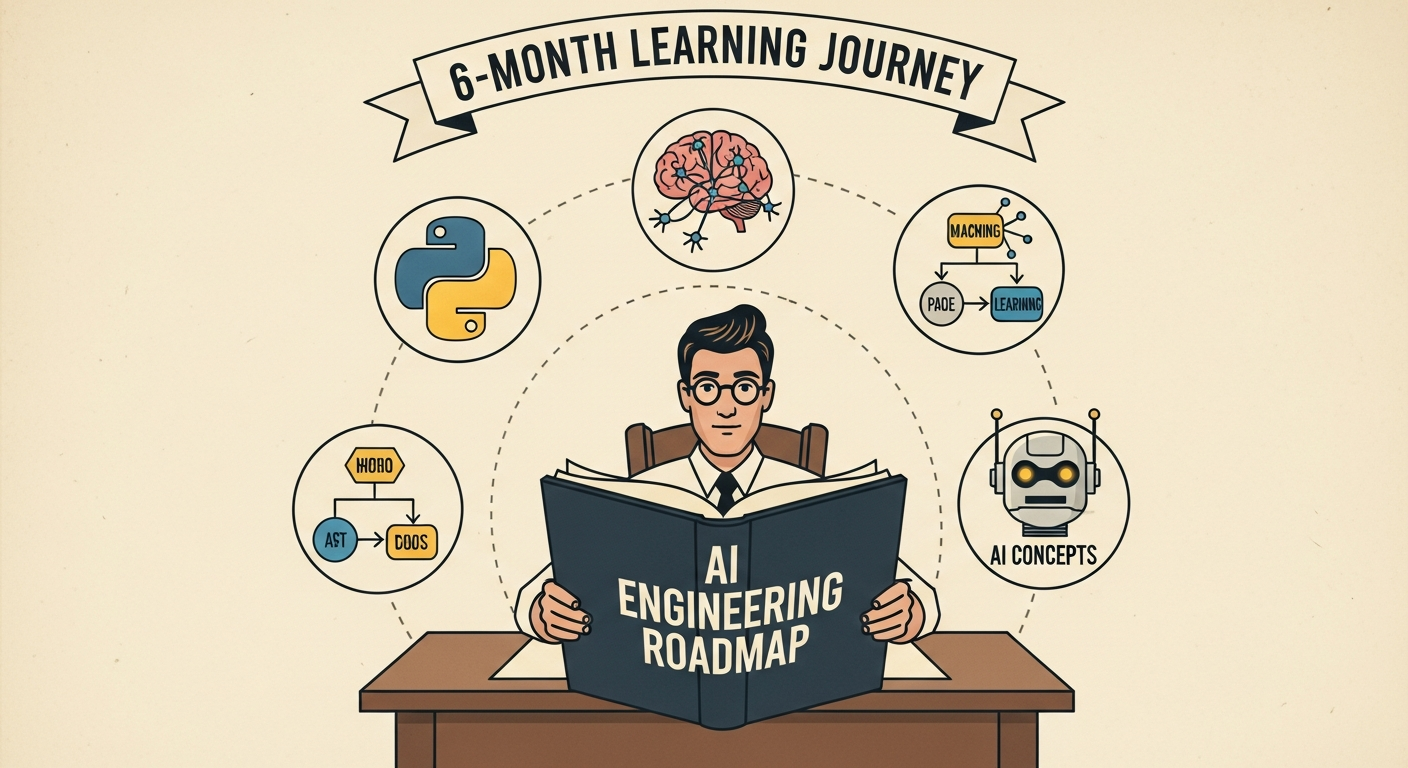
Python is the most important of all programming languages for ai engineering. This is because it has strong libraries like TensorFlow and PyTorch. When you want to work in this field, you should have key technical skills. These skills are knowing about machine learning, deep learning, and data structures. It is also good to know how to get data ready and check how well a model works.
Are certifications necessary for beginner AI engineers?
You do not have to get a certification to be an AI engineer, but it can help. A certification from a good online course or site can show you have knowledge in machine learning and data science. This can make your resume better when you apply for jobs. But, having a strong set of real projects you have worked on is usually more important to employers.
What are the best ways to gain hands-on experience for AI engineering jobs?
The best way to get practical experience in machine learning is to build a project portfolio. You should work on projects from start to finish where you build and put machine learning models into action. It is also a good idea to help out with open-source AI projects. You can join Kaggle competitions, too. These steps let you use best practices and make your ai engineering skills stronger.
How to Go From Software Engineer to AI Engineer in 2026? - YouTube
To transition from software engineer to AI engineer by 2026, focus on mastering AI fundamentals, programming languages like Python, and machine learning frameworks. Enroll in online courses and engage in hands-on projects. Networking with professionals in the field can also provide valuable insights and opportunities for growth.