







.png%3Falt%3Dmedia%26token%3D2585c100-174c-42f1-9ecf-32b27261aeb8&w=3840&q=75)
Comprehensive Python Interview Questions for All Levels
Key Highlights
This comprehensive guide covers Python interview questions for beginners and experienced developers in 2026.
You will review python basics, data types, OOP, exception handling, and python code used in technical interviews.
The article explains coding problems often asked in data science, web development, and AI interviews.
It also covers SQL databases, machine learning, deep learning, and data analysis topics.
You will get practical interview preparation tips, common mistakes, and project ideas that strengthen job readiness.
It also connects Python skills with career growth and AI-focused roles.
Introduction
Python is often a part of interview questions. This is because it is easy to use, quick to write, and good for many different jobs. You will find it in backend jobs, automation, testing, and all types of data science interviews. If you want your first job or want to try a new career, this guide will help you go over the important topics. You will see each main idea in simple words, from a basic python function to coding tasks. This will help your practice be useful and clear for 2026.
Comprehensive Python Interview Questions for All Levels
 This guide is made to help you with strong interview preparation. It has many types of questions that ask about core concepts like syntax, data structures, OOP, debugging, databases, and AI. You will find out what interviewers look for and how you can explain your ideas in python code the right way.
For data science jobs, most basic coding questions focus on strings, lists, dictionaries, loops, functions, NumPy, Pandas, data cleaning, and easy problem-solving. This mix lets you get ready for rounds for both new people and for those with more work time. Let’s go over the basics first. Then we will move step by step and cover more as we go.
[Keywords: data science, data structures, python code, interview preparation, comprehensive guide, variety of questions, data cleaning, core concepts]
1. What is Python and why is it popular for coding interviews?
Python is a popular, easy-to-read programming language made by Guido van Rossum. He released it in 1991. People like it because the syntax is simple, so you do not need to write a lot of python code to get things done. This makes it easier to learn than most other programming languages.
Python comes up a lot in interview questions. You can fix problems fast and share your logic in a simple way. Many jobs use it for web development, data science, machine learning, Artificial Intelligence, and automation. That is why companies pick it in technical interviews to test how good you are at coding.
Today, the job market values python skills. If you do well in technical interviews, you get more chances at work in developer, analyst, and AI roles. If you write clear answers and talk about how you solve things, that gives you a big edge over other people who apply.
2. What are the key features of Python basics every candidate should know?
When interviewers ask about Python basics, they want to check if you understand how it works when you use it. Python is an interpreted language. You do not need to compile it. It allows modular programming, so you can break your code into parts. It is good at handling many jobs with its clean way of writing. It is also a language where types are checked during use, so you do not tell Python the type before you run your code.
A good answer should talk about these points:
Python supports many built-in data types like list, tuple, dict, set, and string.
A python function is simple to make and to use again.
There is support for OOP, modules, packages, and exception handling.
It can be used for scripting, web apps, data science, and system design.
If you are new to getting ready for questions, start with Python syntax, variables, loops, functions, and try some small coding jobs. Then move to OOP, data structures, and how to find and fix issues. This will help you learn at a good pace and make things clear for you.
3. How does Python differ from other programming languages in technical interviews?
Python is special in technical interviews because you can spend more time on your logic and less time worrying about long lines of code. When you compare it to other programming languages, Python is easier to read and quicker to write. This is a big help when you need to answer interview questions in a short amount of time.
From the technical side, python source code gets changed into bytecode. Then, the python interpreter or a virtual machine runs this code. Some types of Python, like PyPy, use something called JIT compilation. This means Python acts like both a compiled and an interpreted language. It is useful to talk about this in deeper rounds of interviews.
Interviewers do not just look for the right answer when they ask coding questions. They want to see how you think, use data structures, break down a problem, and talk about your choices. Using Python, it is easier for them to see your thought process because the code looks simple and clear. This helps them understand and test your logic, which is what they want in technical interviews.
4. Explain the difference between Python 2 and Python 3.
Python 2 and Python 3 are two major types of the python language. If you get asked about them in an interview, the best choice is to say Python 3 is now the main standard. Python 2 is old and not used. Most companies want you to write a python program in Python 3.
Here are some main differences:
Python 3 uses better syntax and updated code rules. This helps people write simple and clean python code.
The range tool in Python 3 works better and faster than how it did before in Python 2.
Python 3 can handle both text and byte stream better.
There is also the problem of mixing types of python code. If you take code from Python 2, it may not work at once in Python 3. This is because the behaviors, tools, and different objects changed in some ways. If you get asked, you should say most people now pick Python 3 for making products, using libraries, giving interviews, and working with python code. This means you know about the new practice, you use current tools, and you work safely with different objects.
5. What are variables and data types in Python?
Variables hold values that the program will use later. In Python, you do not need to say the type before you give a value. Python figures it out when the code runs. This is why people say that Python is dynamically typed. This is one of the first things you may talk about in interview questions for data types.
Python supports different data types. Some main ones are int, float, bool, complex, str, list, tuple, dict, set, and NoneType. Each type is different in how it works. For example, lists can change, but tuples and strings cannot. When you know this, you can write better and safer python code.
For interview questions about data types, try to answer in a clear way. First, say what the term means. Next, give two or three simple examples. After that, tell how it matters for memory management or how the program works. This way, you look ready and sure about your answer.
6. How do lists, tuples, dictionaries, and sets work in Python?
These are some main data structures in Python. A list is a thing that keeps items in order. You can change a list after you make it. A tuple is like a list, but you cannot change it once it is made. A dictionary holds pairs with a key and a value. A set keeps only unique items. There is no order in a set.
Here are some quick examples that can help you with interview questions:
You can update a new list by using append() or extend().
You use a tuple when you want the data to stay the same.
A dictionary is good for fast lookup when you have a key. A set is good for cutting out doubles.
In interview questions, people often ask you to share more about data types and data structures. For example, you might use a set when you need to find all the duplicates in a list. A dictionary can be used to count words. When you talk about these types and explain why you pick one for a problem, your answer will be better.
7. What is list comprehension and how is it used in coding interviews?
List comprehension is a fast way to make a new list by using another set of items. You can also use it to filter values in one simple line. The technique looks good during interview questions because it shows you know the Python style, and that you can write code that doesn’t have extra loops.
For example, instead of writing out a big block of code with a loop and then adding values to a list, you can write one short line with list comprehension. This makes your python script easy to read if you use it in the right way. You can use it not just for lists, but with sets and dictionaries.
Interviewers sometimes ask for list comprehension as it checks both your syntax and how you think:
Create squared values: [x**2 for x in my_list]
Filter odd values: [x**2 for x in my_list if x % 2 != 0]
Use list comprehension when it makes your code clear to read. If what you are doing gets too long, then writing a normal loop can be the better option during an interview.
8. What are conditional statements and loops in Python?
Conditional statements let your program choose what to do next. Loops help you repeat a block of code. You keep running the code until something changes or you reach the end of your sequence. You will see these topics on almost every interview preparation list since they are behind a lot of coding problems.
Python uses if, elif, and else when you want to check things. For repeating, you will use for and while loops. You use a for loop when you know the things you want to go through. A while loop is good when you want to keep going until something becomes false.
Keep these things in mind:
Use if to make decisions inside a python function.
Use for with lists, tuples, sets, or dictionaries.
Use while when what stops you matters more than how many times it runs.
If you want better interview preparation, go to coding sites. Try out timed problems. Take mock tests. You can use their editor to run your block of code.
9. How do you use break, continue, and pass statements?
These three statements decide how a loop or a function works in python. They may look small, but they are used a lot in interview questions. The block of code can act very different based on which one you use. So, you must know when to use each one.
Break stops the loop right away. Continue moves to the next step in the loop, skipping the current one. Pass does nothing right now but is needed when you want to keep the code valid in a python function or class, like when you are planning how the block of code will look.
Here is a quick look at what each one does:
break: exit the loop now
continue: skip this step, keep looping
pass: do nothing for now
In most interview questions, give a simple answer with one short example. The most important thing is to show that you understand how flow control works and not mix up pass with continue.
10. What are functions, lambda functions, *args and **kwargs?
A function in Python is a block of code you can use again. It does some work for you. Using functions helps with modular programming. That means you can break a big job into small, easy steps. In interview questions, they often want to see if you can write, use, and organize functions in the right way.
A lambda is a short function with no name. It has just one expression. You use it for small tasks, especially when you do not need to make a full python function. In Python, you also have args and *kwargs. These are for flexible arguments.
These are the basics you should know about:
A python function using def and can give back a value.
Lambda is good for simple, one-line work.
*args is for extra things you send to the function.
**kwargs is for extra named things you send.
If you tell about each one with a tiny example, your answer will sound real and useful. Most interviewers want to see that you can use modular programming in real code, not just talk about it.
11. Describe the scope of variables and Python modules.
Scope shows you where you can use the variables in Python. The most used scopes are local, global, module-level, and built-in. A local variable can be used only inside a function. A global name can be used anywhere in the file unless another one with the same name hides it. You often see questions about this in interview questions.
Python modules are .py files. They can have functions, classes, and variables. You use them to write code one time, keep things neat, and make their own spaces for names. Packages are folders of modules. The folder structure in packages helps big projects stay easy to work with. It also helps people avoid trouble when two or more things have the same name.
Here are two things to remember:
Local and global variables can have the same name. They do not get in the way of each other because they are in different scopes.
Python modules make their own namespace. This helps you keep your code clean and easy to use.
If someone asks, you can say clear scope management makes your code less confusing. It also helps with safer memory management as your project grows.
12. How does object-oriented programming (OOP) work in Python?
Object-oriented programming is a way to organize code by using classes and objects. A class is like a plan for your code, and an object is made from that plan. In Python, many people use OOP because it helps you show how things work in real life and lets you use the same design again.
You usually set up values in init() and write actions as methods. Instance methods use self, and self stands for the current object. In Python, you can have child classes that use or add to what parent classes do. This helps your code be flexible and simple to keep working.
Here are the main things to know first:
The class makes the structure, and the object holds the real data.
Instance methods handle values just for that object.
If you think it is all too much, try working with one class, one object, and one method. Practice how init, self, and inheritance work. It helps more to take small steps than to try to get every OOP idea right away.
13. What is inheritance, polymorphism, encapsulation, and abstraction?
These are the four main OOP ideas you will see in interview questions. You do not need to use big words. You just need to use clear meanings and one good use case with each. If you explain these things well, your answers to interview questions on OOP will be strong.
Here is a quick look at each idea:
Inheritance: a class can use features from one or more older classes.
Polymorphism: the same method name will do different things for different objects.
Encapsulation: hide the inside state and use methods to work with it.
Abstraction: show only the needed parts and hide how things work inside.
Python supports more than one inheritance for classes, method overriding to give different behavior for the same method name, encapsulation by using public, protected, and private rules, and abstraction with the abc module. You just need one clear example. For example, Dog and Cat can both have sound(), but both give different results. That shows how different objects can use the same method and still act in their own way.
14. How is exception handling done in Python?
Exception handling lets your program deal with problems in a safe way. If something goes wrong, Python can catch the error. This helps your program not crash and lets it give a better message or do something else. That is why exception handling is key in real use and in interview questions.
The most used way is with try and except. You put the code that might not work in try. If it goes wrong, except will handle the problem. You see this a lot when working with files, handling input, dealing with databases, or any python function that needs data from somewhere else.
Here are some best practices:
Catch only the things you think could go wrong.
Make sure error messages help and are easy to understand.
People who ask interview questions want to see that you don't just let things fail. When you talk about keeping things safe, logging what happens, and giving clear messages, your answer will seem real and not just about what should happen.
15. What are try-except blocks, finally, and custom exceptions?
Try-except blocks are the main way to handle problems that happen while you run python code. You put risky code in the try part. The except part is where you catch errors. They help keep your program running and let you manage problems without stopping all your work.
The finally block always runs, even if there is an error or not. People use finally for clean up tasks. One thing to know is that if you put a return in finally, it will override any other return from before. Using this trick well can help you stand out when talking to interviewers.
Here are some words you should remember:
try-except blocks are for catching and handling errors
finally is used for clean up
custom exceptions let you set your own error names for your app
Custom exceptions are good when normal names for errors do not help. They make python code easy to follow and they also make it easier to fix problems in bigger systems.
16. What are common Python coding interview questions and solutions?
Many common Python coding interview questions check simple logic before moving to hard topics. You often get questions about strings, loops, working with lists, fast lookup, recursion, and sorting. These types of problems are asked in interviews for new jobs, backend jobs, and also for data-related roles. This is because they show your basic way to solve a problem.
Interviewers are not just checking if your python code works right. They like to see the way you organize your code, your style for naming things, and how you handle tricky cases or mistakes. They also look for clear answers. For some jobs, your code even tells them how you think about system design. They want to see if you use clean functions and write logic you can use again.
Here are some normal interview questions:
Reverse a string
Check if a string is the same forward and backward (palindrome)
Find repeated items in a list
When you do well with these, you can try harder ones. Try to write code for finding Fibonacci numbers, checking if numbers are prime, counting with a dictionary, and using basic data structures. You see those same types of coding questions a lot, so the more you practice, the better you get.
17. How to reverse a string and check for palindrome in Python?
A lot of interview questions ask you to work with strings. One of the most common tasks is to reverse the text or check if the text reads the same way forwards and backwards. These interview questions are popular because they look at how well you know how to use indexing and slicing in Python. They also test if you can do simple checks without needing big logic in your code.
In Python, you can reverse a string by using slicing. If you need to check if a string is a palindrome, you can just see if the string is the same as its reversed form. This method is short, easy to understand, and great for any beginner who wants to write a python script in an interview.
You can use these simple steps:
Reverse a string with s[::-1]
Check palindrome with s == s[::-1]
When you give your answer, first share how you will solve the problem. This helps the interviewer know your thought process. You should also talk about edge cases. For example, what will your code do with an empty string or one that uses both capital and small letters? If you do this, your answer to these interview questions will look even better.
18. How to find duplicates in a list and generate a Fibonacci series?
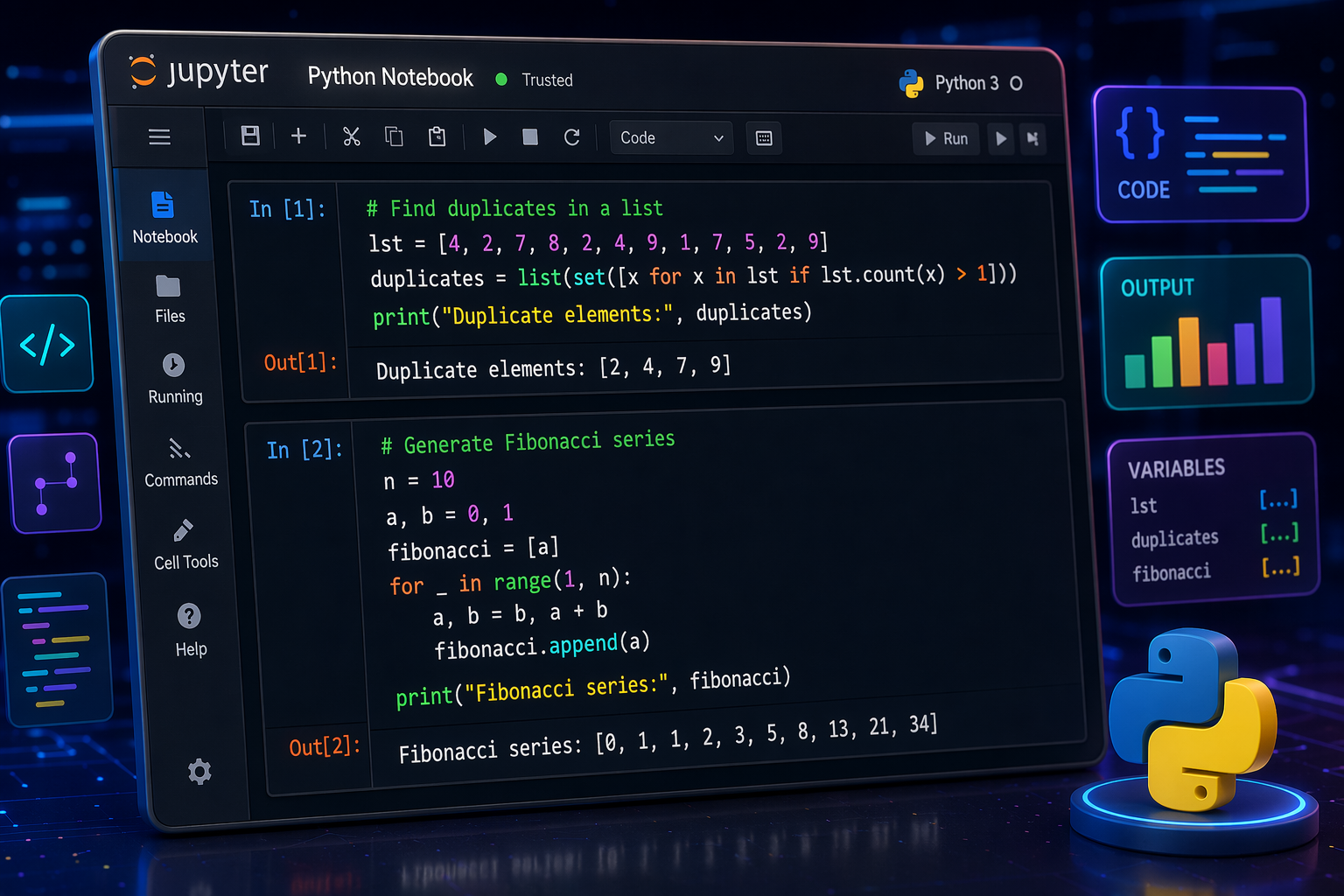
These are two interview questions that people ask a lot. Finding duplicates helps an interviewer see if you know how to use sets or simple dictionaries in python code. Making the Fibonacci numbers checks if you can use loops, update variables, or use a generator. These two questions might look easy, but they show how you think about each step.
The set is a quick way to check for repeats because a set has only single values and leaves out any extras. When you need to make Fibonacci numbers, you can use a loop, or you can use a generator with the keyword yield. The generator is good because it gives out numbers one by one. You do not have to keep the whole new list in memory at once.
Here’s a simple way to do both:
Duplicates: you can look at how many items are in the original list and compare that number to how many are in a set, or you can keep track of what you’ve seen so far.
Fibonacci: you can keep two numbers and update them again and again, or you can use yield in a generator to get one number after another.
You should always say why you picked a way to solve the problem. This is just as important as getting the python code right.
19. How are sorting algorithms implemented in Python?
Sorting algorithms come up a lot because they check if you know logic, loops, swapping, and how long things take to run. If you are in a python interview, you may have to talk about built-in ways to sort, or you might need to write something easy (like bubble sort or insertion sort) by hand. These questions are asked to see things explained clearly, not to see a fancy trick.
Python lets you sort with sorted() or list.sort(), but you still might get asked about how these work behind the scenes. This helps the interviewer find out if you know how sorting with comparisons happens. Even though you will use built-in tools in real python code, knowing how sorting works is good for when you need to solve a problem.
Some things you may see in these interviews:
When should you use sorted() and when to use sort()
How do loops inside loops work when building a small sorting algorithm
Why do most python codebases use built-in sorting
If you write your own code to sort, focus on making your python code simple and easy to read. Talk through each part. This is often all you need to do well in the interview.
20. Explain stack, queue, linked list, hash table, and heap in Python.
These data structures appear in coding rounds because they test how you organize data and choose the right tool. Interviewers may ask for definitions, real uses, or small coding tasks. A good answer is simple: say what it does, how it behaves, and where you would use it.
Here is a quick text table you can remember:
Data Structure | Main Idea | Common Use |
|---|---|---|
stack | Last in, first out | Undo, backtracking |
queue | First in, first out | BFS, scheduling |
linked list | Nodes connected by pointers | Insertions, cycle checks |
hash table | Key-value mapping | Fast lookup |
heap | Priority-based tree structure | Top element retrieval |
Detailed answer examples include using a queue for level-order tree traversal, a hash table for counting items, or slow-fast pointers to detect a linked list cycle. That is exactly the kind of explanation many interviewers want.
21. What are decorators, generators, iterators, and context managers?
These are advanced Python topics, but interview questions often focus on the main ideas in a simple way. You should know what each topic does and why it helps. If you keep your explanation about how people use them, even a tough topic is not hard to talk about.
Here is the short meaning of each:
decorators add something extra to a function without changing how it works at the core
generators give you values one at a time with yield
iterators need iter() and next()
context managers look after setup and cleanup, usually with with
You will want to use generators and iterators when dealing with memory is important. Decorators make it easy to use the same logic with more than one function. Context managers show up a lot when working with files because they handle clean up for you. If you tie each idea to a real use case, your answers during interview questions will sound more clear and sure.
22. How does multithreading and multiprocessing work in Python?
Python lets you use both multithreading and multiprocessing, but these work in different ways. In CPython, there is something called the Global Interpreter Lock. This lock lets only one thread run Python bytecode at one time. Because of this, multithreading does not help much with tasks that use a lot of CPU.
Still, multithreading is good for I/O work. This includes jobs where your code waits for files, the network, or a database. On the other hand, multiprocessing starts new processes. This way, you can use more than one CPU core at the same time. So, it helps when you need real parallel work. You will see these types of interview questions often, especially for those with more experience.
Here’s the main idea:
multithreading is good for I/O-bound tasks
multiprocessing is good for CPU-bound tasks
Just saying a bit about the GIL is usually enough. That shows you know the reasons for your choice, and you know how Python works in real life with these interview questions.
23. How does Python integrate with SQL databases?
Python is good for working with SQL databases. That is why you see the topic many times in interview questions for developer or data science jobs. You can talk about how Python connects, sends queries, or gets data from tables. It's best to keep your answer short and clear.
Most of the time, you will use a database library in Python. The library lets you make a connection, send SQL commands, and get answers from the database back into your Python code. People use it for CRUD jobs, reports, tasks that run without people, and data checks. You'll often find this in backend code and in jobs where you move data to or from other places.
There are two main points to make:
Python can connect to many SQL databases like SQLite and MySQL
Python is used a lot for CRUD (create, read, update, delete) jobs and for working with data
If you can tell about how python code connects to tables and brings back the results, that is usually enough for beginner or mid-level interview questions in data science.
24. Describe SQLite and MySQL connectivity in Python.
SQLite and MySQL are both types of relational databases, but they each serve different needs. SQLite does not take up much space and is mainly used for local apps or for testing things in a quick way. MySQL is more like a big server and it’s used more in large apps. When you go to interviews, interview questions often ask you which one you should pick and why.
In Python, you can connect to both databases using connectors. The way you use them is the same most times. You make a connection, start a cursor, run your SQL commands, get back what you need, and then close the connection. You will see this flow many times, so make sure you get good at working with small inserts and queries. Practicing this will help you with interview questions.
Here is the key difference you need to know:
SQLite is easy to use and all the data is kept in one file
MySQL is set up as a server that you often see with bigger projects
If you can talk about this process well and show small python code examples, you will be able to answer most database interview questions with confidence.
25. What are ORM concepts and CRUD operations using Python?
ORM concepts let you work with records in the database as objects. This means you do not need to write raw SQL for each job you have. You’ll find this helps a lot in web projects and business apps. In interview questions, people often talk about ORM when they want better app structure and faster work.
CRUD is short for Create, Read, Update, and Delete. These are the basic things you do with a database. This does not change, whether you write raw SQL or use an ORM. Python code uses CRUD as a base when there are forms, dashboards, APIs, or when you want to give people reports.
Here are the main points:
ORM connects tables to objects
CRUD is about doing main work with records
python code is simpler and you can reuse it
If you want a good short answer, talk about both together. This shows you know what the theory is and also how python code often runs in real life when you build apps.
26. How is Python used for Data Science interviews?
Python is one of the main choices for data science interview questions. The reason is you can do cleaning, analysis, modeling, and scripting with python code all in one spot. Interviewers often ask about basic python syntax, top libraries, and how you would take data and work with it step by step.
Most companies will test you by asking practical data science interview questions. You may answer questions on lists, dictionaries, missing data, NumPy arrays, Pandas DataFrames, and simple data changes. Some places also want to know how Python is used with big data or for reports. They look for clear answers as much as good code.
Here is what you should be ready for:
Data cleaning and handling using Python libraries
Simple analysis work in a data science interview
If you learn both basic coding and how to use main libraries, you will do well on most data science interview questions at many companies.
27. What are NumPy, Pandas, and DataFrames?
NumPy and Pandas are two important Python libraries for data work. NumPy is best when you want to work fast with numbers, like when you need a numpy array. You can use Pandas when the data is in rows and columns, and you care about both. Pandas’ main table is called a DataFrame.
In job interviews, they often ask what NumPy and Pandas are for. You do not have to give a long answer. You can say that NumPy is good with arrays of numbers. Pandas helps with table data, which is helpful for data analysis and reports.
Here is a simple way to say it:
NumPy is used for fast operations with arrays of numbers.
Pandas is great for working with table data.
DataFrames in Pandas help you work with rows and columns when doing data analysis.
If you give a simple example, your answer gets better. For example, you can read a CSV file into Pandas with pd.read_csv(), or filter rows in a DataFrame by doing this: data[data["age"] > 30].
28. How is data cleaning and analysis performed in Python?
Data cleaning is when you fix messy data sets before you do data analysis. In Python, the work often is about filling in missing data, looking at data types, removing any rows or columns that show up more than one time, and making each column ready to use. People ask about this in interviews because work in data science starts with clean data. It’s not just about building models.
After data cleaning, you use data analysis to look for values, trends, or patterns. You might sum up numbers inside columns, put items into groups, or look at how data is spread out. The tool that is used most often is Pandas, because this tool keeps the steps clear and easy to see in python code.
Good tricks to follow are:
do simple cleaning tasks by using CSV files and DataFrames
say each thing you do out loud, instead of only showing the final answer
Doing it this way helps you do well in coding interviews. It makes you better in your thinking, the way you talk about the work, and how you use data science tools and libraries.
29. How is Python used for Machine Learning and AI interviews?
Python is very important in data science, machine learning, and deep learning interviews. This is because it lets you do data work, build models, and run tests all with one tool. In a data science interview, you might get asked about how Python helps with training your models, testing how well they do, and picking which parts of the data to use.
Most questions will not just be about the code or the language. The interviewers want to see if you can start with clean data and build a pipeline that is ready for a model. You should be able to do simple data steps, run training, and know what to do about things like overfitting or picking the right data points. Python makes all these tasks easier with its many helpful libraries.
You should get ready for questions like:
machine learning libraries and workflows
python code you use for training or testing models
If you can show how you use data, build a model, and get results at the end, you will do well with machine learning or data science interview questions.
30. Describe Scikit-learn, TensorFlow, and PyTorch applications.
These three libraries often come up in interview questions that are about AI. All of them help people work with models, but they get used for different things. When you answer questions about them, you can stay general unless the person interviewing you wants more detail.
Scikit-learn is mostly used for machine learning that is not deep learning. TensorFlow and PyTorch are used more for deep learning work. When you are asked about them in interviews, share which type of project each library is built for, and the way they fit into a workflow.
A quick summary is all you need:
Scikit-learn: classic machine learning models and things you do before training
TensorFlow: deep learning and building models
PyTorch: deep learning with models you can adjust and work with easily
You do not need to know every API by heart. You just need to show the person who is asking that you know which tool to use for each job in Python AI work and in machine learning or deep learning projects.
31. What is model training, feature engineering, and overfitting?
Model training is when you teach a model from data, so it learns what to do when it sees new things. Feature engineering is when you make or pick the best columns of data to help the model learn better. These topics come up a lot in interviews. They help you get good results before you even see what the model learns.
Overfitting is when a model learns the training data too well. This means it does not work well on data it has not seen before. You can say it this way: the model remembers the answers it saw in training but does not know how to handle something new. If you say this in an interview, it shows you get the basic ideas.
Here are three simple ways to explain these words:
model training: fit the model on data
feature engineering: improve input variables
overfitting: strong training performance, weak real-world performance
If you talk about these ideas using python code and show how you prepare data, your answer will work well in a job interview.
32. What are the best Python coding challenges for practice?
The best coding challenges for interview questions are the ones that let you practice common patterns. Start by working on strings, lists, loops, dictionaries, and sorting problems. When you get used to these, move to recursion, linked lists, queues, and ways to go through trees. This will help you focus your study time and keep you on track.
A good way to get better is to start with easy questions. Repeat them until you can say the logic out loud with no trouble. After you get faster with those, take on the medium ones. The main point is not just to write python code, but to teach yourself how to break down any problem under time pressure.
Some good practice types are:
easy: reverse string, palindrome, duplicates, Fibonacci
medium: cycle detection, cache design, BFS, nested dictionary flattening
This plan helps you get better step by step. You won't get lost or jump to problems that are too hard, too fast.
33. Where to find easy, medium, and advanced Python coding interview questions?
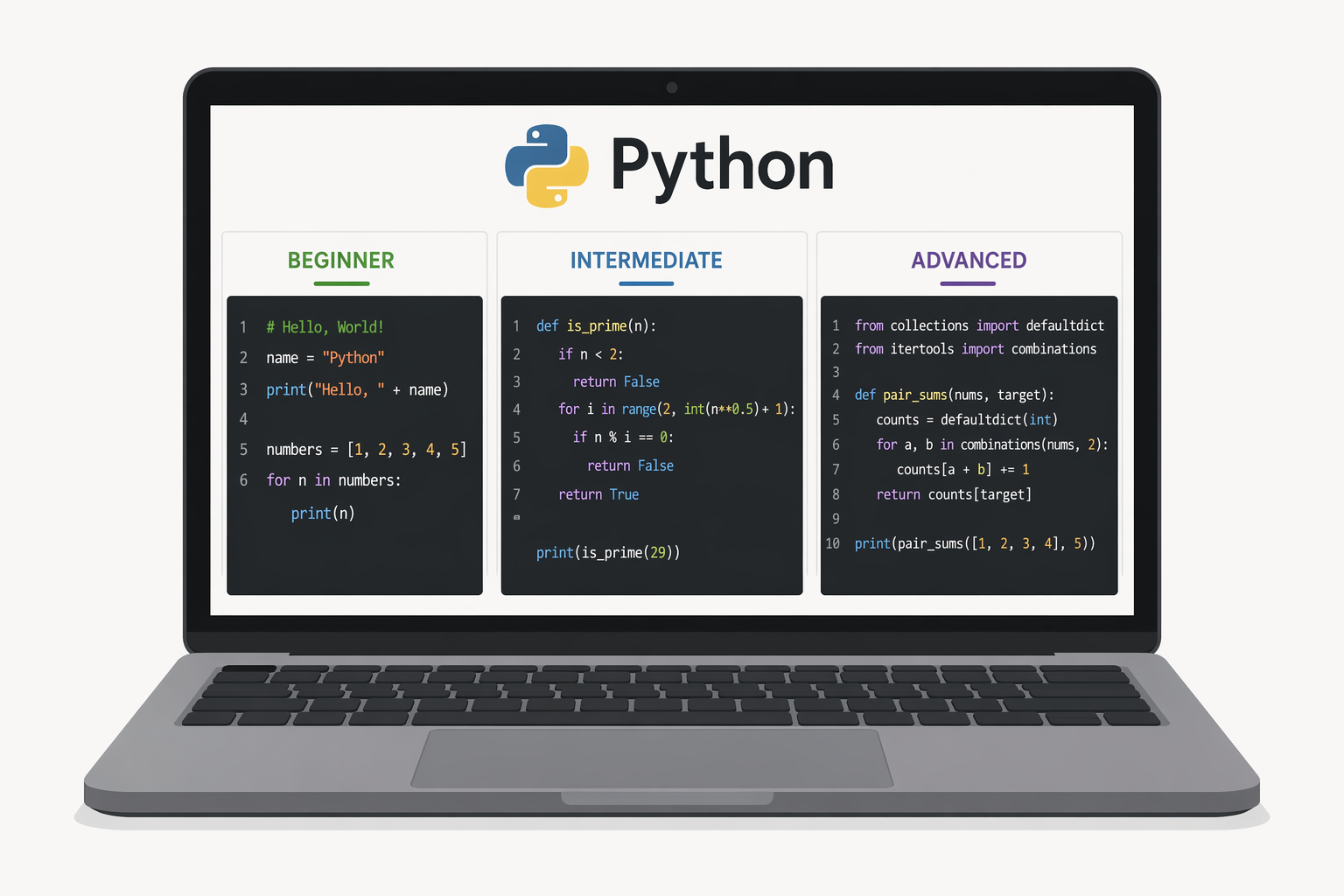
You can find interview questions about Python on coding practice sites, interview prep websites, and challenge libraries. These places often sort problems by topic and how hard they are. Good sites put challenges into basics, data structures, libraries, and harder topics like generators or decorators.
It is helpful to sort problems by level. Easy Python questions help you pick up speed and feel more sure. Medium ones help you get better at logic and see patterns. Harder questions make you think deeper and write better code. This setup lets your practice be focused, not out of order.
Try to find sources that give you:
topic-wise interview questions
timed challenges where you can code right there
explanations for the python code and tricky test cases
Using these will make your interview prep more real. It helps you see what you get stuck on, like loops, OOP, debugging, or working with data structures.
34. What are common mistakes made during Python interviews?
Many people make mistakes during interviews because they don’t practice the right way. It’s not because they don’t have talent. Some learn answers by heart but can’t get a python function to work. Some know the words to use in code but cannot say why they picked one way over another. In a data science interview, being good at coding is important. The way you explain your work is just as important.
Another thing to watch for is skipping tests and checks. It stands out when someone writes code fast but doesn’t test different inputs, empty values, or small errors. In a data science interview, not knowing object-oriented ideas well can make answering tough questions harder.
Watch out for these mistakes:
memorizing without coding practice
weak OOP and debugging skill
no project examples to discuss
If you stay away from these, your interview will go much better. Talk through problems, test what you write, and link your answers to your own work in data science.
35. How can Python projects strengthen your interview performance?
Python projects show that you can use ideas, not just say what you have learned. When it comes to interview preparation, this is very important. Projects let you talk about how you made things, dealt with bugs, used tools, and got results. This makes your answers stronger in any developer or data science interview.
Recruiters often like to see things such as a web scraper, chatbot, automation tool, or something for data analysis. These projects show that you know how to use Python in real life. It does not even have to be a hard project. If you know your project well and can talk about why you made each choice, it can help you a lot.
Strong projects include:
automation, web scraping, or scripting tools
data analysis or machine learning tools
When you talk about a project, be sure to tell the problem, how you worked on it, and what you got in the end. This shows you think through things for real, and that is something interviewers like a lot. It will help you for both developer and data science interviews.
36. What do recruiters expect from Python-based AI interviews?
Recruiters want candidates for Python-based AI roles to understand both the basics of programming and how to use that in a real project. In a data science interview, they check if you write clear code and handle data well. They also like to see that you know about many libraries and can talk about how a model pipeline works in easy words.
Python skills are a must for Data Science and AI jobs. Recruiters look for Python knowledge to see if you are ready for these roles. Python helps a lot with things like cleaning data, training models, automating steps, and running tests. You do not have to know everything about Python, but you should feel good using the key features and popular libraries.
Most recruiters want to see:
strong basics in Python, working with data, and good at solving problems
some experience with AI or machine learning workflows
If you can show how Python connects to real model projects and talk about your process in a clear way, you are giving recruiters what they want in a data science interview.
37. What is a Python interview preparation checklist for India in 2026?
A good interview preparation checklist can help you stay on track with your study. Try not to jump all over the place. Go over topics in layers. Start with python syntax and built-in features. Next, work on OOP, data types, data structures, exceptions, databases, and topics about AI. When you can, match what you practice with the job description.
Get some projects ready and be able to explain your design choices in simple words. Recruiters will want to know what you made, what did not work, and what you learned from it. This is just as important as writing a correct python function during a test round.
Use this checklist:
revise python basics, data types, OOP, and scope
solve coding problems daily
review projects, GitHub work, and resume points
prepare for role-based topics from the job description
If you are looking for things like ai courses in hyderabad or a data science course in hyderabad, make sure your interview preparation is hands-on and comes with real projects.
38. What are top Python career opportunities and salary trends in India?
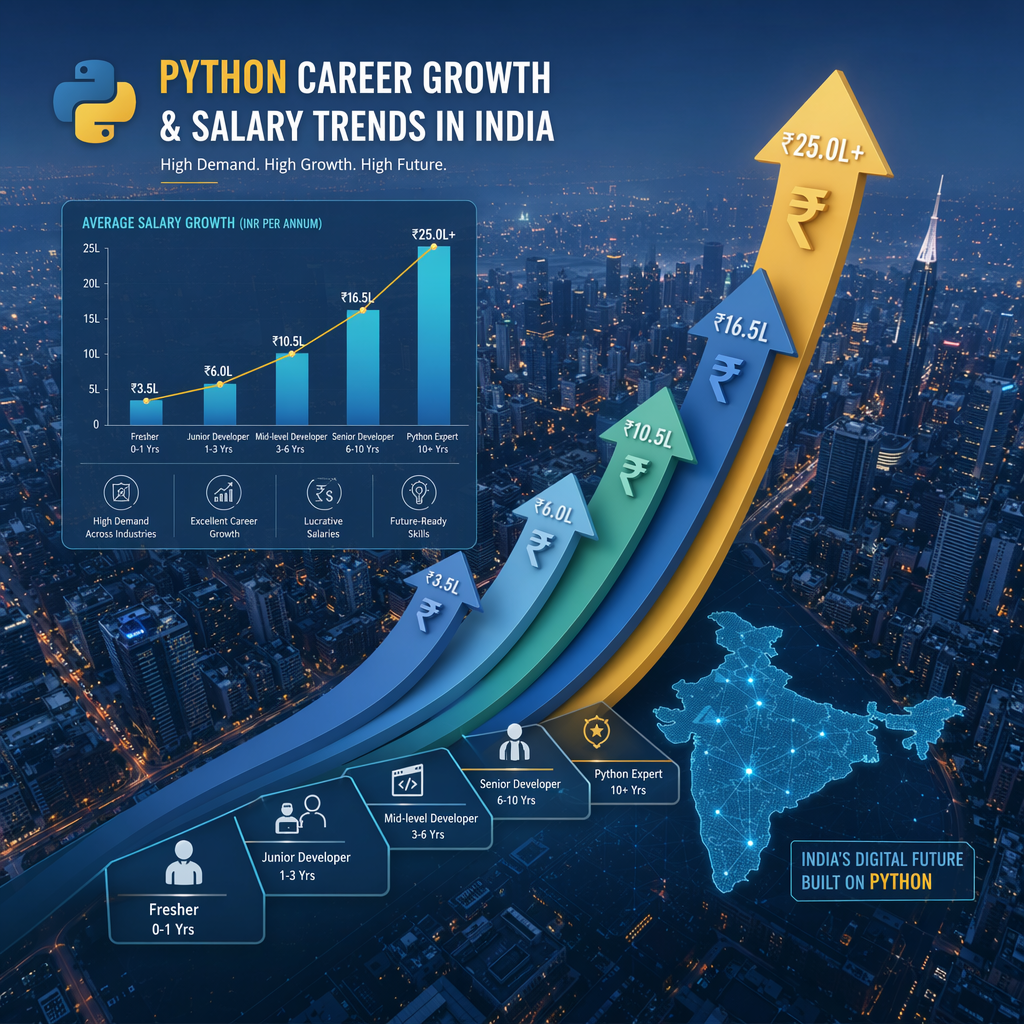 Python gives people the chance to work in many fields. It is used a lot for software, automation, analytics, AI, and backend development. You can find jobs like Python Developer, Data Analyst, Data Scientist, Machine Learning Engineer, AI Engineer, and Backend Developer. That is why there is always strong demand for these jobs in India.
The facts show there is more need for Python developers in India and even in other parts of the world. Companies want to hire these workers, and they often give good perks and benefits. When you go to an interview, try to talk about how your skills match the job more than talk about average salary numbers, unless they ask for it.
Popular roles are:
Python Developer and Backend Developer
Data Analyst and data scientists roles
Machine Learning Engineer and AI Engineer
If you are thinking about options like a machine learning course in Hyderabad or an AI engineering course in Hyderabad, you should add coding work and hands-on projects to help you learn better.
39. What are actionable tips for getting hired faster in Python roles?
Getting hired faster comes down to a few key things. Make sure you have strong basics, practice coding over and over, and show how you use what you know. For your interview preparation, write clear python code, explain your work in simple words, and create small projects. These projects should use modular programming and show you can solve problems.
AI-powered tools can help you do better in coding interviews if you use them in the right way. The tools can suggest patterns to practice, explain what went wrong, and help you review important ideas. But they should help your work—not do it for you. Interviewers want to see your own thinking and how well you can do things on your own.
Keep these tips in mind:
focus on the basics first, before moving to harder topics
practice coding every day and try out tough test cases
build projects around data science, AI, or automation
Many people look for paths to learn such as generative ai course in hyderabad, ai developer course in hyderabad, ai training institute in hyderabad, and ai engineering institute in hyderabad.
Conclusion
To sum up, doing well in Python interviews means you have to know the basics of the language, how it is used in data science and AI, and have strong coding skills. When you practice answering interview questions, from simple to hard ones, you get the knowledge you need for these interviews. You should also work on real projects and solve real coding problems. This gives you good, hands-on experience. If you need some help on your journey to master Python for your job, just ask for support. Get a free consultation today. It can help make your preparation better and boost your confidence for your next interviews!
Frequently Asked Questions
1. How important are Python skills in coding interviews for Data Science and AI jobs?
Python skills are very important for interview questions in data science and AI jobs. Teams use python code to clean data, look at results, build models, and do simple tasks. In a data science interview, the things you know about python will often be checked against the job description. If you know python well, you can stand out from other people.
2. Can AI-powered tools help improve my Python coding interview performance?
Yes, the AI-powered tools help you practice interview questions. They tell you about errors, show you patterns, and help you go over python code. These tools can help with AI questions in a data science interview. This includes topics like logistic regression. But you still have to practice coding yourself if you want to do well.
3. What is the best way to structure answers during a Python interview?
For Python interview questions, start by explaining the idea in one line. After that, show a small example or block of code to help make it clear. Next, talk about why this is important in a python script or for interview preparation. If needed, discuss trade-offs or how the idea connects to system design. This will help your answer be complete and easy to understand.