





.png%3Falt%3Dmedia%26token%3D975efbf1-e304-4f9e-befd-f072cc275853&w=3840&q=75)
How AI Performance Marketing Transforms Your Ad Strategy
Key Highlights
AI performance marketing uses machine learning to improve campaign performance with less manual work.
It helps you make faster ad optimization decisions using real-time performance data.
You can reach better audience targeting groups instead of using broad traditional methods.
AI tools improve bidding, creative testing, and budget control across digital marketing channels.
Businesses use AI to raise conversion rates, lower waste, and get higher ROI.
Human oversight still matters because strong strategy and creative quality drive better results.
Introduction
Artificial intelligence is changing the way you do digital marketing. In performance marketing, AI helps you look at data faster. It lets you get better at finding the right people and change your campaigns while they are running. This means you do not waste ad spend, and you can focus on the things that really bring good results. You do not need to guess anymore. You use real signals from real people and real actions to know what works. If you want an easy way to see how AI in performance marketing works, this guide will show you the basics in a simple way.
AI Performance Marketing – Quick Overview
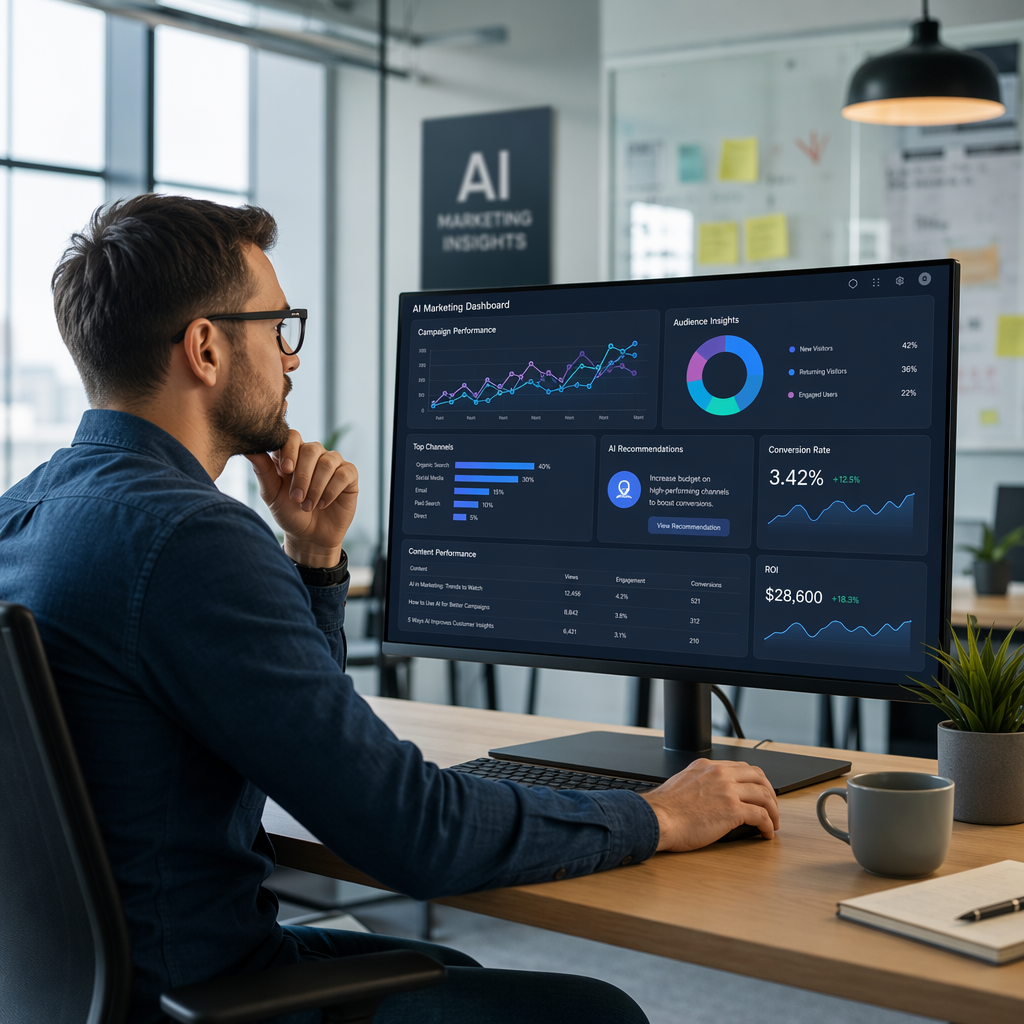 AI performance marketing means using AI systems to help your marketing campaigns by looking at performance data. To put it simply, AI checks what is working and what is not working. It also shows you where your ad spend should go next.
AI also helps with audience segmentation and uses predictive analytics, so you can show better ads to the right people at the right time. Because of this, many businesses now use AI to work faster, reduce waste, and make better decisions for their campaign from the start.
What Is AI Performance Marketing and Why Is It Important for Indian Businesses?
AI performance marketing means using artificial intelligence to get better results in performance marketing across digital channels. The tool helps you make choices using data, not only your feeling or guesswork. The main aim is clear. It is to get more customers while keeping your costs down.
For Indian businesses, this is big because there is more and more competition on marketing channels now. Brands need better ways to follow what people do, know how customers act, and move fast. AI can go through lots of data and then give you the right steps to take for your business goals.
This is important because speed, targeting, and getting measurable results now matter more than ever. It doesn’t matter if you run a startup, an agency, or a local brand. AI helps you improve your campaigns and reach your customers, without wasting time on manual processes. You can now work faster and even get better output.
How AI Drives Ad Optimization and Campaign Success
Machine learning is at the heart of ad optimization. It looks at how your campaigns do, checks for patterns, and reacts much faster than if you did it by hand. That is why AI is changing the way people manage paid ads now.
You get the value of AI in real time. You do not have to wait for weekly reports. It uses advanced analytics to change bids, fine-tune your targeting, and move your budget around while your ads are still running. This helps save spend and make campaign performance better.
Some ways AI helps your campaign success are:
changing bids when the chance of a sale goes up,
finding audience segments that react well,
testing different ads fast,
and moving budget from weak spots.
So, that is how AI turns more of what you spend into campaign results you can measure.
Key Benefits of Adopting AI Performance Marketing
One big plus of AI in performance marketing is speed. AI looks at a lot of data analytics way faster than people can. This lets you change things that help your results, and you do this fast.
There is also better efficiency. Businesses that use AI often see higher conversion rates. They waste less ad spend. These steps help push for a higher ROI. Since AI keeps learning from each result, it gets good at finding patterns that lead to better, measurable results.
Key benefits include:
stronger audience targeting,
faster campaign adjustments,
lower wasted ad spend,
improved reporting clarity,
more competitive advantage.
For brands that want to grow, this mix makes a real difference. You can see what works and act on it before the market moves again.
Quick Comparison Table: AI vs Traditional Performance Marketing
The biggest difference between AI marketing and traditional methods is adaptability. AI reacts to signals while campaigns are active. Traditional marketing often depends on manual processes, delayed reports, and broad targeting choices.
That changes how marketing campaigns perform. With AI, campaign optimization happens faster and with more precision. Traditional approaches still help with brand building and emotional storytelling, but they usually cannot match the speed of machine-led adjustments.
Area | AI Marketing | Traditional Performance Marketing |
|---|---|---|
Targeting | Uses data and audience signals | Often broad and less precise |
Optimization | Real-time changes | Slower manual updates |
Reporting | Clear performance tracking | Harder to measure directly |
Budget use | Dynamic allocation | Fixed plans and slower shifts |
Scale | Handles many campaigns easily | Needs more human effort |
Fundamentals of AI Performance Marketing
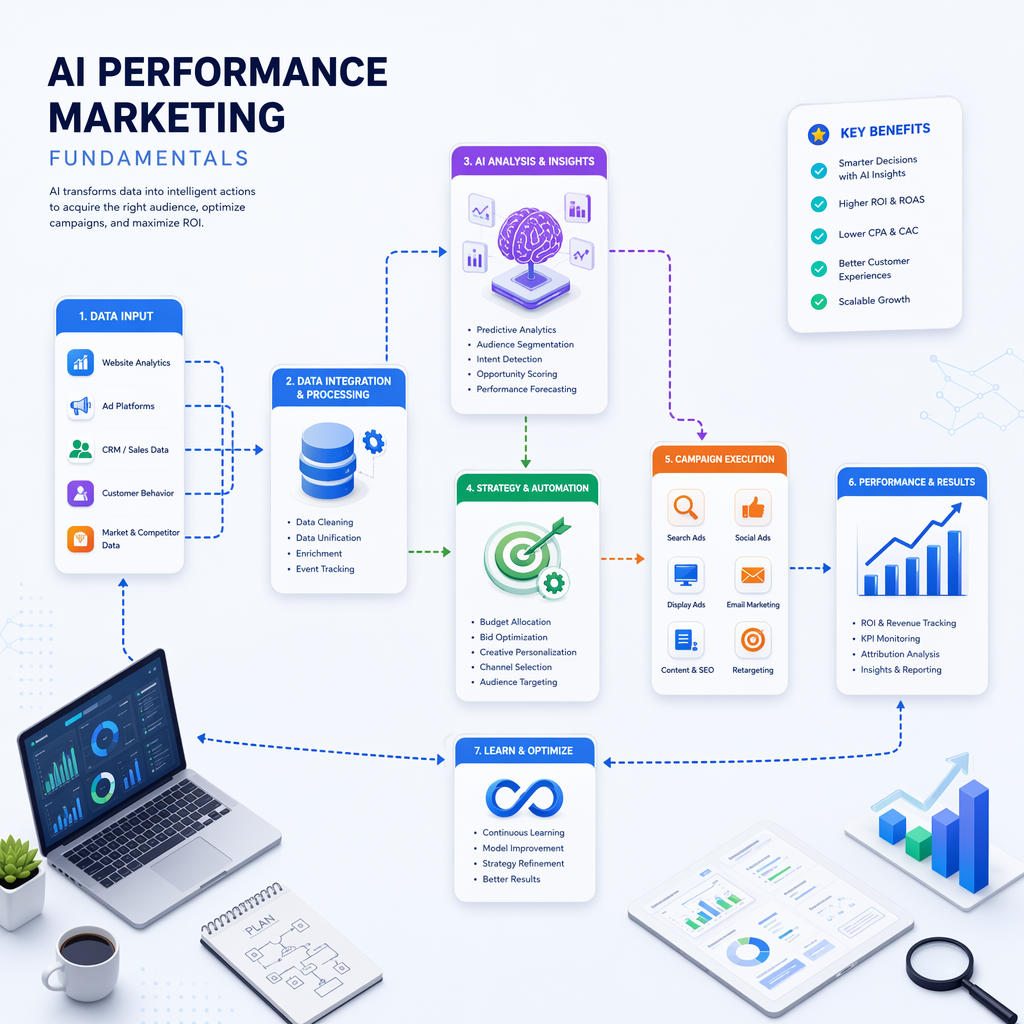 To understand performance marketing that uses AI, you have to start with the basics. AI looks at performance data. It finds patterns in this data, and helps make your marketing campaigns better. You do not have to wait for long review times. AI works best when there is enough data you can trust to make good choices.
Machine learning can help you test ad copy. It can shift your budgets and build better audience segments. It does not take over your whole strategy, but it gives you a smarter system to use each day. In the next parts, you will see how this change came, and why marketers use it now more than before.
The Evolution of Performance Marketing in India
Performance marketing in India has changed a lot because more businesses now use digital platforms. In the past, many brands in India would use traditional marketing to grow. They chose things like print ads, broadcast media, and large traditional campaigns to get more people to know about them.
These old ways still help to build trust and show that a brand is real, but there is now more focus on digital growth. People working in marketing want fast feedback, better targeting, and a stronger link between what they spend and what they get back from campaigns. This has pushed Indian businesses to look for tools that let them keep track of what people do online.
Today, most modern brands use AI for better targeting. They can test their creative ideas faster and use live results from a campaign to pick the best media buys. This change in performance marketing does not mean brands stop using traditional marketing or print ads. It means they try new systems that help people make better use of their time and money. So, performance marketing is now about being more flexible and getting clear results, especially in a market with lots of competition.
AI-Powered Campaign Management Explained
AI-powered campaign management is when you use AI marketing tools to take care of jobs that used to need hours of manual review. The tools can study campaign performance, look at signals, and give you advice or even make changes based on what seems most likely to work.
This can help you get smarter with your ad spend. You can test creative ideas faster and have better control over your costs. AI systems are good at big data analysis across more than one channel. They help you see where your results are best. You know that is not easy or fast if you only use manual reporting.
The best thing is how this lifts your marketing ROI. When the tools spot waste early and send your spend to better people or creative ideas, your planning is more efficient. You still need people to set the main idea and goals, but your daily management gets a lot better with AI marketing tools.
Automation in Advertising and Its Impact
Automation is changing how advertising works by letting computers do the same jobs again and again but in less time. On the new ad platforms, smart tools or AI can see what people do in real time. It can also change your bids and ads when needed. This means you get more time to think about big plans and your business goals.
With automation, you also save money. The reason is simple. AI does the same checks and updates for your ad campaigns much faster. So, there are fewer delays, and less money is spent on mistakes. But, the best way is often a hybrid model. Let smart tools do the work, while you and your team pick the message and focus on your business goals.
Automation usually helps you by:
giving faster campaign moves,
taking away some manual work,
making better use of what is happening now with live signals,
and giving stronger control of the budget on every channel.
That is the reason why automation is now a normal part of media work. It is not just something extra anymore.
Why AI Is Now Essential for Marketers
AI marketing is now very important because the way people expect things has changed. People like to get messages that matter to them. They want a smooth time when they use a service, and they look for content that comes at the right moment. AI can help you get closer to this kind of customer experience.
Another thing to think about is the data challenge. Marketers use many channels, and there is too much information to go through slowly. With advanced analytics and stronger data analytics tools, AI can help you put together signals and act before you miss a good chance.
One more reason is competition. If other brands use AI to make things better, give a more personal touch, and check results more quickly, they will have a competitive advantage. You do not have to use AI for everything right away, but not using it now can make your marketing slower and less helpful.
Beginner’s Guide: Getting Started with AI Performance Marketing
Getting started does not have to feel hard or take a lot of time. You can begin with simple and clear goals. Try using a few AI marketing tools that you know. Pick one or two digital platforms where you are already running ads. The main idea is to make ad optimization better, one step at a time.
Start small and watch your campaign performance closely. Learn from what you see. Keep human review in the process, so you have good checks for your ads. If you are a student or someone who wants to build new skills, this is also a good spot to train. Many people look into terms like machine learning, ai marketing, data science course in hyderabad, ai courses in hyderabad, and machine learning course in hyderabad when they want a new job with digital platforms and ad marketing.
What You Need: Tools, Platforms, and Skills for Beginners
You do not need a big or fancy setup to get started with ai marketing. Many people can begin with basic ai marketing tools that are already in main digital platforms. Then, they learn to read reports and make simple campaigns better over time.
The important thing is to use these tools along with your hands-on skills. Tools can be strong, but you still need technical expertise, data analytics knowledge, and human oversight. AI is here to help your work. But, you must still set your main goals, look at creative quality, and make sure your brand stays on track.
A starter setup usually comes with:
one ad platform, like Google or Meta,
basic analytics access,
simple creative testing tools,
reporting dashboards,
a clear review process.
If you want to make your career stronger, look into things like ai engineering course in hyderabad, generative ai course in hyderabad, ai developer course in hyderabad, and ai training institute in hyderabad. These can help you get a good base in this field.
Step-by-Step Guide to Launching Your First AI-Driven Campaign
Your first AI-driven campaign should be easy to follow. Start with one goal, choose one platform, and pick one offer. Let the system gather signal before you make any big changes. This helps you get better data analytics and steady learning.
While your campaign runs, look at campaign performance in real time. AI works best if you set clear rules for audience segmentation, creative testing, and budget. If you do this, it's much easier to make changes and there is less confusion later on.
A simple launch plan is:
choose one business outcome,
set the rules for audience segmentation,
upload more than one ad to see how they do,
set your budget and tracking,
look at results once you get enough data.
When you use this process, you can get results faster and your campaign stays on track. This keeps things clearer and helps you use real time data and simple steps for success.
Step 1: Define Your Campaign Goals and KPIs
Before you use AI, make sure to set clear business goals. Do you want to get leads, sales, more traffic, or app installs? If you miss this step, the system can focus on the wrong thing. This can hurt your campaign performance.
Next, pick KPIs that show real, measurable results. You can use numbers like conversion rates, cost for each new customer, return on ad spend, or how many good leads you get. These numbers help you see if the campaign is adding real value to your business.
This step is important because AI will follow the signals you give. If you have a weak goal, the AI won't know what to do. When you pick clear KPIs, you improve your marketing ROI. This tells the system what good results look like and helps you measure performance without guessing.
Step 2: Choose the Right AI Tools for Ad Optimization
Once you know your goals, choose ai systems that fit them. Some tools are for bidding. Some help with creative testing. Others work on reporting. The best ai marketing tools will depend on what your campaign needs most.
For many people, it is best to start with platform-native tools. Google Ads and Meta have built-in AI features for bidding, finding the right audience, and delivering ads. These tools do a good job because they use live performance data.
Do not use too many ai marketing tools at the same time. It is better to begin with one ai system for ad optimization. See how it works, and check the results as you go. Keeping your setup simple makes it easy to manage. This is a good way to learn which AI choices help you the most with outcomes.
Step 3: Set Up Target Audiences and Budgets
Audience setup can make or break many campaigns. You need to start with clear audience targeting that fits behavior, interests, or your known customer groups. If you pick broad targeting, make sure your data collection is good enough to help the system do its job.
After that, it is good to keep your audience segments organized and simple. Put warm users, new prospects, and high-intent groups in their own groups, if the platform lets you. This helps the AI get better signals and see where the stronger responses come from.
The way you handle your ad spend is very important as well. You want to give the system enough spending for it to learn well, but do not spread your budget too thin. With advanced analytics, the AI will be able to move your money toward the stronger audience segments later. For this to work well, your first setup must have structure and must set real expectations.
Step 4: Launch, Monitor, and Optimize with AI Insights
After you launch a campaign, do not start changing things every day. The ad platforms need some time to get enough signals. If you change too much right away, the AI cannot learn what really helps.
Instead, check how things are going in real time. Watch for useful trends. See which ads, groups, or spots help with better conversion rates. Strong data analytics will let you see where costs go up, when engagement is better, and where you should move your spend.
Good campaign optimization is about making clear changes, not changing things all the time. Pause weak ideas, back up strong ones, and keep testing in small steps. Finding the right mix of patience and action will help you use AI the right way.
How AI Optimizes Every Stage of Your Ad Campaign
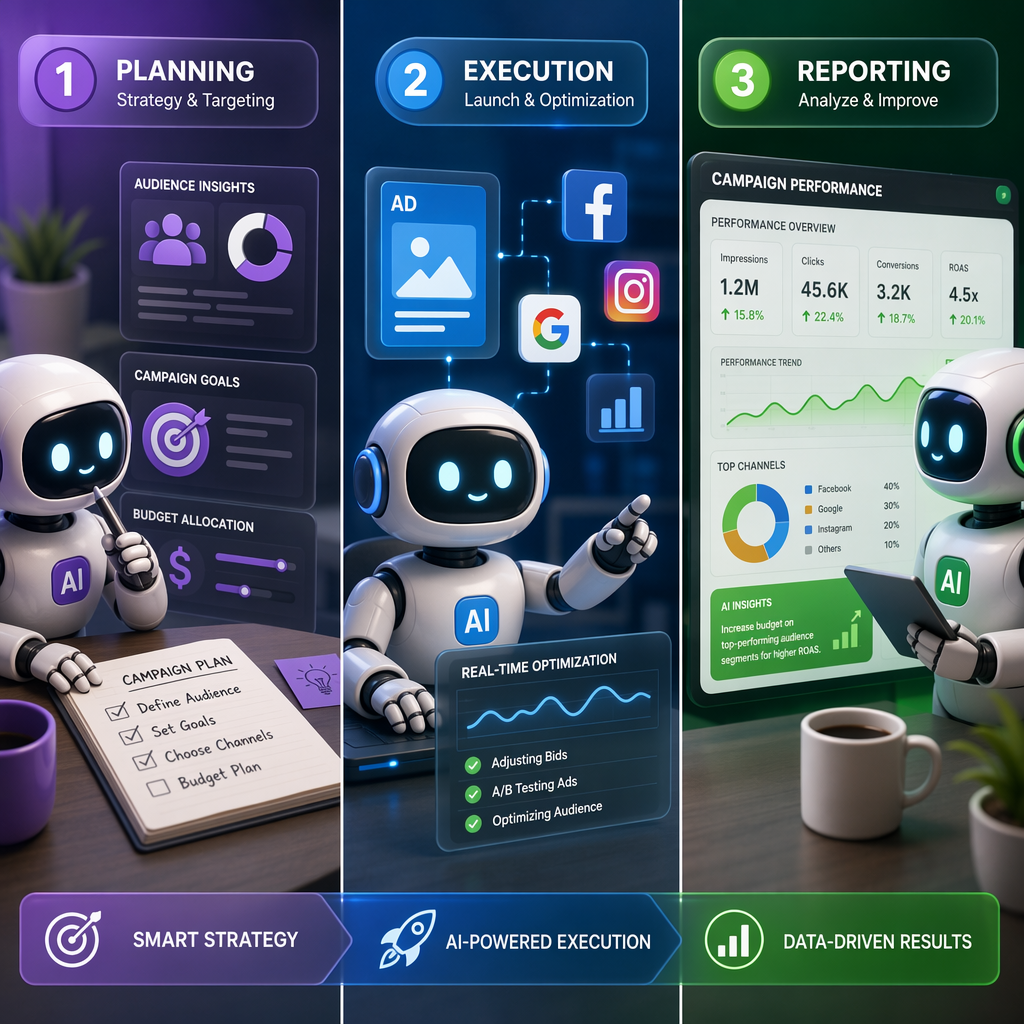 AI helps with more than one part of your campaign. It helps you with planning, targeting, bidding, testing, and reporting. Because it uses predictive analytics and acts in real time, AI can boost campaign performance much faster than older ways of review.
AI also links audience segmentation and data analytics. This helps you make better choices at every step. AI does not treat optimization as a single thing to do just once. Instead, it makes it a process that keeps going. The next four sections will show you how this works in real time.
Data Collection and Audience Analysis
Every AI campaign starts with data collection. The platforms get signals such as clicks, views, site visits, sales, and what customers do. If this data is missing, there is not much to help with optimization because the system will not have enough to learn from.
After the data gets in, AI does better at audience targeting. It can find patterns people do not catch. AI can also look into audience segments, find out which groups want to buy more, and spot where their response is stronger across channels or placements.
This is important because good analysis helps your campaign performance. You are not simply picking up numbers. You use data analytics to see who gets interested, what creative style they pick, and which moves help them get closer to buying. This is a clear way AI does better than traditional methods.
Predictive Modeling and Smart Bidding Strategies
Predictive analytics lets AI guess what could come next. In machine learning, it looks at old actions, now signals, and what could happen soon. With this, the system can make better choices for bids, even before the end result is known.
That is where smart bidding helps. On Google and Meta, AI will raise or drop bids if there is a better chance for a conversion to happen. This keeps ad spend safe and makes campaign optimization much better, all without waiting for someone to look at every part.
Smart bidding is good because it does these things:
it raises bids when it thinks people really want to buy,
it lowers bids if the traffic looks weak,
it changes bids for trends on a device or where the ad shows,
it learns from past conversion data.
This is why AI with machine learning can make your paid ads work better and faster than when you have to change bids by hand.
Creative Testing and Dynamic Creative Optimization
Creative testing helps get better campaign results. You do not have to guess which ad will work best. AI lets you compare headlines, images, calls to action, and other creative elements with less waiting.
It also helps with content creation, even if you need a lot of it. With generative ai and tools from the platforms, marketers can build many versions faster. You can use b testing to see what gives more engagement or better results. This is good when you want to reach many audience segments, and each group needs a new message.
AI-supported creative optimization often includes:
testing several headlines at once,
rotating image variations quickly,
matching creatives to audience behavior,
removing weak combinations faster.
But the human touch still matters. Studies show AI ads do best when they do not feel fake and when creative quality stays high.
Real-Time Performance Monitoring and Continuous Improvement
One of the biggest strengths of AI is real-time monitoring. You do not have to wait until the end of the month to know what is going on. The system can point out problems, see patterns, and help you make things better right away.
This is good for campaign performance. Weak ads, bad placements, or slow landing pages can hurt your results fast. With advanced analytics, you can spot these problems early. You can act before you lose too much money or see your conversion rates go down.
Getting better all the time is what makes AI performance marketing strong. You do not just launch and hope things work. You keep making changes based on new data. This process of testing, learning, and making tweaks is usually what takes a campaign from average to strong.
Conclusion
In the end, AI Performance Marketing is changing the way people do ad optimization and campaign management. By using advanced technology, marketers can target their audience better, make smart creative choices, and use their budgets in the best way. As we talked about, adding AI to your marketing plan has many good points like better ROI, quicker changes, and less manual work. As you look at this new world of marketing, using AI tools and ways will help you stay ahead of others and make your campaigns strong with data-driven ideas. If you want to boost your advertising, you can get a free consultation to see how AI can make your performance marketing better.
[performance marketing,audience targeting,ad optimization]
Frequently Asked Questions
How does AI improve performance marketing compared to traditional methods?
Artificial intelligence helps with campaign optimization by looking at performance data much faster than traditional marketing. It can change things quickly to help with better targeting, smarter bidding, and fast creative testing. This usually means you get higher conversion rates, waste less money, and see more measurable results when you run digital campaigns.
Which AI tools are best for ad optimization on Google and Meta platforms?
Many people who are just starting out find the best ai marketing tools are the ai systems already inside google ads and meta. These tools help with ad optimization. They do this by using smart bidding, audience signals, and automated delivery. They are good for people in digital marketing because the tools work right inside the main platforms. The ai tools also use live data from your campaigns.
Is AI performance marketing suitable for small businesses in India?
Yes, AI can be good for small businesses. The reason is that it can improve cost efficiency and help campaigns make changes in real time. On digital platforms, small brands can start out with simple ways of automation. They just need clear goals and some basic testing. This makes performance marketing easier, even when the budget is small.
What skills should marketers develop for success in AI-powered ad campaigns?
Marketers need to know about data analytics, audience targeting, campaign performance, and creative testing. It is also good to have some technical expertise when you use ad tools and look at dashboards. If you want to learn more, you can search for things like ai engineering institute in hyderabad or generative ai course in hyderabad. Many people look for these now.