







.png%3Falt%3Dmedia%26token%3D90661b18-c4f3-40ed-9d64-f00f3bd76981&w=3840&q=75)
How RAG AI Improves LLM Accuracy in Real-World Applications
Key Highlights
RAG AI enhances the accuracy of large language models by employing retrieval-augmented generation, allowing access to comprehensive knowledge bases and external data sources.
By integrating real-time information retrieval, RAG systems significantly reduce common issues like hallucinations and outdated knowledge in AI responses.
The effectiveness of RAG lies in its ability to supply contextually relevant information, thereby improving the reliability and trustworthiness of generated outputs.
Practical applications of RAG span various industries, effectively supporting customer service, legal fields, and healthcare with accurate, domain-specific solutions.
Overall, RAG represents a pivotal evolution in AI, bridging the gap between static models and the need for dynamic, up-to-date data in real-world applications.
Introduction
Have you ever thought about how to make artificial intelligence better and easier for us to trust? Large language models are strong, but they sometimes get things wrong or use old stuff. This makes it hard for them to be really helpful in the real world. There is a way called Retrieval-Augmented Generation, or RAG, that helps solve this problem. RAG brings together the big knowledge from large language models and up-to-date facts that people want. One effective way to improve the accuracy of RAG models is by ensuring the retrieval system fetches relevant, high-quality documents. Additionally, techniques such as fine-tuning the retrieval and generation components, using better ranking algorithms, and including feedback loops to correct mistakes can further enhance their performance. Let's see how RAG is changing the way artificial intelligence works.
What Is Retrieval-Augmented Generation (RAG) AI?

Retrieval-Augmented Generation (RAG) AI gives regular models a boost by adding information retrieval to the generation process. With this setup, the AI can get and use large sets of data. It helps the AI be more accurate, fit better with what people need, and understand more about real situations.
Defining RAG AI and Its Role in Modern Applications
Retrieval-Augmented Generation (RAG) AI brings together large language models and strong information retrieval methods. It lets ai systems get relevant data from external knowledge sources. This helps make the answers you get better. RAG AI uses real-time data and solves the problems that come up with regular large language models. It builds a moving system that can answer your questions in a more true way.
With the help of vector databases and embedding models, RAG AI can get relevant documents for you. This makes user experience better in many areas. Some of these areas are customer support and healthcare solutions. So if you need good answers with up-to-date information, RAG AI is a good choice.
How Standard LLMs Differ From RAG-Enabled Systems
Standard large language models use the training data they got when they were made. This static training data has a "knowledge cutoff." It means the model does not know events or information that happened after its training ended. Because of this, the answers can be out of date or wrong.
RAG-enabled systems work differently. They are not stuck with only their first training data. They can get external knowledge from outside sources any time for a question. This way, they have up-to-date and accurate information.
The big differences are:
Knowledge Source: Standard large language models use only static training data inside. RAG systems get external knowledge that changes all the time.
Timeliness: RAG gives information that is current. Standard large language models are held back by their last training time.
Context: RAG systems bring in relevant data needed for each domain, so their answers are more exact.
Why RAG Emerged as a Key Advancement in AI
The push for better generative AI made RAG happen. Standard large language models are strong, but they often make things up or give wrong info. This causes a big problem, especially for business and important tasks where you need true answers.
RAG came as a fix. It makes the AI reply by pulling facts from a reliable knowledge base. By using a retrieval model, RAG gives generative AI real information to work with. It deals with the issue of depending only on old, pre-trained data.
RAG links the strong language skills of generative AI and the safety of dynamic data from outside sources. This lets ai systems be smart and true at the same time. Now, they work better for big tasks and are trusted more in business use.
Understanding the Challenges of Large Language Model (LLM) Accuracy
 Large language models can do a lot. But their accuracy may not be good. The models use patterns found in the training data. Because of this, they sometimes say things that are wrong, not useful, or just made up. People call these mistakes "hallucinations." They can hurt the response quality. This makes the models not great for important jobs.
The problems come from how the models are built. They do not really "know" anything. They guess what the next word should be. So, they might share out-of-date facts. They also do not use real-time context. Let's go deeper into these issues.
Hallucinations and Inaccurate Responses in LLMs
One big problem with large language models is called "hallucinations." This happens when the model gives you answers that sound true but are wrong or made up. The model works by picking word sequences from its training data, so it might follow patterns that do not fit what happens in real life.
These hallucinations hurt the response quality and make it hard to trust an AI. For example, a chatbot can share the wrong phone number or act like something happened in history that never did. The model does this because it does not link up with any source that is true. It counts on the patterns found in its training data.
If there is no way to fact-check, large language models will keep making mistakes by sharing answers that seem real even when they are false. This makes them tough to use in the areas where facts really matter, like customer support, healthcare, or finance. RAG helps fix this by giving a true base for answers.
Outdated Knowledge and Limited Context Windows
Large language models are taught using very big sets of data, but that data stops at a certain date. After they are trained, they do not know about anything new that has happened, any fresh discoveries, or new facts. This older knowledge means these large language models may not answer questions about what is happening now. As time goes by, their answers may not be as helpful or correct.
There is a technical limit called the "context window." This is how much details the model can look at in one go when giving you an answer. If your question or the external knowledge is bigger than this window, the model can lose track of the chat or leave out some relevant information.
These problems lead to real hurdles:
Outdated Information: The large language models may give you details that are not correct now, like company policies that do not exist anymore or products that are no longer sold.
Incomplete Context: If a document is too long for the context window, the model will not have all it needs to answer the question in full.
This is why large language models sometimes miss new things and might not use all the right facts when they answer questions.
Gaps in Real-Time and Domain-Specific Information
Standard LLMs are made to learn from general internet data. Because of this, they often do not have deep or detailed information about a special field. For example, a general model will not get into a company’s private notes, engineering plans, or its legal case files. This means there is a gap in what they know when people ask a very special or hard question.
Also, these models do not use real-time data. They do not know live stock prices, new news stories, or if the store has something at this time. They cannot see new data as it comes in. This makes them not good for jobs where you need what is happening right now.
So, you get a system that may talk well but does not bring much strength in special areas. For an AI to help in business, it has to use a knowledge base that keeps up with new data, is updated all the time, and can work with domain-specific info. This is what RAG wants to fix.
How Retrieval-Augmented Generation Works Step by Step
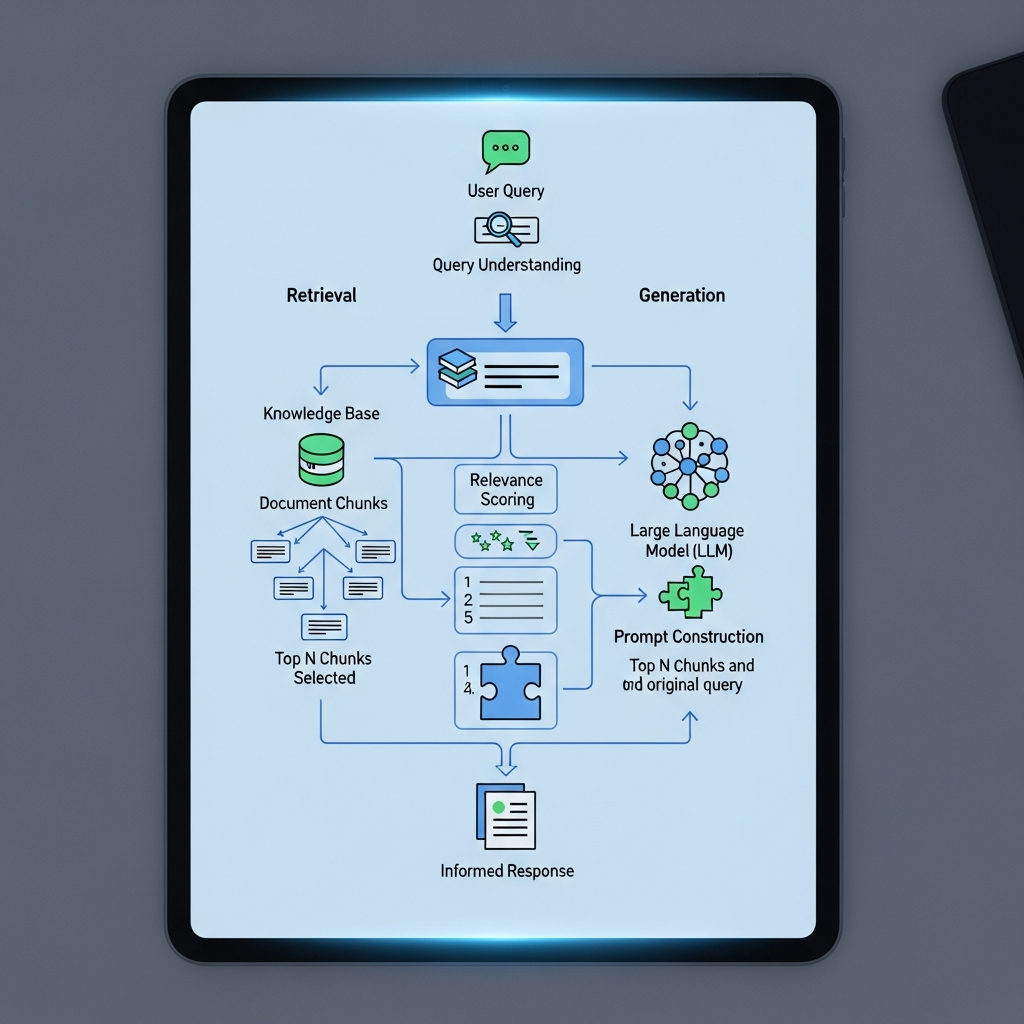 The special thing about retrieval-augmented generation, or RAG, is how it works. It uses a clear path, known as a rag pipeline. The process does not ask an AI model to answer a question right away. Instead, it first does important information retrieval. This means the AI gets the right facts and context before it tries to give you an answer.
This extra step turns a simple back-and-forth into a smart talk that uses real facts. Below, you can see the steps that show how rag pipeline brings information retrieval and answer generation together, making the results much better.
User Query and Initiation Workflow
The RAG process starts when a user sends a question or prompt. You might type a question in a chatbot or enter a search term on a knowledge portal. The query can be any prompt sent to an AI model.
After the user query is received, the system starts its process. The first thing it does is try to figure out what the user wants. The query gets changed into a format that is good for finding answers. This is where prompt orchestration happens, and the system gets ready to look for the most relevant documents.
At this early stage, the main steps are to:
Receive the user's input.
Look at the query to understand the main question.
Get the query ready for the retrieval phase.
Start the search for relevant information in the knowledge base.
This clear start helps the rag pipeline move in the right direction. It makes sure that the system can bring back the best context for the user.
Retrieval System Searches Data Sources
Once the user asks a question, the retrieval model starts its work. This piece is very important in the RAG process. The retrieval model looks through all external knowledge to find the best information for the user's question. These data sources can be a company's own papers, databases, websites, or any other place where information is stored.
The retrieval model does more than just look for keywords. It uses things like semantic search to get the meaning of the user's question. Then, it goes through all the connected data sources to find documents, text, or facts that fit what the question is really asking. This way, the information it finds will fit well with what the user wants.
The system does not grab just one piece of data. It finds and ranks the top results, choosing only the best ones. This mix of top information is then sent on to the next step, so the generative model has good and real facts to use.
Fetched Documents Inform LLM Response Generation
Once the retrieval system finds the most relevant passages or data, it puts this information together with the original user query. This mix forms a new prompt that is richer. This augmented prompt gives generative AI both the user's question and the facts it needs to give the right answer.
The LLM starts the response generation process. With the context from the documents pulled in, the model makes a clear and helpful answer. Because the reply uses the retrieved information instead of just static training data, it is more likely to be correct and fit what the user needs.
The key steps in this final stage are:
The system makes an augmented prompt that has the user query and the context from the retrieved passages.
The LLM creates a response using this richer prompt.
The final answer is shown to the user, often with citations to the source documents. This flow makes sure the user gets a trustworthy response.
Core Components of a RAG AI System
 A strong RAG system is not just one tool. It is made of many connected parts that work as one. Each part has its own job. Some store data, and others help build the answer you see at the end. The main things in a rag system are large language models, a vector database, embedding models, and a retrieval model.
If you want to know how a RAG AI system works, you need to see how these parts connect. Let's look closer at what each main part does. When they work together, they make the whole system smart and reliable.
Role of LLMs in a Retrieval-Augmented Workflow
In a retrieval-augmented workflow, the large language model, or LLM, works as both the maker and the speaker. The retrieval system is there to find the facts, and then the LLM takes over. Its job is to make a natural, simple, and clear generated response using that information. The LLM doesn't just say back what it finds; it uses the data to answer what the user really wants to know.
The LLM gets an augmented prompt, which is put together through prompt engineering. This prompt has the user's question and the external knowledge that comes from different data sources. The LLM uses its language skills to read this input and come up with an answer that fits the question and the context.
The LLM is really the "generation" part in RAG. It brings together fluency and smart ways of thinking. At the same time, its knowledge is shaped by the facts the retrieval system gives it. The mix of both makes the final answer easy to understand and correct, and this helps build user trust.
Vector Databases and the Importance of Embeddings
To enable fast and efficient searching of vast amounts of information, RAG systems rely on a special type of database called a vector database. Before data can be stored here, it must be converted into a numerical format. This is done by an embedding model, which transforms text, images, or other data into numerical representations called vectors.
These vectors capture the semantic meaning of the data. The vector database then stores these vectors, organizing them in a way that makes it easy to find similar items. When a user asks a question, their query is also converted into a vector, and the database performs a vector search to find the stored vectors that are most similar.
This process is far more sophisticated than a simple keyword search, as it understands context and meaning.
Component | Role in RAG |
|---|---|
Embedding Model | Converts text from documents and user queries into numerical vectors (embeddings). |
Vector Database | Stores the embeddings and enables fast, semantic search to find relevant information. |
AI Retrieval Systems and Prompt Orchestration Explained
The AI retrieval system is the core part that makes the search work in a RAG architecture. It takes the user's question and checks the knowledge base. Then, it finds the most relevant documents or pieces of data. The system does not just look for keyword matches. It uses semantic search to understand what the user means and gets info that fits with the context.
After it finds the right documents, prompt orchestration begins. This step is about making the best prompt for the LLM. It is not only about putting the found text next to the user's question. Good prompt engineering means putting the information in a way that helps the LLM give the best answer.
The orchestration process can include:
Picking the most relevant snippets from the found documents.
Summarizing long parts to make sure it fits within the context window.
Organizing the prompt with clear instructions for the LLM.
Adding examples to show how the answer should look. This careful step makes sure the LLM has what it needs to make a good answer.
How RAG AI Improves the Accuracy of LLMs
 The main reason to use RAG models is the big jump in accuracy. RAG helps large language models use external data. The models stop making things up. They start giving facts based on real, accurate information. This fixes the biggest problem found in standard LLMs. The answers get better and make more sense.
This change is not a small fix. It is a big move in how ai systems work. RAG improves accuracy in many ways. It offers more factual answers and cuts down on made-up responses, called hallucinations.
Delivering More Factual and Trustworthy Responses
One of the biggest effects of RAG is how it helps the AI model give answers that are based on facts. The AI has to use relevant information that comes from a trusted knowledge base. So, the answers are built from real and checked data, not just old patterns from its training.
When AI shows facts, the information becomes much more reliable. People can feel good knowing the answers they get are not just guessed. They are based on fresh. real data. A lot of RAG systems even show links to the exact source documents used. This lets you easily see and check the facts.
Here's how RAG builds user trust:
Fact-Based Answers: Answers come from specific, retrieved information.
Verifiability: Citations let people check where the information is from.
Consistency: The AI gives consistent answers because it always pulls from the same source data. This level of reliability matters a lot when you want to use AI at work or in other important places.
Reducing Hallucinations and Increasing Reliability
Hallucinations block the wide use of generative ai. RAG fights this problem by keeping the generative ai model focused. The model does not make things up. It uses relevant data given in the prompt. This simple move makes it much less likely for the model to create false answers.
RAG tells the ai model to stick to the facts. This makes it more reliable. The ai model is less likely to give answers that do not make sense, that are wrong, or that are not related. Because of this, the whole ai model is better and more trusted for tasks that need deep knowledge.
RAG makes the system better by:
Grounding the model: Giving true and clear context keeps the model from saying things that are not real.
Constraining creativity: The model only creates answers using the data provided.
Providing a "source of truth": The model looks at the retrieved data. It does not rely on its past memory which can be bad.
Access to Up-to-Date and Domain-Relevant Information
Normal LLMs stay stuck in the past because they only know what is found in their old training data. The RAG system breaks this rule by letting the model reach out to live, external data sources. With the RAG system, the AI gets new information as soon as it is there. This helps make sure that answers are always up to date. It does not matter if you ask about a company’s newest policy or some breaking news, the RAG system can get that info from external data sources.
The RAG system is also good at giving the most useful answers in a certain topic or field. Companies can link their RAG system to their own private place where they keep special data, technical guides, or customer info. When people ask questions, the rag system pulls answers from only the best and most related sources.
With RAG, one smart AI can turn into an expert on many things—just by getting data from the right outside place for each use case. Because of this, the rag system is a good way for people to build new AI helpers without starting training over for every single need.
Exploring AI Retrieval Systems in Practice
AI retrieval systems are the backbone of RAG architecture. They find the right information from a knowledge base when you need it. These systems do more than simple keyword matching. They use advanced ways like vector search and semantic search. This helps them understand the meaning and context of a query. The aim is to make information retrieval both fast and accurate.
Modern retrieval systems use vector search and semantic search. Let’s look at how these methods work and how people use them in real enterprise settings.
Vector Search and Similarity Matching
Vector search is a useful method that helps a system find information based on meaning, not just by the keywords. The process starts with an embedding model. This model turns documents in the knowledge base and the user's search into numbers called vectors. These vectors show what the text is about.
When everything is changed into vectors, the system looks for which ones are most alike. It checks how close the user's query vector is to each document vector in the database. The documents with vectors that are nearest to the query vector are seen as the most relevant documents.
This method lets the system find good matches even if they do not use the same words as the user's search. For example, searching for "ways to reduce car costs" could find a document about "tips for saving money on vehicle maintenance." This happens because the key ideas are much the same in meaning.
Semantic Search for Contextual Relevance
Semantic search builds on information retrieval by looking at the real meaning and context of what a user wants to find. It does not just match keywords. This search tries to understand the goal behind the question. It checks how words and ideas are connected and gives more correct and useful answers.
This is very important for RAG. Semantic search makes sure the relevant documents are not just similar or connected in a weak way. They really help answer the user's question. By knowing the context, this search can tell one meaning of a word from another. It can also find documents about the same topic, even if they use different words.
Key benefits of semantic search in RAG include:
Higher Precision: It finds relevant documents that fit what the user really wants.
Improved Recall: It gets relevant documents even if the right keywords are not there.
Better User Experience: The user gets good answers quickly without retyping their question.
Knowledge Retrieval Workflows in Enterprise Settings
In a company, knowledge retrieval workflows help AI systems reach the company's big internal data. This data is kept in many places. Some are in structured databases and CRMs, and some are in unstructured documents in the knowledge base. A RAG workflow makes it easy to find and share relevant information with the right person or system.
For example, a customer service agent can use a RAG-powered tool to quickly get relevant information about a customer's problem. The tool searches technical manuals, past customer support tickets, and billing records. It gives a clear answer by putting together all the data for the agent.
Common enterprise knowledge retrieval workflows include:
Internal Chatbots: Help employees with questions about HR policies, IT support, or project details.
Customer Support Assistants: Let agents get real-time information to solve customer needs faster.
Sales Enablement Tools: Help sales teams find the latest product information, pricing, and competitor analysis.
Real-World Applications of RAG AI in India and Beyond
RAG AI turns its big ideas into real results for many fields. It helps customer service to get better and makes legal work easier to go through. These uses show how AI, built on facts, can fix many real problems in everyday life.
Let’s look at some of the best ways RAG changes things. In India and around the world, this tech is making, both people and businesses, handle information in a new and better way.
Business Use Cases: Customer Support, Legal, and Health
RAG is changing many important fields by making it easy to get clear and tailored information fast. In customer support, chatbots powered by RAG can use a knowledge base with product manuals, FAQs, and customer info to find relevant data. They can solve problems quicker and with better answers.
In the legal world, AI systems use RAG to search through huge lists of case law, rules, and contracts. Lawyers can ask tough questions in plain language and get answers with the right sources. This helps legal research and checking documents go faster.
Health AI also gets a boost from RAG. Medical staff can quickly find the latest studies, patient details, and guidelines. This helps them make quick and smart choices for each patient. RAG's strengths include:
Customer Support: Faster and better answers to customers.
Legal AI: Fast and exact legal research.
Health AI: Clinical decision support based on solid evidence.
Internal Company Chatbots and Knowledge Assistants
Many companies now use chatbots and helpers that run with generative AI and RAG to help their staff. These tools connect with the internal knowledge base for the company. This way, people can find the information they need to do their job well. The tools can answer simple HR questions, or give detailed help with technical problems.
Instead of looking through lots of folders or asking someone for help, staff can just ask the AI assistant questions by using plain words. The AI will go to the internal knowledge base and find the most relevant information from company rules, project files, or the internal wiki. Then, it gives back a simple and clear answer.
This saves people a lot of time and helps make sure that staff all get the most up-to-date and correct information. The knowledge assistants bring all the company's information together in one place, so work goes faster and there are fewer problems for the team.
Conversational AI and Domain-Specific Search
RAG is important in today’s conversational AI. It helps chatbots and virtual assistants give better answers and talk in ways the make the conversation more helpful. When ai systems use domain-specific search, they go past basic replies and can bring answers that fit fields like finance, travel, or e-commerce.
When someone talks with a RAG-powered AI, it does a domain-specific search throughout the external data sources selected for the topic. The AI pulls in relevant information that fits the field. This means the answers are correct and on point with what the user wants. The bot uses all this info to make a natural response the fits the user's need.
This way gives us a few strong benefits:
Hyper-Personalization: An e-commerce bot gives product picks based on the real inventory and what the user likes now.
Expert-Level Knowledge: A finance helper can break down investments or share market data using outside info that is always up to date.
Enhanced User Experience: Users get answers to their questions that are clear and fit their needs. They don’t just get basic info or get sent somewhere else.
Conclusion
In the end, RAG AI is changing the way large language models work for real jobs and tasks. It helps pull up relevant information faster. It also fixes issues like making things up or having old facts, so answers from AI are more reliable and you can trust them. Companies and those who build products are using RAG more, and you can see that it brings better results in customer support and knowledge management. AI is moving toward being more personal and flexible. Using RAG AI is not just good for you—it's something you need. If you want to see how RAG AI can lift your large language models, get a free talk with our experts today!
Frequently Asked Questions
What Makes RAG Different from Traditional AI Text Generation?
Traditional generative AI uses only the static training data it gets when built. But retrieval-augmented generation works in a new way. It looks for current and relevant information from external knowledge sources before the AI model makes a response. When the AI gets real-time data, it can give answers with much better response quality and more facts. This use of external knowledge helps make sure the output is up-to-date and right.
What Are the Main Benefits of Using RAG in AI Applications?
The main benefits of using RAG models in generative ai are better accuracy, fewer mistakes, and getting up-to-date information. These models use a knowledge base to help check answers. This lets rag models give information that is more trustworthy and relevant. It helps make ai that people can count on and that is useful.
How Does RAG AI Help Increase Trustworthiness and Reliability?
A RAG system uses data from external data sources to give answers. It does not rely only on what the AI knows inside. By using these facts from outside sources, the system is more reliable. This helps keep wrong information out. Users can trust the AI system more because it gives answers based on real and checked data.