







.png%3Falt%3Dmedia%26token%3Dd9269bef-a1c6-4121-ae91-f4e4ee807bfc&w=3840&q=75)
How Top NLP Applications Transforming Businesses Today Work
Key Highlights
Natural language processing helps machines work with human language in useful ways.
It combines machine learning with language rules to read, sort, and generate text.
Common NLP examples include AI chatbots, search tools, speech features, and language translation.
Businesses use text analytics to study reviews, messages, and other customer communication.
NLP supports faster service, better insights, and smoother automation across daily work.
You already see it in phones, apps, and digital assistants every day.
Introduction
Natural language processing is a field in artificial intelligence. It lets computers understand and reply to human language. It works by putting together machine learning, simple language rules, and pattern finding. The systems can read what you type, hear what you say, and then they give back answers that help you. You use natural language processing when you look up something on the internet, talk to a voice assistant, or chat with bots in customer support. When you check out ways to learn about AI, you see terms like ai courses in hyderabad with natural language processing. This is because natural language processing is key to how people use artificial intelligence today.
Understanding Natural Language Processing (NLP)
 Natural language processing, or NLP, is the part of AI that helps software work with spoken and written words. This nlp technology lets machines read, understand, and make language in ways that feel more real to people.
You can see natural language processing as a bridge between computers and human communication. The applications of nlp show up today in search, support, translation, and content creation. To see why nlp is important, let’s look at what it does, its link to AI, and how it works in the world right now.
Defining NLP and Its Core Functions
At the heart of natural language processing is the study of how computers and linguistic systems work together. This work is based on computational linguistics and computer science. It helps machines read and make sense of human language. Computers look at both text and speech to find out what people truly mean. The goal is for machines to learn, read words, find patterns, and give back useful answers.
A lot of this is about sentence structure. The system checks how words go together, what each word does in a sentence, and how meaning can change with context. Some key nlp tasks are entity recognition, part-of-speech tagging, sentiment analysis, summarization, and translation.
New language models make all this go even further. Now, they can answer questions, write text, and help with natural language generation. Most of the time, the main tools in natural language processing are syntax analysis, semantic analysis, tokenization, tagging, and prediction based on models. All these help turn messy, everyday human language into data that software can use.
How NLP Connects with AI and Machine Learning
NLP and machine learning are not the same, but they work together a lot. NLP is a part of artificial intelligence that is all about language. Machine learning helps NLP by letting systems learn from data, instead of just using rules that never change.
In the early days, NLP systems used rules to do very basic things. Then, people started using statistical methods, and it got more accurate. Now, deep learning and neural networks are behind much of the progress in working with language. These models find patterns in large amounts of text and speech.
This is why chatbots, translators, and search engines seem a lot smarter today. Machine learning lets NLP understand what people mean, tell one thing apart from another, and see how words fit together. NLP gives artificial intelligence a way to use language. So they are tied together, but not the same. NLP is the big area that works with language, and machine learning helps make it even better.
The Importance of NLP in a Digital World
Today, companies get a lot of unstructured data from emails, chats, surveys, customer reviews, and social media. If you do not use NLP, a lot of this information stays hard to handle. With NLP, businesses can sort, sum up, and understand text from many sources.
This is important because many business decisions rely on customer service, signals from the market, and quick answers. NLP can do things automatically, save people from doing repetitive tasks, make search better, help with translation, and show what people are saying in public opinion. These are real use cases, not just technical ideas.
The benefits for companies are easy to see. NLP can cut down manual work, boost accuracy, and find insights hidden in big groups of text. It can also help teams reply faster and give better service to customers. Now, you will see how the whole process works—step by step—from raw text to useful results.
How Natural Language Processing (NLP) Works
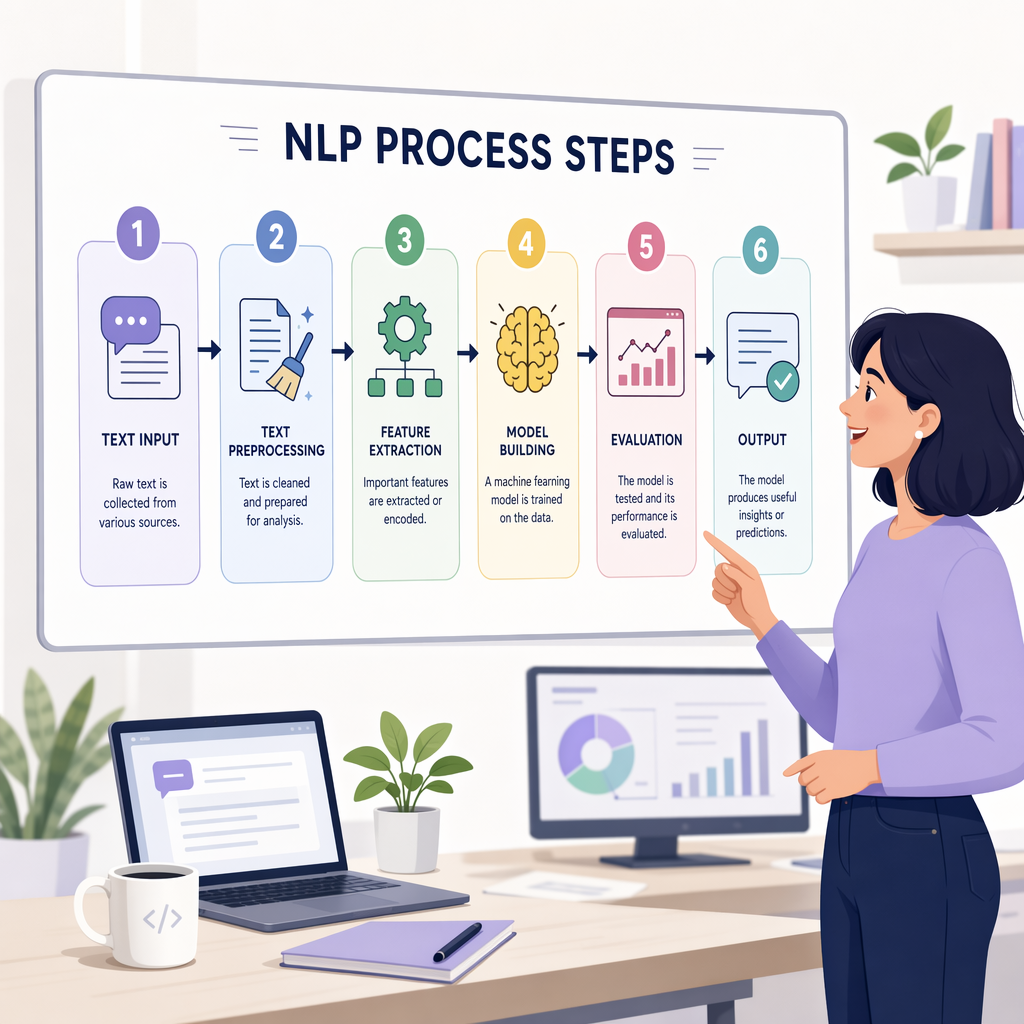 NLP starts with some steps, and these steps are called the nlp pipeline. First, you get some text data or speech. Next, you clean this data. After that, you break it into smaller parts. Then you look at it and check what is in it. People use this for training nlp models or to run them for a task.
Some nlp models put text into groups. Other models will use generative ai to switch languages, find out feelings, or make answers. The reason for all this is simple. NLP turns language into something a machine can work with and use. The next parts show this whole process using easy examples that you may know.
The Step-by-Step NLP Pipeline Explained
Most nlp systems start by getting text from things like emails, chats, websites, calls, or documents. The next step is to get this information ready so the model can use it. At this stage, data sets and training data are important.
After that, the nlp system breaks language down into small parts and looks at the meaning. It can use grammar checks, word tagging, semantic analysis, and other nlp techniques for pattern learning. These methods help the model link words, find context, and guess intent.
Common steps in the pipeline include:
Get text from real business or users.
Clean the text and make it the same by taking out extra stuff.
Split the text into tokens like words or phrases.
Change the text into simple formats for models to understand.
Train, test, and make the model better for specific tasks.
This flow lets software use nlp techniques to classify, sum up, translate, or answer with the text.
Real-World NLP Examples for Beginners
You use NLP every day, and you may not even notice it. Many tools work with language to read, hear, or make content. That is why nlp applications seem normal now.
Think about your phone or the apps you like most. When a system works with social media or looks at customer reviews, that is NLP. When you speak and your phone turns it into text, NLP is there. Search engines, digital assistants, and smart replies also use NLP.
Here are some simple examples:
Voice typing on your phone from speech recognition
AI chatbots that answer easy support questions
Search engines that understand longer questions
Translation tools that change one language into another
Review analysis that finds positive and negative feedback
These show NLP is not just for research. It is now a part of our daily digital life.
Making Machines Understand Human Language
Machines do not understand human language like people do. They need a way to help them read words and figure out their meaning. This is why natural language understanding matters. It lets software find meaning, even when people use different styles to write.
For instance, the system can pick out names, places, products, or dates using entity recognition. It also checks the words around each phrase to see what, in that moment, the phrase means. This stops mix-ups, like when one word can have different meanings.
Chatbots use these steps to understand what a person is saying. They read the message, look for intent, search for important things, and pick a good reply. Machines use the same methods to do machine translation, improve search, and answer questions. In short, machines learn about human language by breaking it into patterns. Then, they compare, rank, and answer back.
Business Value of NLP Today
 NLP technology helps businesses use language data that many people used to miss or look at by hand. It takes customer feedback, emails, chats, and reports and turns them into ideas teams can use right away.
This makes business processes faster and smarter. Businesses use NLP technology for business intelligence, better service, handling papers, and helping with choices. Teams do not need to read everything by hand anymore. Now, they can spot trends, sort out content, and find problems faster. Let’s see where NLP technology brings the most value in normal daily work.
Enhancing Customer Communication with NLP
One of the biggest ways businesses use NLP is to help with customer communication. Companies get a lot of questions each day. NLP helps them answer people faster and makes responses clearer by using smart automation and routing.
In customer service, nlp models can read what people write, find out what they need, and send them to the right answer or team. Virtual assistants are also used to take care of simple requests any time of the day. This helps make wait times shorter and keeps replies the same for everyone.
Businesses often use NLP to:
Answer routine questions through chat and voice bots
Summarize customer conversations for agents
Route issues based on urgency or topic
Support always-on help through virtual assistants
These tools can help raise customer satisfaction. People get quick answers, and teams have more time for other cases that need more care.
Automating Routine Operations via NLP
NLP is helpful when you have large amounts of unstructured text to work with. A lot of companies still manage things like forms, reports, claims, emails, and support tickets. These take a lot of time if you do everything by hand. NLP can automate many of these repetitive tasks.
Older systems used simple keyword matching. That works, but only for some things. These days, NLP can do much more. It can sort documents, pull out important info, make content shorter, and spot things that don't fit. All these nlp tasks help people save time on manual review.
The benefits for companies are clear. People use less effort, there are fewer mistakes, and things get done faster. Insurance teams can go through claims quickly. Legal teams can put big groups of papers in order. The billing and buying groups can get details from vendor files. In all these areas, NLP helps teams get through work faster and focus more on what matters most.
Using NLP for Data-Driven Decisions and Insights
Business decisions get better when teams know what customers and markets say. NLP makes this easier. It takes raw language and turns it into good insight. This helps with data analysis from emails, feedback, news, and all internal papers.
When you have large datasets, reading by hand takes too much time. NLP can scan thousands of comments fast. It groups similar themes and does text summarization so leaders see the main points right away. It can also show repeated complaints, talk about products, and spot new topics in public talk.
Sentiment analysis brings something extra. It shows if words people use sound good, bad, or just simple facts. This is great for checking product reviews, social posts, and how people feel during service talks. When leaders see the mood, trends, and topics sooner, they make smarter and quicker choices. This is how language data helps real business value.
Top NLP Applications Transforming Businesses Today
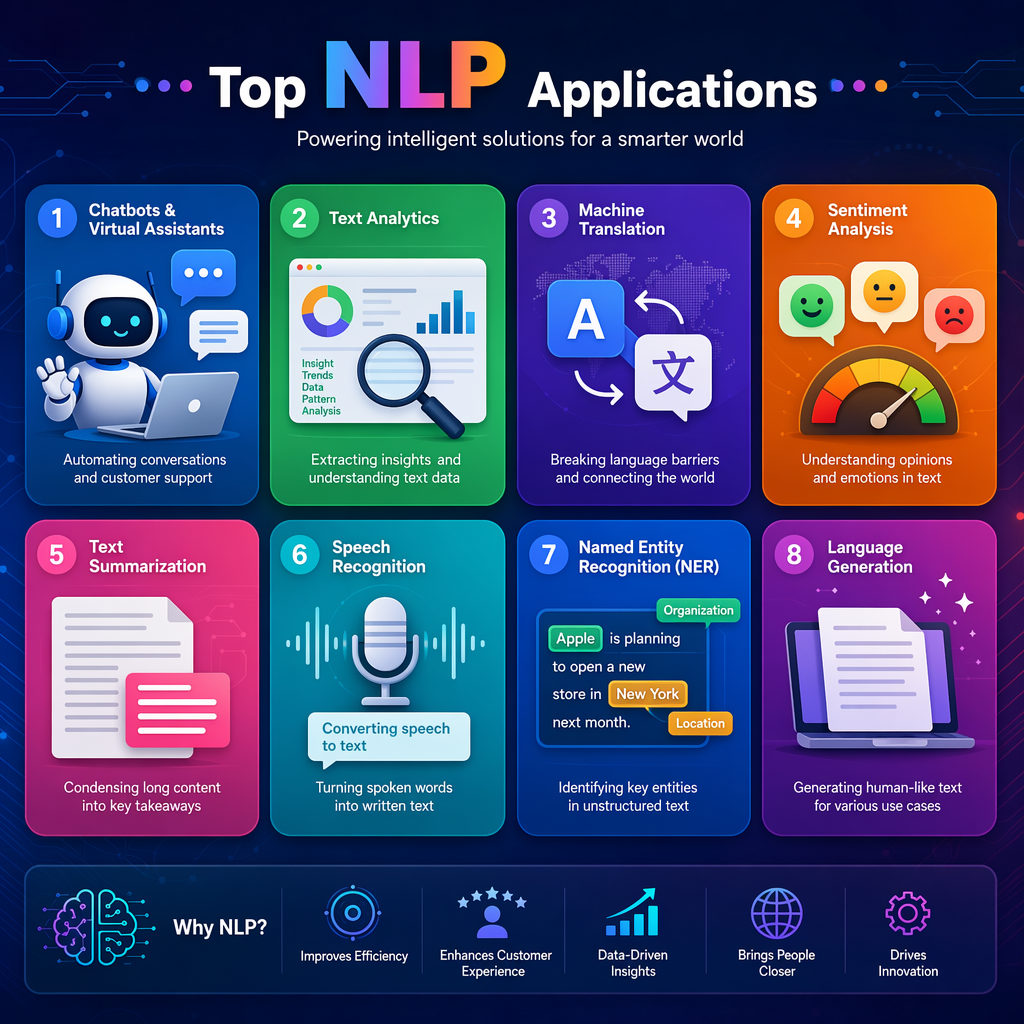 The top NLP applications helping businesses today focus on how people use language. They spot what people want, understand different meanings, and make answers that people can use. These tools use machine learning to help companies handle messages, work with documents, and manage spoken input. This makes all the work faster and easier.
Some nlp applications can tell when a word has different meanings. Some are good at language translation, others help people search, or make conversations better. When you look at it all, you can see how much NLP is used in business and our daily life now. The next three sections will talk about some of these, like chatbots, text analytics, and tools that use voice. These are things many of us already know well.
AI Chatbots Revolutionizing Customer Interaction
AI chatbots are a good example of how natural language works with technology. They use conversational ai to read what people send. The chatbot figures out what the message means and answers in a way that feels natural. Some systems can also remember what people say for a short chat, so the replies fit better.
This makes customer experience better. People get help faster and when they need it. Some bots follow simple steps to help. Others use natural language generation, so their answers can change based on what the user says. Both kinds try to give clear answers and make things easy for users.
Common business benefits include:
Faster first responses to common questions
Round-the-clock support without full staff coverage
Better routing for complex issues
More consistent answers across channels
That is why you now see ai chatbots in places like retail, banking, education, and business support. They let companies talk with more people without slowing down how they help.
Harnessing Text Analytics for Business Growth
Text analytics is the business-focused side of NLP that turns text into measurable insight. It helps teams review large message volumes, sort topics, and identify patterns. In simple terms, text analytics relates to natural language processing because NLP provides the methods, while text analytics applies them to business questions.
Companies use text classification, topic grouping, and sentiment detection to support business intelligence and data analytics. This helps leaders understand reviews, support tickets, survey answers, and online discussions without reading everything manually.
NLP application | Business use |
|---|---|
Text classification | Sort support tickets, emails, or claims by topic |
Sentiment analysis | Measure customer mood in reviews and comments |
Summarization | Condense long documents or conversations |
Entity extraction | Find names, places, dates, or products in text |
Search understanding | Improve retrieval of relevant information |
This is why text analytics has become a practical growth tool, not just a technical feature.
Language Translation and Voice Assistants in Daily Use
Two common examples of NLP that many people use each day are language translation and voice assistants. Language translation tools take the meaning from one language and change it into another. The goal is for both language and message to stay the same. This makes it easier for people and businesses to talk to each other, even if they do not speak the same language.
Voice assistants, like apple’s siri and amazon’s alexa, use speech recognition. They first change what you say into text or commands. Then NLP will figure out what you want. That is how your phone can answer a question, remind you about a task, or give you help with directions.
Many people know about these tools, as they are in phones, homes, and offices now. apple’s siri and amazon’s alexa are just two good examples. These tools show that language technology is not just in research labs anymore. It is with us every day. NLP is important in business, too. If a machine knows what people say in more than one language, it helps everyone get answers faster, reach more people, and use information more easily.
Deep Dive: AI Chatbots and Conversational AI
Conversational ai is one big reason why people focus a lot on NLP these days. It lets a business help customers on a large scale. At the same time, it uses language that people use and find easy to understand.
Virtual assistants and new bots do more than just follow a basic script. Now, some of them use generative ai. This helps them answer in a more flexible way, make short notes of talks, and help keep talks smooth. If you want to know how this can help a real company, look at how they use it in customer service, lead generation, support work, and the kinds of bots that many people use in different industries.
Lead Generation and Virtual Customer Support
NLP helps businesses talk to customers better when they first visit a website. A bot can say hello, answer simple questions, and show people the right product, team, or what step to take next. This is good for getting new leads and also for support.
For online support, the system needs to know the meaning of words in each message. When someone types “I need help with billing,” it should go a different way than when they say “I want to upgrade.” NLP finds this difference by using intent detection and language analysis.
This saves time for everyone. Customers get help faster, and sales or service teams get the details they need for the next step. Using NLP, bots can gather info, answer common questions, and send complex issues to the right human agent. All this helps people move more smoothly from being interested to solving their problems.
NLP Examples: Banking, E-commerce, and Service Bots
You can see strong nlp applications in many types of work. In banking, assistants can answer questions about balance or cards. In online stores, bots help with finding products and give order updates. Inside a company, service bots help workers get information or finish basic tasks.
These tools make business processes better by making routine talks shorter. They also make nlp technology simpler for teams to start using, since you can pick one use first and then add more over time.
Common examples are:
Banking bots that help with account or card support
E-commerce chatbots that answer product and delivery questions
Service bots that route internal help desk requests
Q and A assistants that respond to student or customer queries
These cases matter because people use nlp technology every day, not just in theory. They fix real talk problems for many people at the same time.
Text Analytics as a Game Changer
Text analytics is changing the way we look at text because it turns text analysis into something useful for business. Instead of keeping a lot of comments, reviews, and messages, companies can study all that information in a clear way. This helps them find good patterns and make better choices.
This tool works with NLP, mostly for social media, social media monitoring, and sentiment analysis. NLP gives the language skills for the work. Text analytics then uses those skills to answer real business questions. To show how they are different, we should talk about review mining first, then see how the two words are not the same.
Extracting Insights from Reviews and Social Media
Customer reviews and social media comments give a lot of information about products, the way people see the brand, and the service quality. The problem is that there is just too much to read at one time. Teams can't go through all of it quickly. Text analytics steps in to fix this by sorting what people say and making short summaries.
It helps spot public opinion, find issues that come up again and again, and shows which products or places people talk about the most. When teams use entity recognition, they get even more details, like names, brands, dates, and places from the text. This makes the whole analysis more focused.
Teams often use text analytics to:
Look at customer reviews to find common praise or complaints
Watch social media comments for how people feel about the brand
Sort feedback into simple product or service groups
Pull out product names or places with entity recognition
Notice changes in public opinion over time
This way, businesses can get a better idea of what customers think without waiting for slow manual reports.
Text Analytics vs. Natural Language Processing: What’s the Difference?
Many people think these terms mean the same thing, but they do not. Natural language processing is a bigger area. It covers all the ways computers can work with human language. Text analytics uses some of those ways to help businesses.
NLP techniques handle language tasks. They clean up text data, split it into small parts, find names or items, check for feelings, and use semantic analysis. Text analytics uses what comes from these steps. It helps show dashboards, groups, trends, or gives support for making choices.
The main difference between text analysis and natural language processing is their use. Text analysis is looking at written stuff to get insight. Natural language processing is what makes that possible. If you look for themes in reviews or social media posts, you are using text analysis, and NLP is working in the background.
Frequently Asked Questions (FAQ)
Natural language processing (NLP) helps many businesses in different ways. Companies use NLP to do sentiment analysis on customer feedback. They also use it to automate customer service with AI chatbots. NLP makes search engines better by helping them understand what people are looking for. All these tasks are clearer and work faster with NLP applications.
NLP makes it easier for businesses to talk with people. By understanding human language and looking at unstructured data, like posts on social media, businesses can give customers more personal experiences. This helps raise customer satisfaction. Companies get better results and smoother communication by using natural language processing in customer service, search engines, and when looking at customer feedback.
What are the main challenges businesses face when using NLP?
Many businesses have trouble dealing with large volumes of unstructured data. There are also complex issues like unclear language, bias in their training data, and making mistakes about the context. When people speak, problems come up because of things like slang, strong accents, or loud noise. All these things can make it harder for companies to get the accurate and reliable results they need, especially when they deal with customers.
How do companies measure the success of NLP applications?
Companies check how well the NLP system works by looking at customer satisfaction and reading customer feedback. They also keep an eye on changes in business processes. Besides this, they see how good the models are at sorting, pulling together, or sending information. If the work gets faster, more right, and you can do more at the same time, then the NLP system is giving value.
Is knowledge of coding necessary to deploy basic NLP solutions?
Today, it can be easy to set up basic tools because there are many nlp models and AI services you can use right away. Even so, knowing how to code and some machine learning goes a long way. It helps you make things your own, check how good they work, and use nlp in more ways. Many people who want to learn more look for a machine learning course in Hyderabad or an ai developer course in Hyderabad for these reasons.
Conclusion
To sum up, natural language processing is leading the way in business change. It is changing how a company can use data and talk to its customers. From AI chatbots that help people talk faster, to text tools that give important facts, there are many good applications of NLP. When businesses try to use these new tools, knowing how natural language works will help them be more quick and keep their customers happy. By choosing these tools, people can make their work easier and also do better than others in their field. If you want to see what natural language processing can do for you, get a free talk with our team. Our experts can give you ideas to help move your business forward.