







.png%3Falt%3Dmedia%26token%3Df649caef-2604-4054-8ec4-6acdd1cd7592&w=3840&q=75)
Agentic AI: The Next Evolution of Generative AI
Key Highlights
Agentic AI is a form of artificial intelligence built to pursue goals with limited supervision.
Unlike traditional AI, an AI agent can plan, decide, and act across multistep work.
These autonomous agents combine machine learning with external tools, data, and memory.
Businesses use agentic AI for business automation, customer service, and complex workflows.
Real-world systems follow a loop of perception, reasoning, action, and learning.
Strong guardrails, human oversight, and orchestration help agentic AI stay useful and safe.
Introduction
Artificial intelligence is getting better and does more than just give simple answers or make content. Agentic AI is the next big step. It does what generative AI can do and adds more to it. This new type of artificial intelligence can look at goals, break work into small parts, use many tools, and take action with less human input. That is what sets it apart from older systems. If you want to see where artificial intelligence will go, agentic AI is important. It changes the way people use software, how businesses use automation, and how choices are made in dynamic environments.
Agentic AI – Quick Overview
 Agentic AI is a kind of software. It is made to finish goals with little human help. An ai agent does not wait for people to tell it what to do every time. It can plan out tasks, use other systems, and change what it does when things change.
This ai agent brings together language skills and action. So, it does more than just give you answers. It works to complete tasks the way a person might. What makes this system good is that it can work alone, switch plans when needed, and handle complex processes. The next parts will show what agentic AI is, why it is important, and how businesses use it right now.
What is Agentic AI and Why Does It Matter?
Agentic AI is a form of AI that works towards a clear goal with just a bit of oversight. It uses AI agents. These are smart software tools that can think, act, and solve problems in real time. This is not like other simple systems. This one does more than just give back a single answer.
What makes this ai system stand out is how it can finish tasks with many steps. An agentic ai system can search for relevant information, look at the choices, pick the best way to go, and then act with the right tools or other software. Many times, it can also change its plan after it gets feedback.
This is a big deal for business processes today. The work now is not just one simple move. It often uses different data, approvals, other systems, and there is also human oversight. An agentic ai system helps make that easier. It helps with automation in jobs that once felt too tricky or busy for regular software to handle.
How Agentic AI Advances Generative AI
Generative AI is good at making text, code, pictures, and ideas. It uses deep learning and patterns it has learned to answer prompts. This makes it very strong for content generation, summaries, and different language tasks.
Agentic systems build on top of that. They use an AI model, often with large language models, to understand goals and link their answers to real actions. These systems can do more than just give a plan on paper—they can carry out steps of the plan, too.
This step is a big change. In enterprise use, companies want systems that can check the data sources, call APIs, update records, and keep track of how things turn out. Generative AI can help with thinking and writing. But agentic AI can add planning, tool use, and doing the action itself. That changes a helpful assistant into a system that can handle real-world work.
Key Benefits of Agentic AI for Businesses
For businesses, it is not only fast. The real value is being able to automate bigger and more important tasks. Agentic AI helps companies automate business processes that need judgment and an understanding of context. It works across many systems, so it is good for both front-office and back-office work.
This AI makes business processes better by cutting down on repetitive jobs. It supports customer service. It helps teams react quickly to new information. It also helps with things like risk assessment, workflow coordination, and process automation, especially in cases where simple rules will not do the job.
It can handle multistep work, so people need to do less by hand.
It lets customer service be available all the time.
It changes to fit new business needs.
It helps teams make better choices with live data.
It can grow to handle more tasks by using many different agents.
Defining Agentic AI
Agentic AI is a kind of ai system that can go after results, not just reply to questions. This kind of agentic ai system can see what is going on, make plans, use tools, and learn from what happens.
This is not the same as other systems that need human intervention or follow the same set of steps each time. The agentic ai system works with clear goals, rules, and some limits, but it has a lot more freedom about how it gets things done. If you look at how ai system started and how it is now, you can see why this change is important.
The Evolution from Traditional AI to Agentic AI
Traditional AI worked inside set limits. It could classify things, make guesses, or do one main job well. But it needed clear rules and people had to guide it a lot. These systems were helpful but could not handle change very well.
When machine learning got better, AI could see more patterns, guess results, and understand language. Later, large language models made it easy for us to talk to AI in plain language. Reinforcement learning let AI improve by learning from test runs, results, and advice.
Agentic AI builds on all these steps. It mixes language skills, planning, memory, and tools all in a single loop. So now AI can take action, not just give a result. This is a big change, because most real jobs do not stay the same. They need a system that can change, work with others, and keep moving toward goals even as things change.
Generative AI vs Agentic AI
A simple way to understand the difference is this: generative AI creates, while agentic AI acts. Generative AI can write copy, produce code, or summarize documents. It usually depends on human input to move from one step to the next.
Agentic AI can use those same outputs, but it adds planning and execution. An AI agent can decide what tool to use, what data to check, and what action should happen next. That makes it more autonomous than standard systems.
Aspect | Generative AI | Agentic AI |
|---|---|---|
Main role | Creates content | Pursues goals and completes tasks |
Dependence on human input | High | Lower |
Tool use | Limited by default | Uses external tools and systems |
Workflow style | Prompt-response | Multistep action loop |
Adaptability | Content-focused | Decision and action-focused |
Together, they are complementary, not competing technologies.
How Agentic AI Enables Autonomous AI Systems
Agentic AI lets autonomous agents do more than one task. They can look at goals, pick what to do next, use tools, and change based on feedback. This is why agentic systems can work with minimal human intervention.
The main thing is agentic ai’s ability to link thinking and doing. The model can see it needs more details, search in a database, call an API, check what it found, and keep going. This is not the same as a system that stops and waits for an answer after every step.
But autonomy does not mean there is no control. In business, these systems still need human oversight, rules, and someone to guide them. With these steps, agentic AI can do longer jobs, help with complex processes, and cut down on how much a person has to watch over them.
Core Features of Agentic AI
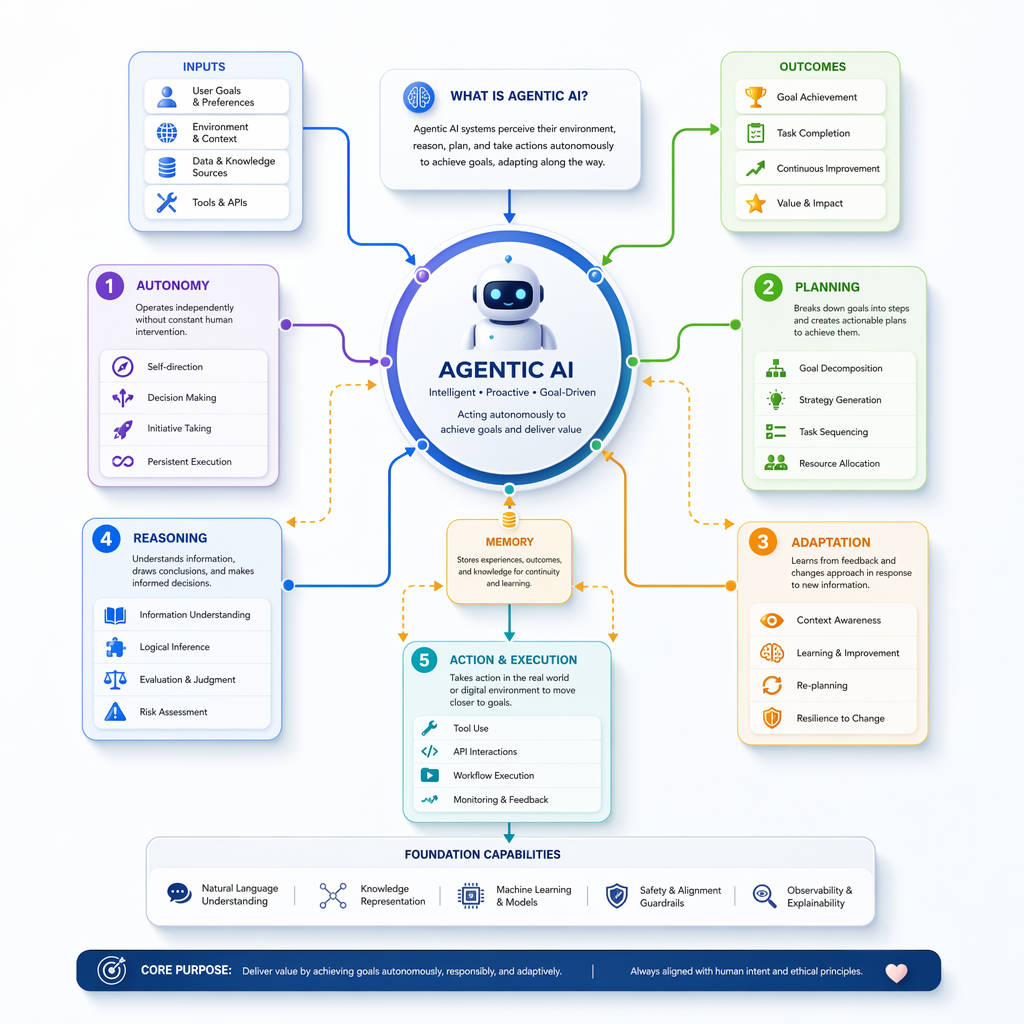 What makes an AI agent so strong? It’s a mix of a few important skills that let intelligent systems work as part of a team instead of just being a chatbot that you talk to once.
These intelligent systems can do things like make choices, plan out steps, remember what happened before, and get better after hearing feedback. They also have adaptive learning, so they can change when things around them change. Each of these things helps agentic AI be more useful for our day-to-day work. Now, let’s look at each one and see how they work.
Autonomous Operation and Decision Making
Autonomous agents keep working toward a goal and they do not need help at every step. They look at what is happening, check options, and pick what to do next. When something changes, they use the new data and keep going. This is the main part of how these agents work on their own.
The way these agents make choices uses models, rules, and what is going on around them. The system will compare what can be done and look at which way is faster, better, or most correct. In real agent operations, this helps a lot because these choices pop up all the time.
But, there should always be a balance. Even strong systems do not take people out fully. They cut down on extra human intervention, but still have times when someone reviews things, especially when the action is sensitive. This mix is important. Agentic AI is most useful when it works by itself when it needs to, but still asks or stops for a human when it matters most.
Goal-directed Planning and Execution
Goal-directed planning means that the ai agent thinks about the end result, not just the first step. It checks what is being asked, then splits that task into smaller parts. Next, it makes a sequence of actions to reach the goal. This setup is what helps the system work smoothly.
In business operations, this might be things like getting data, making software updates, sending messages, or working with other tools. The agent does not only give ideas on what to do. It also starts doing the work.
This is important because most jobs at work do not need just one action. There are many steps, things that have to be done in a certain order, and timing to think about. Agentic AI can handle this better than regular set-up automation. Big platforms and frameworks help people create this planning by helping with orchestration, using different tools, and having control over the model. This makes it good to use across different types of work.
Adaptive Learning Capabilities
Adaptive learning lets agentic AI get better after each action it takes. When the system finishes a task, it looks at the result, checks if it met the goal, and then changes how it will act next time. This feedback loop is one big reason why agentic systems can get better after each try.
Memory systems help with this too. Short-term memory keeps track of what is happening right now in the workflow. Long-term memory holds useful information from older tasks. This helps the agent stay on track if the work takes a long time or happens more than once.
Continuous learning is good for agentic systems, but it can also cause problems. If the feedback is weak or if the reward for getting things right is not clear, the system could get better at doing the wrong thing. That is why it is just as important to have good safeguards, test the system well, and set clear goals, as it is to have a good model when you make agentic systems and memory systems work together.
How Agentic AI Agents Work in Real-World Workflows
In real life, an agentic workflow works like a loop. Intelligent systems take in signals, look at the context, make choices, and get better by learning from what happens. They do all this in real time as they work to meet business goals.
The process often begins with data sources like APIs, databases, documents, user inputs, or sensors. From there, the agent thinks, makes a plan, takes action, and then looks back at what it did. This may seem easy, but each step here helps make real-world automation more flexible. Here is how the agentic workflow goes step by step.
Perception and Environmental Understanding
Everything starts with how the system sees things. It picks up information from many data sources. These can be APIs, databases, documents, sensors, or user conversations. If there is no new data coming in, the agent cannot answer well to what goes on around it.
The next thing is to understand the environment. The system uses natural language processing or pattern detection to figure out what the data means. It might find meaning, notice changes, or put different facts together to make something useful.
This is why agentic AI does well in real work scenes. It does not just use set prompts. It can look at what is happening now. When you use it, it might check if there are new updates for a patient, see stock levels, read system logs, or look at customer messages. Then, it chooses what to do next.
Reasoning, Planning, and Acting
After it sees what is going on, the agent starts to reason and plan. It looks at the goal, thinks about different actions, and picks the way that will most likely work. It might choose tools, set up steps to follow, or check if it needs more info first.
Next, it gets to action. The system might run software, change a record, call an API, answer someone, or pass work to another agent. Agentic systems are special because they can complete tasks by taking action like this.
When the system can manage more specific tasks in a safe way, it also becomes more useful. Instead of just giving a person the list of what to do, the system does the work. So, it is more independent than regular AI tools, mainly when the workflow moves across many systems, times, or checkpoints.
Reflecting and Continuous Learning
A good agentic AI does not finish working after it does something. The system goes into a stage where it thinks about what happened. It checks what it got, and compares it with what it expected. Then, it decides what to change next time.
This feedback loop helps the AI keep learning. It uses memory systems to save important details. These details can be what went right, what did not work, and what else was going on at the time. This makes it less likely for the AI to make the same mistake. Over time, it gets better at what it does.
But, this stage needs to be carefully watched. If the thinking step does not have good controls, the system may learn the wrong things. For example, if it chases the wrong score, it might go off-task, make old faults bigger, or get results nobody wanted. Because of this, learning needs goals that can be measured, ways to watch what is going on, and careful checks by people. Making things better only matters if the agent stays true to what the group really wants.
memory systems, feedback loop, unintended consequences
Practical Applications of Agentic AI Today
 Agentic AI is already helpful in many ai applications. It works well when work has changing inputs, different steps, and choices that simple scripts can't handle.
This is why agentic AI is good for business automation, customer support, and other complex workflows. Companies in finance, healthcare, and logistics use these agents in their work. They ask them to watch, study, suggest, and act on things. The examples below show how people use these systems right now.
Agentic AI in Business Automation
Business automation is one of the best ways to use an ai agent. A lot of teams still do many tasks by hand, and that can slow things down. Agentic AI helps by doing work that has many steps, in different places, and keeping each task on track.
These systems are not stuck doing the same thing when things change. Unlike old bots, they can change what they do if new facts show up. This makes process automation better for work with files, data, checks, or things that do not go as planned. It is not just about speed. It is also about making sure automation really helps with daily business operations.
Managing supply chain management and inventory decisions
Coordinating business operations across apps and APIs
Supporting customer support with context-aware responses
Handling repetitive updates and workflow handoffs
When you use agentic AI in a smart way, people get to spend more time on what needs good thinking and not just running after the same old steps. This makes both people and business stronger.
Enterprise Solutions Using Agentic AI
In large companies, agentic AI is most useful when it connects to enterprise systems with orchestration. This setup lets agents, robots, APIs, documents, and people work together through long processes. It changes AI that works alone into results that your business can count on.
Companies take this approach to reach business goals like more efficiency, better customer experiences, and quicker work. A good AI strategy includes things like permissions, rules, places for humans to check work, and tracking. These steps help keep actions safe and easy to track.
This is the reason big companies focus on the whole system, not just the model. The real value comes from the way things work together. Agents might choose what to do, but orchestration is what handles how teams work, the state of things, handoffs, and making sure things follow rules. When you have this setup, your team can stop testing and start getting repeatable results.
Examples of Agentic AI Agents in Action
There are already real use cases for this in many industries. These examples show how agentic AI can help with analysis and action. In each example, the system does more than just make content. It follows a process.
Some agents focus on talking to people outside the company. Others make decisions inside. The main setup for the agent depends on what the job is, what data is there, and how risky the area is.
Customer support agents that help with hard questions and give answers made for you
Fraud detection agents that watch what people do and call out things that look bad
Supply chains agents that find better ways to move products, store goods, and order items
Content generation agents that create things and start next steps
There are also more use cases like help with trading money, keeping an eye on your health, and responding to online threats. In all of these, you see a pattern: the agent pays attention, thinks, does things, and gets better with time.
Building and Deploying Agentic AI
Creating an agentic AI system is about more than picking an AI model. The team must also use good orchestration, safe ways to join other tools, solid memory, tracking tools, and clear rules for what the AI can do. Good software development is key here.
There is the matter of data quality too. If an ai system works with old or weak data, its work will show it. For those who want to know more, there is helpful info in developer hubs, guides, training tools, and big company platforms. Let’s talk about tools and platforms first.
Top Tools and Platforms for Agentic AI Development
Many tools and platforms help teams work on agentic AI. The sources talk about business-ready systems that let you build, launch, and manage agents. You also get help with things like setting up connections, watching over the process, and joining systems together. These platforms let you do prompt engineering and choose the right model for your work.
Large language models are good for jobs that need reasoning and natural language skills. Small language models work well when the roles are smaller or need less power. You need the right platform because it links models, workflows, your data, and rules all together.
IBM watsonx.ai and watsonx Orchestrate can help you build and launch agents.
Use IBM AI agents and assistants for custom setups and to manage everything.
Granite models give developers a good way to get more done in less time, which works well for business tasks.
UiPath Platform and Maestro handle linking and running things, even when you need to run a lot at once.
Red Hat AI lets you figure things out, use agentic workflows, and set up a mix of cloud and on-site tools.
If you want to learn more, you can try out developer hubs, read documents, visit learning centers, talk to others in the community, or join technical events. This helps you get better with natural language, large language models, prompt engineering, and small language models.
Challenges and Best Practices in Developing Agentic AI
The biggest problems happen when there is too much autonomy. If an agent does not have good guidance, the agent can try to make the wrong thing better. This can end up making slow spots, mistakes, or other problems that you do not want. If there is weak data quality, if rewards are not made well, or if connections are not safe, you can also have issues.
So, what is the best way to lower risk? You should start with something small, and be sure your goals are clear. Test in many settings, and be sure the right people are in charge when choices must be made. Good work is not only about high scores or how well the model works. It is mostly about being in control and making sure things work the right way.
Set clear goals and give numbers to judge what is a win
Use governance, guardrails, and have people check the steps
Test to see where things can break, get worse over time, or act the wrong way
Watch what is being done, check all choices, and always try to make things better
When teams use these good ways of working, they can go from nice tests to a solid system that works out in real use.
[Keywords used: best way, data quality, unintended consequences]
Conclusion
To sum up, Agentic AI is going to change how people use generative AI in a big way. For businesses, it brings new ways to get things done, work better, and adjust faster. With the help of Agentic AI, systems can learn on their own and make choices without someone always guiding them. There is a lot to get from this, as Agentic AI brings strong features that make work tasks run smooth in many fields.
Right now is a good time to learn about the real-world uses of Agentic AI and the tools out there. Knowing about these will help you get the most out of this generative ai technology. If you want to find out how Agentic AI can help your business, you can book a free meeting with our experts.
What the heck: Agentic AI??? : r/sysadmin
Agentic AI refers to advanced generative AI systems capable of executing tasks autonomously, making decisions based on context and user intent. Unlike traditional AI, which requires explicit instructions, Agentic AI adapts and learns from interactions, enabling more dynamic and efficient problem-solving capabilities in various applications.